
An interview with a serving Hungarian army captain has widened an already bitter dispute over the Druzhba oil pipeline, shifting the argument from energy security to the source and handling of sensitive imagery cited by the governments of Hungary and Slovakia.
A public intervention by Captain Szilveszter Pálinkás, until recently one of the best-known faces of the Hungarian armed forces, has opened a new front in the political dispute surrounding the Druzhba oil pipeline. What had already been a row between Budapest, Bratislava and Kyiv over the condition of the pipeline has now become a broader question about military credibility, classified imagery and the relationship of two NATO member states with sensitive intelligence material.
Pálinkás, a serving Hungarian officer who previously fronted the army’s national recruitment campaign, gave a lengthy interview to Telex in which he described deep problems inside the Hungarian military, including collapsing morale, growing numbers of discharge requests and what he portrayed as damaging political interference in defence matters. The significance of the interview lies not only in its content but in the fact that he spoke publicly while still formally in service, making him one of the most prominent serving critics of the current defence leadership in Hungary.
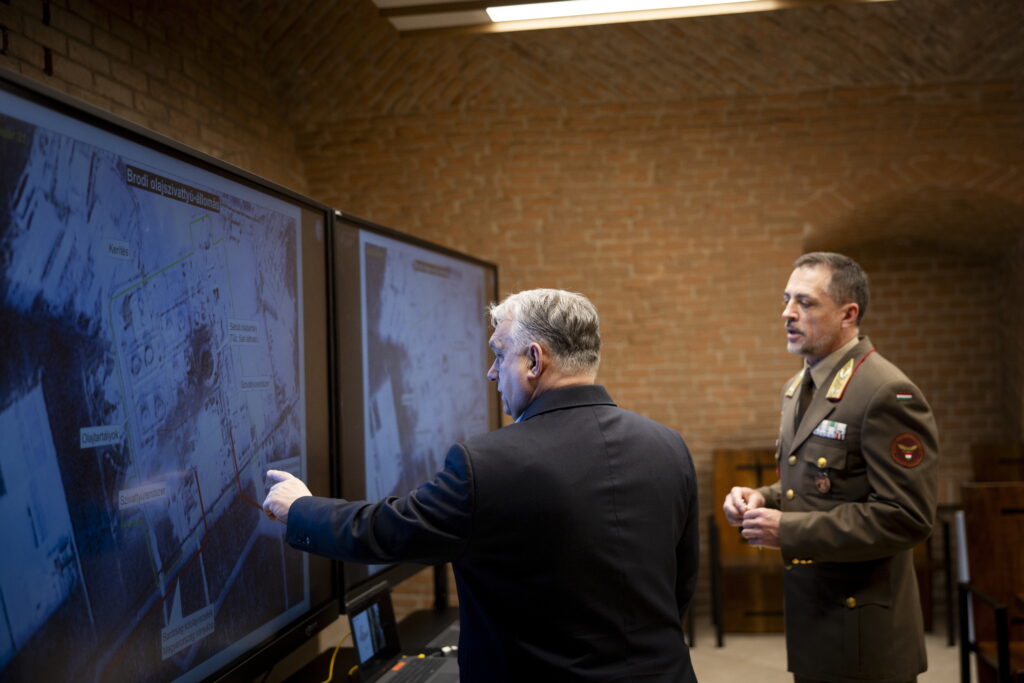
The wider political fallout, however, concerns the satellite images used by Prime Minister Viktor Orbán during his clash with Ukraine over the Druzhba pipeline. In early March, Orbán said satellite images showed there was no technical obstacle to the pipeline’s resumption and argued that the relevant material disproved Kyiv’s claim that Russian strikes had rendered the route inoperable. Slovak Prime Minister Robert Fico then made similar claims, saying he possessed satellite images showing that the main route of the pipeline had not been damaged, while also insisting that the material could not be fully disclosed because it was classified.
The pipeline dispute itself is real and politically consequential. Russian strikes in late January interrupted oil flows through the Ukrainian section of Druzhba, cutting supplies to Hungary and Slovakia, the two remaining EU states still dependent on that route for Russian crude. Ukraine has maintained that the infrastructure suffered real damage and required repair, while Budapest and Bratislava accused Kyiv of delaying restoration and using the outage for political leverage. The European Commission later offered technical and financial support to help restart the route.
What has now sharpened the issue is the interpretation placed on Pálinkás’s remarks by critics in Hungary and Slovakia. Their argument is that the imagery cited by Orbán and Fico was not ordinary commercial satellite photography, but material of a military nature, akin to battle damage assessment imagery used after a strike to determine what had been hit and with what effect. From there, critics have drawn a further inference: that if the imagery was neither Hungarian nor Slovak, and not supplied through NATO channels, it may have originated from Russia. That allegation is politically explosive, but it remains, on the currently available public evidence, an allegation rather than an established fact.
That distinction is central. What is publicly established is that Orbán did cite satellite images following a national security briefing, and that Fico said he held classified imagery which, in his view, contradicted the Ukrainian account of the damage. It is also established that Ukraine rejected their claims, arguing that overhead imagery could not prove the condition of internal systems, pumping equipment and sensors affected by the strike. President Volodymyr Zelenskyy publicly questioned how satellite images could show the actual internal state of the pipeline.
What is not publicly established is the provenance of the images. No official document examined so far identifies the supplier of the imagery cited by Orbán or referenced by Fico. No public investigation has concluded that the material was Russian military intelligence. Nor is there public evidence, at least at this stage, showing that either government handled secret Russian battle damage assessment imagery. Those are serious claims, but they remain unproven.
Even so, the controversy matters because it sits at the intersection of defence, energy and alliance politics. Both Hungary and Slovakia have maintained a softer line towards Moscow than many of their EU and NATO partners, and both have treated restoration of Druzhba as a matter of national priority. Hungary linked the dispute to wider EU decisions on support for Ukraine, while Fico has continued to call for the restoration of Russian energy flows. In that context, any unresolved question about the source of the imagery used by the two prime ministers is likely to draw further scrutiny.
For now, Pálinkás’s interview has unquestionably intensified pressure on the Hungarian defence establishment and added a new layer to the Orbán-Fico dispute with Kyiv. What it has not yet done is prove that either leader used Russian military intelligence. That is a matter for evidence, not inference — and, if the affair develops further, for formal investigation.

