
Keir Starmer’s announced resignation timetable turns Britain’s planned July EU-UK reset into a transition-management problem, with Andy Burnham likely to inherit sensitive files on trade, defence, youth mobility and post-Brexit economic confidence.
Keir Starmer’s decision to set out a resignation timetable has injected domestic political uncertainty into Britain’s planned reset with the European Union, weeks before a July Brussels summit meant to deepen cooperation on defence, trade and post-Brexit economic files.
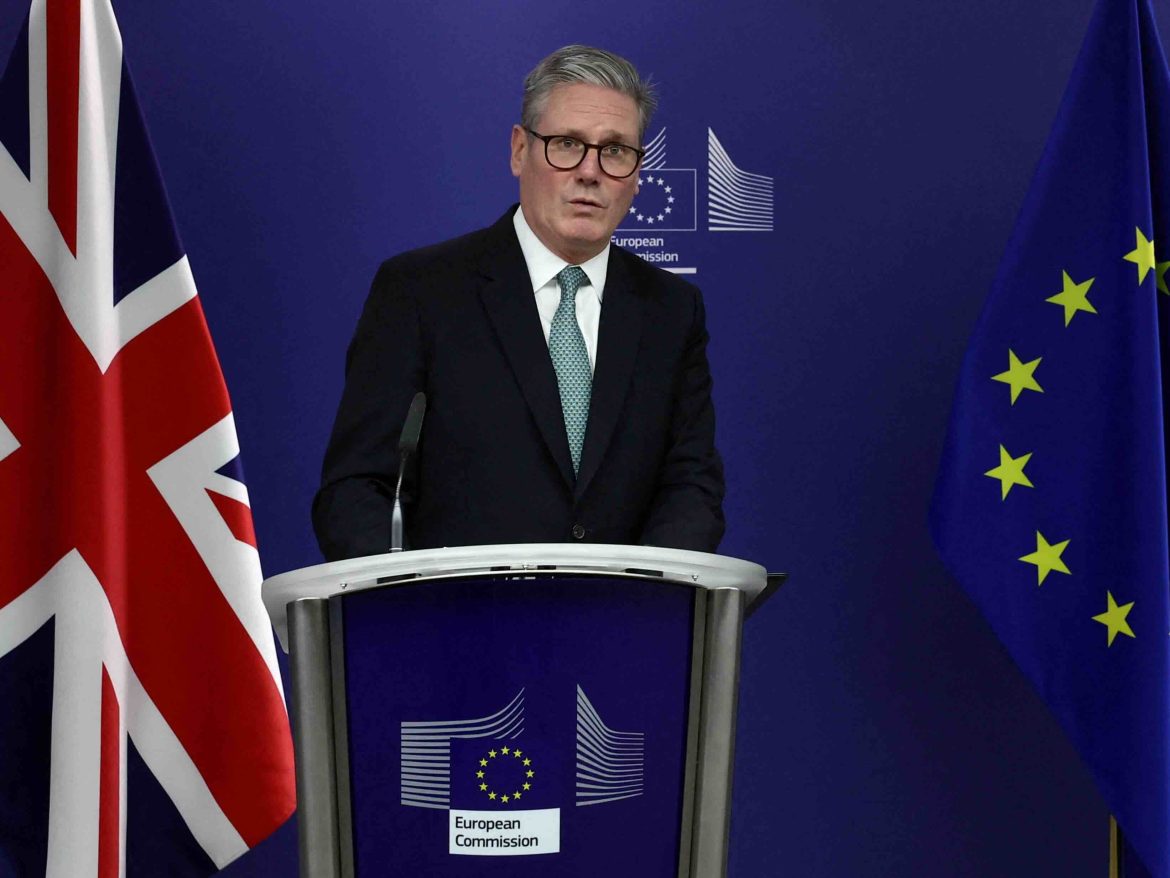
On 22 June, Keir Starmer announced that he would resign as prime minister once the Labour Party had selected a successor. The decision came amid pressure from Labour MPs and cabinet figures, with Andy Burnham emerging as the leading contender to replace him. The timetable could leave Burnham to take responsibility for the UK’s EU reset ahead of the July summit.
The immediate story is Westminster leadership. The wider story is Europe-facing: a domestic power shift in London now intersects with a live diplomatic process that Brussels, businesses and defence planners had expected to manage with Starmer’s government.
A reset becomes a transition file
The July 22 EU-UK summit had been designed as a practical reset rather than a reopening of the Brexit settlement. London and Brussels were expected to work through cooperation on security, defence industry, trade frictions, youth mobility and regulatory alignment in selected areas. The Guardian reported earlier this month that unresolved issues included youth mobility, tuition fees, veterinary arrangements and business travel.
Those files are technical, but they are politically sensitive. A veterinary agreement could ease food and agricultural trade but would raise questions about dynamic alignment. Youth mobility could improve exchanges but would be attacked by Brexit hardliners as a backdoor return to free movement. Defence cooperation is easier politically, but it still requires clarity on procurement, intelligence-sharing and institutional formats.
Starmer’s exit timetable complicates that work. Even if civil servants continue negotiations, EU officials will ask whether the incoming Labour leader will keep the same priorities, reopen mandates or slow decisions until after taking office.
Burnham and the Brussels question
Andy Burnham is widely seen as a leading contender to succeed Starmer. Guardian live reporting said Wes Streeting had backed Burnham for the leadership, raising the possibility of a rapid transition. If Burnham inherits the EU reset, he will face a strategic choice: preserve continuity to reassure Brussels and markets, or reshape the agenda to signal a new domestic political direction.
Burnham’s political brand is more regional, working-class and public-service focused than Starmer’s. That could affect how he frames the reset. He may emphasise jobs, manufacturing, energy bills and local economic benefits rather than constitutional language about Europe.
That might help politically. The strongest case for a UK-EU reset is not ideological. It is practical: lower trade friction, stronger defence coordination, more predictable supply chains and better tools for managing migration, energy and security risks.
But a leadership contest can narrow room for compromise. Candidates may avoid anything that looks like conceding ground to Brussels. The EU, for its part, will be reluctant to invest political capital in arrangements that could shift under a new prime minister.
Defence cooperation
The defence file is likely to be the least controversial and the most urgent. Russia’s war against Ukraine has made British capabilities, intelligence and military industry important to Europe’s security architecture. Britain remains outside the EU, but it is still one of Europe’s major military powers and a central NATO actor.
For Brussels, closer defence cooperation with the UK is useful because it strengthens European support for Ukraine and helps coordinate procurement, sanctions and capability planning. For London, it allows Britain to show leadership in Europe without reopening the most politically toxic parts of Brexit.
The question is whether a leadership transition slows that momentum. Defence officials can keep talking, but high-level political authority matters when agreements require money, industrial priorities and sensitive information-sharing.
Trade and market confidence
The economic files are harder. The UK economy has continued to feel the effects of non-tariff barriers with the EU, especially for small exporters and food producers. A reset could ease some of those costs, but only if London accepts forms of regulatory cooperation that remain politically delicate.
This is where leadership instability matters most. Businesses want predictability. Markets want to know whether the next prime minister will sustain fiscal discipline and pursue closer economic cooperation with Europe. Brussels wants to know whether London can deliver on any commitments made in July.
If Burnham or another successor signals continuity, the summit may proceed with limited disruption. If the leadership contest becomes a debate over the terms of the reset, the EU may delay serious concessions until the new leadership is settled.
Youth mobility and political risk
Youth mobility is another sensitive file. EU governments have pushed for easier mobility for young people, students and early-career workers. The UK has been cautious, aware that opponents could frame any deal as a partial return of free movement.
A new Labour leader may see youth mobility as politically attractive, especially among younger voters and businesses facing labour shortages. But during a leadership transition, even modest schemes can become symbols. That makes careful framing essential.
The reset will therefore depend not only on policy substance, but on whether Labour can explain it as a practical national-interest package rather than a Brexit reversal.
Brussels watches for continuity
For the EU, the immediate question is continuity. Brussels has dealt with years of British political turbulence since the 2016 referendum. It will not want another reset process that begins with warm language and then stalls because London changes leadership or red lines.
The July summit can still matter. It could produce a framework for cooperation that survives Starmer’s exit, especially if the incoming Labour leadership accepts the basic approach. But expectations may now be lower. EU officials are likely to seek proof that Britain’s domestic transition will not derail the process.
Starmer’s departure does not end the reset. It makes it more fragile.
The next prime minister will inherit a European agenda shaped by trade costs, defence pressure, public opinion and the practical limits of Brexit distance. Whether that agenda advances will depend on how quickly Labour turns a leadership crisis into a stable negotiating position.

