
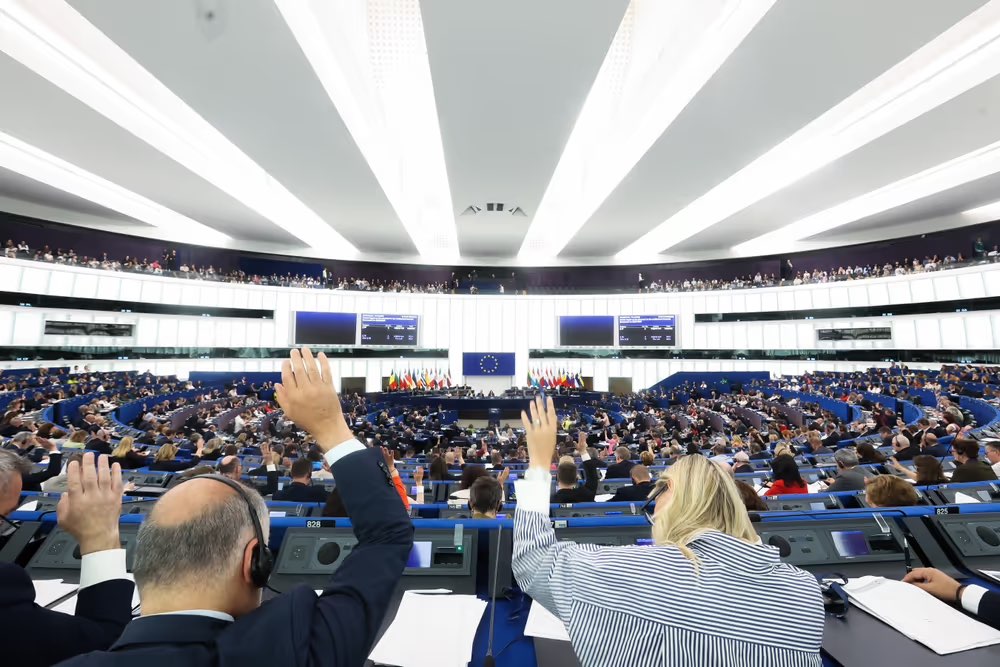
The vote in the European Parliament this week for a significantly expanded long-term EU budget may have been dressed up as strategic foresight. In reality, it looks far more like an invitation to revolt.
By endorsing a 2028–2034 financial framework of roughly €1.94 trillion—well above the European Commission’s already ambitious proposal—MEPs have fired the starting gun on what is likely to become one of the most fractious intra-European battles of the decade.
The reason is simple: the Parliament can demand, but it is the member states that must pay.
And therein lies the problem.
Under the EU’s constitutional architecture, the seven-year budget—the Multiannual Financial Framework—requires unanimous approval from all 27 governments. That single fact alone transforms the Parliament’s grandstanding into something closer to political theatre. For every euro added in Brussels, there must be a finance minister somewhere in Europe willing to defend it at home.
That willingness is, at best, fragile.
The Parliament’s case rests on familiar arguments. Europe, it says, faces a convergence of crises: war on its borders, industrial competition from the United States and China, climate obligations, migration pressures, and the lingering costs of pandemic-era borrowing. All of these, MEPs argue, require a larger common purse.
Few would dispute the scale of the challenges. But the leap from necessity to fiscal expansion is where the consensus fractures.
For one thing, the Parliament’s proposal quietly rewrites the rules of budgetary discipline. By insisting that repayment of the EU’s pandemic recovery debt be treated as separate from core spending, it creates the illusion of fiscal space where little exists. That may satisfy the arithmetic of Strasbourg; it will not convince the treasuries of Berlin, The Hague or Stockholm.
These are countries already weary of being net contributors. They account for a disproportionate share of the EU’s funding, largely through GNI-based contributions that make up roughly 70 per cent of the budget. Asking them to stretch further—at a time of sluggish growth and domestic fiscal strain—is politically combustible.
Nor is the proposed method of raising new revenues likely to soothe tensions. Taxes on digital services, crypto transactions, carbon emissions and even electronic waste may appear elegant on paper. In practice, they cut across national tax sovereignty and risk external retaliation, particularly from the United States, where most large technology firms are based.
This is not merely a technocratic disagreement. It is a clash of political cultures.
The Parliament, insulated from direct responsibility for national budgets, tends towards expansion. National governments, answerable to voters facing higher taxes or reduced domestic spending, tend towards restraint. The tension between the two is structural—and it is now reaching a breaking point.
There is also a deeper, less acknowledged divide: how the EU should prioritise its spending.
Southern and eastern member states continue to rely heavily on cohesion funds and agricultural subsidies. Wealthier northern countries increasingly want resources redirected towards innovation, defence and competitiveness. Trying to satisfy both camps within a dramatically enlarged budget risks pleasing neither.
Indeed, the Parliament’s attempt to “have it all”—more defence spending, preserved farm subsidies, sustained regional aid—may prove its greatest miscalculation. It assumes that political trade-offs can be indefinitely postponed by simply increasing the size of the envelope.
History suggests otherwise.
Previous budget negotiations have been notoriously bruising, often stretching into all-night summits and last-minute compromises. And that was when the sums involved were smaller and the geopolitical context less fraught. This time, the stakes are higher, the divisions sharper, and the economic backdrop more uncertain.
Even before this latest vote, several member states had signalled resistance to any meaningful increase in contributions. That resistance is unlikely to soften now that the Parliament has raised the bar still further.
If anything, it may harden into outright defiance.
The danger for Brussels is not simply a protracted negotiation, but a broader erosion of trust between institutions. National capitals may begin to view the Parliament less as a partner in governance and more as an irresponsible spender detached from fiscal reality.
That perception, once embedded, is difficult to reverse.
There is, of course, an alternative path—one that acknowledges the need for greater European capacity while respecting the limits of political consent. It would involve prioritisation rather than expansion, reform rather than accumulation, and a candid recognition that not every ambition can be funded simultaneously.
But that would require a degree of discipline that the Parliament has, for now, chosen to set aside.
Instead, it has opted for maximalism.
The result is predictable. A budget designed to project unity may instead expose division; a plan intended to strengthen Europe could end up paralysing it.
In the months ahead, as negotiations move from the debating chamber to the negotiating table, the rhetoric will shift from aspiration to arithmetic. And when it does, the enthusiasm for a bigger budget is likely to meet a colder, harder reality.
Europe’s governments, facing their own voters and their own deficits, are unlikely to sign blank cheques.
Rebellion may be too strong a word—for now. But resistance is all but certain. And in the delicate ecosystem of the European Union, resistance from a few can quickly become blockage for all.
European Parliament’s Spending Priorities Shift as Geopolitical Pressures Mount
Main Image: Fred MARVAUX: © European Union 2026 – Source : EP, Usage terms: Identification of origin mandatory
Click here for more News & Current Affairs at EU Today
Click here to check out EU TODAY’S SPORTS PAGE!
___________________________________________________________________________________________________________________

