
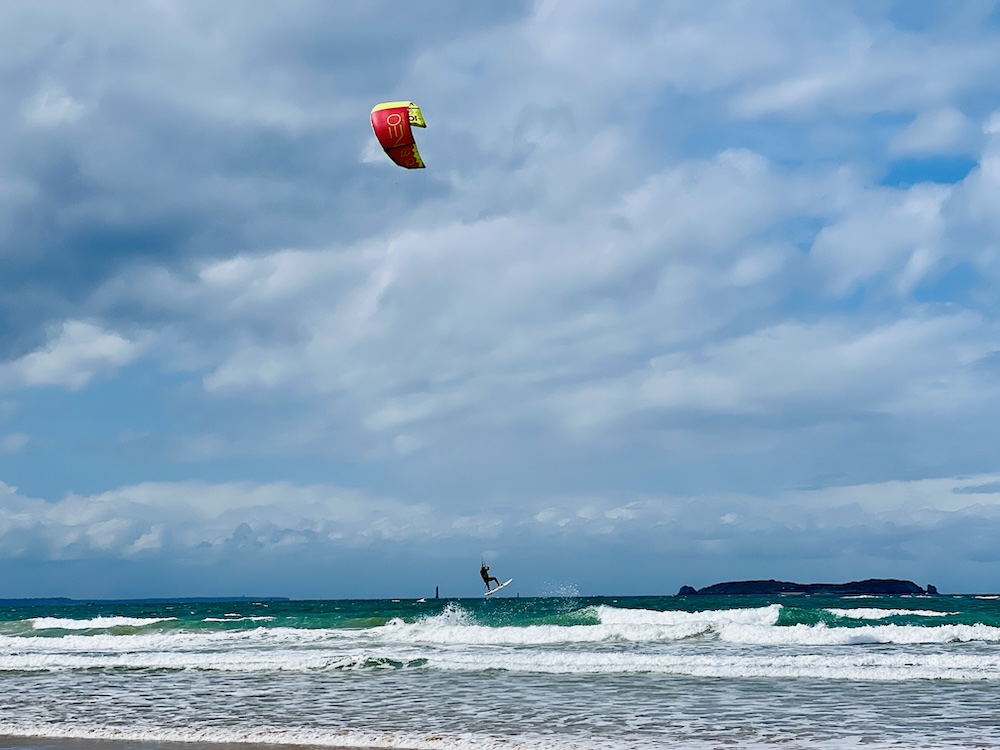
On Saint-Malo’s exposed shoreline, a bright but windy day can transform the bay into an arena for one of Europe’s most visually arresting water sports: kitesurfing. With riders lifting above the surf near Plage du Sillon, the sport has become part of the city’s wider nautical identity.
SAINT-MALO — Some sports require a stadium, a fixture list and a crowd. Kitesurfing requires only wind, water and people capable of reading both. On a bright, windy day in Saint-Malo, that is enough to turn the city’s seafront into a public sporting stage, with riders accelerating across the bay, cutting through the surf and, for a few seconds at a time, rising above the waves.
What makes the scene so striking is not simply the athleticism, but the setting. Saint-Malo is a city that has always been defined by the sea, and its coastline is not a decorative backdrop. The local tourism authorities present water sports as a central part of the destination’s offer, while Plage du Sillon — the city’s principal urban beach — is officially described as the largest sandy beach in Saint-Malo, stretching for around three kilometres. That combination of exposure, open water and long shoreline helps explain why kitesurfing is such a visible part of the coastal picture when conditions are right.
Kitesurfing, also known as kiteboarding, combines elements of sailing, surfing and aerial board sport. Riders stand on a board and are pulled by a controllable kite attached by lines and a harness, using gusts, wave shape and body position to maintain speed and control. In Saint-Malo, it is not merely an occasional pastime. Local operator Kite Center 35 offers kitesurfing tuition on Plage du Sillon, and Saint-Malo’s own tourism listings identify it as part of the area’s established nautical activity base.
That matters because the sport is unusually well suited to the logic of this coastline. Many water sports disappear from public view once they move offshore. Kitesurfing does the opposite. The kite remains visible high above the surface, making the action legible even from a distance. For people walking along the promenade or standing on the beach, there is no need to understand the technical details to grasp what is happening. The attraction is immediate: bright sails against a clear sky, boards skipping across broken water, and riders briefly suspended in the air before dropping back into the chop.
A video embedded here captures precisely that quality. It shows why kitesurfing has become one of the most photogenic sports on Europe’s Atlantic edge: the scale of the kite, the speed across the water and the brevity of the jump combine into an image that is both athletic and cinematic. In a place such as Saint-Malo, where the sea is always part of the urban frame, the sport seems to belong naturally to the landscape.
Yet there is more to it than spectacle. Kitesurfing is technically demanding and heavily dependent on local conditions. Kite Center 35 emphasises state-qualified instructors, recent equipment and sessions adapted to different levels, a reminder that the airborne ease seen from the shore rests on training and judgement rather than improvisation. The sport may look effortless from the beach, but it is built on close management of wind strength, direction, launch space and sea state.
That tension between freedom and control is part of what gives the discipline its public appeal. Kitesurfing offers a rare combination of visible risk, technical skill and environmental dependency. It is not staged in defiance of the weather, but because of it. A strong onshore wind that might discourage bathers or casual swimmers can create ideal conditions for experienced riders. The weather, in other words, does not interrupt the sport. It produces it.
There is also a wider point about how coastal towns present themselves today. Saint-Malo is known internationally for its walled city, maritime history and beaches, but contemporary visitor information also places active water sports firmly within the local offer. That suggests a shift visible across many European coastal destinations: the shoreline is no longer just a site of passive leisure, but of organised outdoor activity, instruction and performance. Kitesurfing fits neatly into that modern coastal economy, drawing not only participants but onlookers, photographers and, increasingly, video audiences.
In Saint-Malo, this does not displace the city’s older identity. It adds to it. The same coastline that once served commerce, defence and navigation now also hosts a sport built on speed, lift and balance. That continuity matters. Kitesurfing may be contemporary, but its raw materials are familiar to the place: wind, tide and exposed water.
On a sunny, very windy day, those elements can make the bay look less like a postcard view than a live sporting arena. The crowd forms itself on the promenade. The action begins without announcement. And for as long as the wind holds, Saint-Malo offers one of the clearest reminders that some of the most compelling sports are still shaped not by architecture, but by the elements.
Click here for more News & Current Affairs at EU Today
Click here to check out EU TODAY’S SPORTS PAGE!
___________________________________________________________________________________________________________________

