
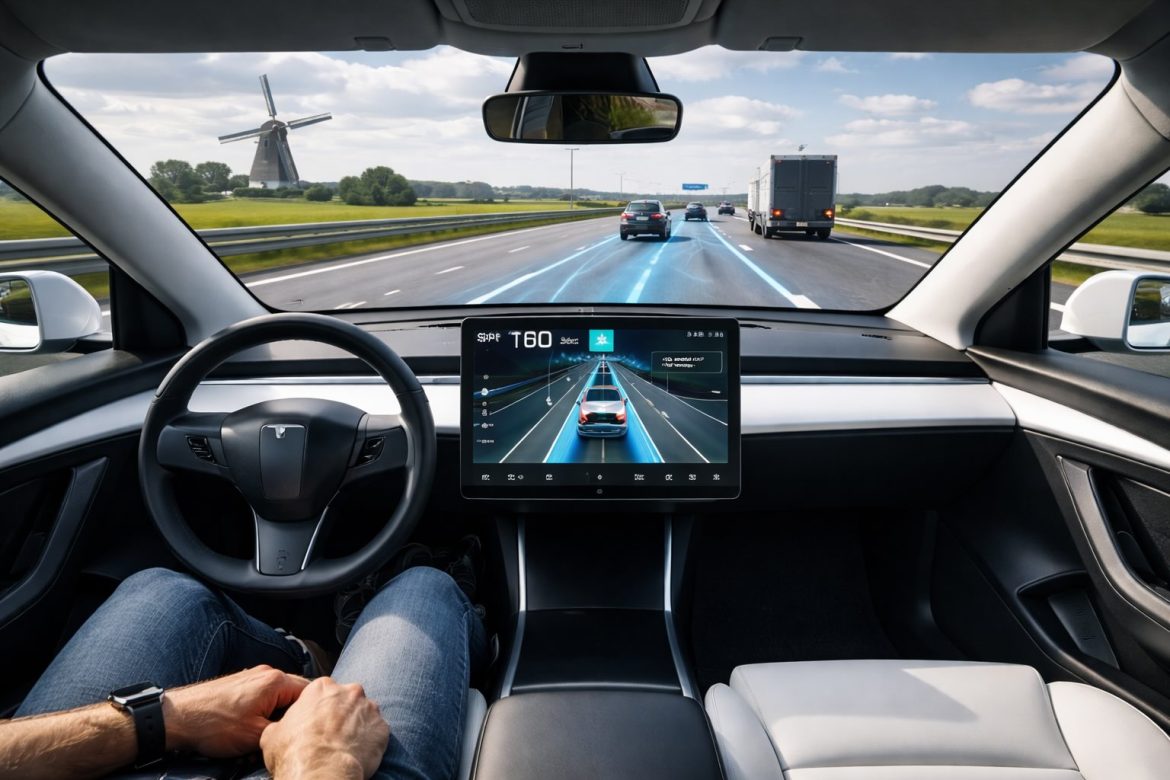
Dutch regulators have approved Tesla’s Full Self-Driving Supervised system for use on public roads, making the Netherlands the first country in Europe to allow the technology under conditions that keep the driver fully responsible at all times.
The Netherlands has become the first country in Europe to approve Tesla’s Full Self-Driving Supervised system for use on public roads, after the Dutch vehicle authority RDW granted type approval with provisional validity in the country. The decision gives Tesla an important regulatory foothold in Europe and may strengthen its wider push to expand the technology across the European Union.
The approval follows what the RDW says was an extensive examination of the system over roughly 18 months. In its explanation of the decision, the Dutch authority said the technology had been closely assessed before the type approval was issued. The regulator concluded that, when properly used, the system can make a positive contribution to road safety. That finding appears to have been central to the decision, although the authority also drew a firm line between advanced driver assistance and genuine autonomous driving.
Despite Tesla’s branding, the RDW states clearly that a vehicle equipped with FSD Supervised is not self-driving in the legal sense. It is treated as a driver assistance system, which means the motorist remains responsible for the vehicle at all times and must always be capable of taking control. The authority’s Dutch-language notice makes the same point explicitly, stressing that the driver must remain attentive and retain control throughout the journey.
In practical terms, that means a driver may not use the system as a licence to disengage from driving. Looking at a phone, reading, or otherwise shifting attention away from the road remains prohibited. The vehicle may assist with steering, braking and acceleration, but it does not remove the legal obligation of the person behind the wheel. This distinction is likely to be important in any wider European debate, where regulators have generally taken a cautious approach to claims surrounding automated driving systems.
The system itself includes monitoring measures designed to ensure that the driver continues to pay attention. According to the RDW, the vehicle checks whether the driver is sufficiently alert while the system is active. If that is not the case, a warning is issued and the driver must demonstrate attentiveness. In the most serious instances, the system can be temporarily disabled. That framework of constant human supervision appears to have been a key factor in allowing the technology onto Dutch roads.
The Dutch decision may also have implications beyond the Netherlands. The RDW says it will submit an application to the European Commission to seek broader recognition of the system, after which EU member states would have to consider the matter. For now, however, the approval applies only in the Netherlands. The RDW has emphasised that a number of further steps would still be required before the system could be used throughout the European Union.
Tesla’s FSD system has already been available in the United States, but the Dutch regulator has underlined that the American version is not directly comparable to the version approved in the Netherlands. According to Reuters and the RDW, Tesla vehicles in the US operate with different software versions. That difference matters because European approval depends on compliance with local regulatory and safety requirements rather than on experience in another market.
The Dutch approval therefore represents a regulatory milestone rather than a declaration that fully autonomous Teslas have arrived in Europe. It allows the use of an advanced assistance system under strict conditions, with the driver still legally and practically in charge. For Tesla, it is a potentially important step in opening the European market. For regulators, it is an example of cautious authorisation. And for drivers, the message from the Dutch authorities remains straightforward: the software may assist, but responsibility stays with the human being at the wheel.

