
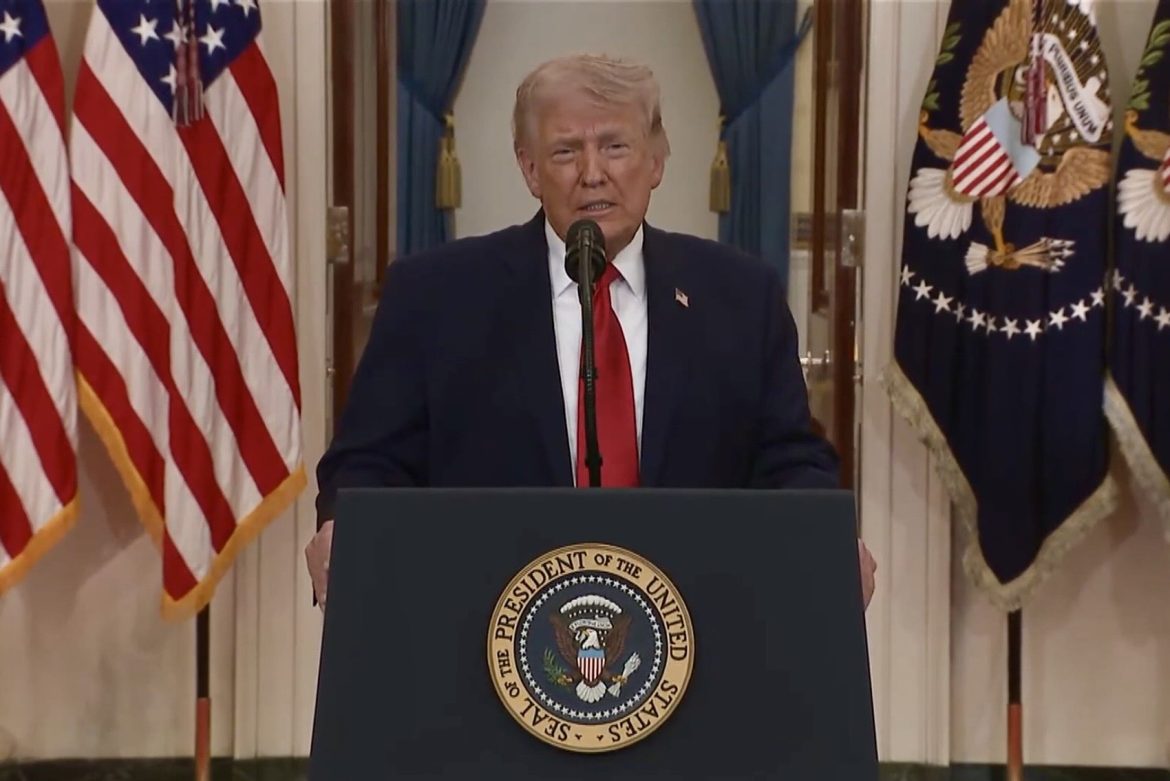
President Donald Trump used a primetime White House address on 1 April to present the war with Iran as limited, advancing and close to completion.
Yet the speech appeared aimed less at defining victory than at calming an increasingly uneasy American public, nervous allies and markets already reacting to the widening economic cost of the conflict.
In a speech lasting about 20 minutes, Mr Trump said the United States was close to achieving its “core strategic objectives” and suggested that heavy operations could continue for another two to three weeks.
He argued that the campaign had sharply degraded Iran’s naval, air, missile and nuclear capabilities, while presenting the war as a necessary measure to prevent Tehran from threatening the United States and its allies. The White House, in its own account of the speech, cast the address as proof that the administration’s objectives had remained consistent throughout the conflict.
The political logic of the speech was clear. Mr Trump is trying to reassure Americans that this will not become another open-ended Middle Eastern war. A Reuters/Ipsos poll published on 31 March found that 66 per cent of Americans wanted the United States to end the war quickly, even if that meant not achieving all of the administration’s stated goals. The same polling showed broad unease about the original decision to strike Iran, while an earlier Reuters/Ipsos survey found only one in four Americans backed the initial attacks when the war began on 28 February.
That public scepticism has deepened as the economic effects of the war have become harder to ignore. Reuters reported this week that US petrol prices had risen above $4 a gallon for the first time in more than three years, while oil prices jumped again after Mr Trump’s speech offered no credible sign of de-escalation. Brent crude rose above $107 a barrel and traders reacted negatively to the absence of any clear diplomatic or military end point.
Seen in that context, the address was an exercise in political containment. Mr Trump needed to persuade voters that the war is finite, that the costs are manageable and that the White House remains in control. He therefore framed the conflict as a short-term sacrifice rather than a prolonged strategic gamble. That is especially important for a president whose approval rating had already fallen to 36 per cent in a Reuters/Ipsos poll published last week, with fuel prices becoming an increasingly potent domestic issue before the midterm elections.
But the speech left the main strategic questions unanswered. Mr Trump claimed the campaign was nearing completion, yet gave no precise definition of what would constitute success. Reuters noted that Iran may still retain stockpiles of enriched uranium, including material believed to be protected in hardened underground facilities. That matters because the administration has repeatedly said the war was launched to ensure Iran could never obtain a nuclear weapon. If Tehran’s remaining nuclear assets are not fully accounted for, Washington’s central war aim remains at best incomplete.
Nor did the president explain how the conflict is to end politically. In recent days the administration had been pressing Iran to accept a peace framework, but Mr Trump made no meaningful attempt to describe any negotiating track in his address. Instead, he returned to threats of further military escalation. That omission reinforced the impression of a White House that is still searching for an exit while trying not to appear to retreat.
The same ambiguity was evident over the Strait of Hormuz, the key shipping route whose disruption has sent energy markets sharply higher. Mr Trump urged others dependent on Gulf oil to take a greater role in securing the waterway, while also suggesting that the strait would reopen once the war ended. Neither remark amounted to a plan. The issue has become even more sensitive because his criticism of allies coincided with remarks, in which he said he was strongly considering taking the United States out of Nato. France has already replied that the alliance exists to protect Euro-Atlantic security, not to mount offensive operations in Hormuz.
There is also the unresolved question of the expanding American troop presence in the region. Mr Trump offered little explanation of what newly deployed US personnel would actually be expected to do if the conflict broadens. That omission will do little to ease concern about mission creep.
The reasoning behind the speech, then, was not difficult to discern. Mr Trump was not chiefly trying to unveil a new strategy. He was trying to stabilise opinion: to reassure voters rattled by rising fuel prices, to calm markets unnerved by the threat to Gulf shipping, and to signal that the White House still believes it can end the war on its own terms. The problem is that reassurance without clarity rarely lasts. For all the presidential staging, the address left the same questions hanging over Washington: what victory means, how long the war will continue, whether diplomacy still has a role, and how far the United States is prepared to go if Iran refuses to yield.

