
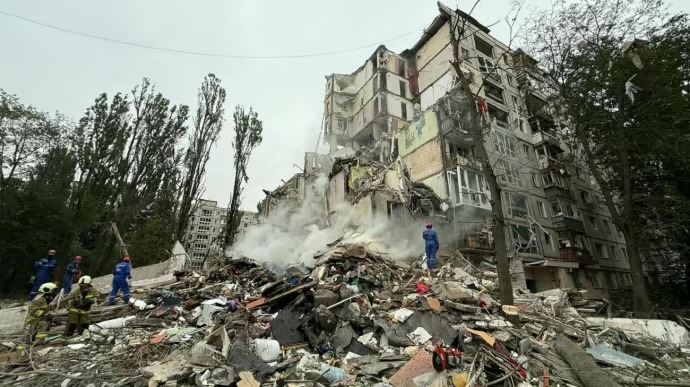
At least 31 people, including a five children, were killed and 159 others injured following a combined drone and missile strike launched by Russian forces against Kyiv in the early hours of 31 July.
The attack caused extensive destruction across multiple districts of Ukrainian capital, with residential buildings, schools, and civilian infrastructure among the damaged sites.
Initial reports from city authorities confirmed two deaths and dozens of injuries shortly after the attack. As rescue operations progressed, the Kyiv City Military Administration (KMVA) revised the figures, confirming fourteen fatalities. According to KMVA head Timur Tkachenko, four of the deceased were found in Sviatoshynskyi district, and two in Solomianskyi. Among the victims was a child aged six.
The assault began during the night, prompting air raid alerts across the capital. Mayor Vitalii Klitschko reported that the attack destroyed an entrance section of a residential high-rise in Sviatoshynskyi district. Emergency services responded immediately, with rescue and medical teams deployed to the affected areas. Fires broke out in several non-residential buildings, and widespread structural damage was recorded in multiple locations.
In Solomianskyi district, multiple residential buildings sustained damage, with fires affecting vehicles and commercial properties. In Holosiivskyi district, damage was reported to school premises and a kindergarten. In Shevchenkivskyi district, windows were shattered at a children’s hospital due to blast waves.
President Volodymyr Zelenskyy commented on the strike via social media, posting a video showing the impact of a missile hitting a residential building. He stated: “Kyiv. Missile strike. Direct hit on a residential building. People are trapped under the rubble. All emergency services are at the scene. Russian terrorists.”
Emergency services reported that among the injured were three police officers responding to an emergency call at the time of the strike. The latest data provided by Kyiv Mayor Klitschko and KMVA indicate that 52 people were injured overall, including nine children. Of these, at least 26 were hospitalised, while others received treatment on site.
Authorities have confirmed that the Russian strike targeted 27 locations across four city districts, using a combination of unmanned aerial vehicles (UAVs) and missiles. The type of munitions used and the exact sequence of the attack are under investigation by the Security Service of Ukraine (SBU) and local law enforcement.
Road closures were implemented across affected areas to facilitate emergency response operations. Images released by the State Emergency Service (DSNS) depict collapsed structures, burning vehicles, and rescue teams working through the debris. According to DSNS, search and rescue operations remain under way.
This latest strike is part of an ongoing campaign of attacks on major Ukrainian cities during the summer of 2025. The use of combined drone and missile strikes has become a regular feature of Russian operations, aimed at overwhelming Ukraine’s air defences and causing psychological strain on the civilian population.
Although Ukrainian air defence systems intercepted a number of incoming projectiles, some managed to penetrate and strike populated areas. The Defence Ministry has previously stated that the increasing frequency and complexity of Russian attacks pose a growing challenge to defence capabilities.
Local officials have urged residents to remain indoors during alerts and to adhere to civil protection protocols. Clean-up and damage assessment operations are continuing, with municipal services deployed across the affected districts.
As of 31 July, Kyiv remains under high alert, with the possibility of further attacks not ruled out. Ukrainian authorities have reiterated calls to international partners for increased air defence support in the face of persistent Russian strikes targeting urban centres.

