
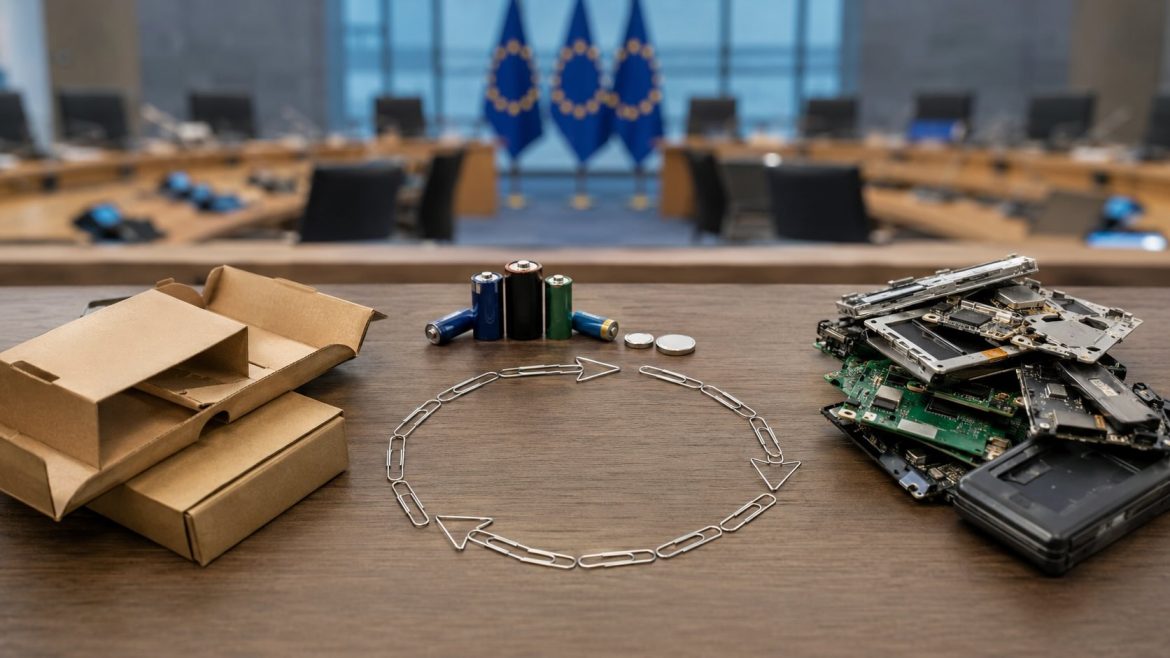
The Council of the European Union has backed part of a new environmental simplification package, but member-state resistance has forced it to drop work on two contested proposals affecting extended producer responsibility rules.
The decision, announced on 24 June, shows the limits of Brussels’ current effort to reduce regulatory burden. The Council agreed its negotiating position on parts of the environmental simplification package, covering industrial emissions, circular-economy rules and geospatial data. However, it discontinued negotiations on two proposals relating to extended producer responsibility, after strong reservations from a large majority of member states.
That makes the file more than a technical exercise in cutting paperwork. It has become a test of how far the EU can go in easing business obligations without weakening enforcement in waste, packaging, batteries and product compliance.
The original package was presented by the European Commission on 10 December 2025 as part of a wider effort to reduce administrative costs and simplify environmental legislation. The Commission initiative contained six legislative files, including changes to industrial-emissions reporting, environmental assessments, geospatial-information rules and extended producer responsibility obligations.
The Council has now moved ahead with some of those elements. Its agreed position would simplify parts of the Industrial Emissions Directive, the Industrial Emissions Portal Regulation, rules on waste from electrical and electronic equipment, the Waste Framework Directive and the INSPIRE Directive on spatial information. These areas matter to businesses because they involve reporting, permitting, environmental data and compliance obligations across several sectors.
The more politically sensitive issue is extended producer responsibility, commonly known as EPR. Under EPR systems, producers are made responsible for the collection, treatment or financing of waste from products they place on the market. The principle is already embedded in EU rules for packaging, batteries, electrical equipment, single-use plastics and textiles. It is intended to make producers bear part of the cost of waste management rather than leaving it entirely to municipalities or consumers.
One of the Commission’s proposed changes would have suspended rules requiring certain producers selling goods into another member state to appoint an authorised representative for EPR compliance. The aim was to reduce administrative costs for companies operating across borders. Supporters of simplification argue that fragmented national systems can create unnecessary bureaucracy, particularly for smaller firms and e-commerce operators.
However, opponents warned that weakening authorised-representative requirements could make enforcement harder. If a producer sells goods into a country without a clear local compliance contact, national authorities may struggle to trace responsibility for waste obligations, recover costs or act against non-compliant operators. This concern was raised by parts of industry and environmental organisations, which argued in a joint response that the representative obligation should remain in place.
The Council’s decision to stop work on the two EPR-related proposals is therefore significant. It suggests that most member states were not prepared to accept simplification where they saw a risk to enforcement. It also indicates that governments prefer to deal with the issue later through the planned Circular Economy Act, expected in autumn 2026, rather than through a narrower suspension of existing obligations.
The development exposes a wider tension in EU policymaking. Since 2025, Brussels has placed simplification at the centre of its competitiveness agenda. Businesses have complained about overlapping reporting duties, complex permitting, multiple databases and uneven national implementation. The Council’s broader simplification agenda now covers files ranging from environmental law and chemicals to defence readiness and digital rules.
Yet environmental legislation is not only a cost issue. It also provides the enforcement framework for pollution control, waste treatment, product traceability and public access to environmental information. Reducing paperwork may be commercially attractive, but removing obligations that help authorities identify responsible operators can shift costs elsewhere.
This is particularly relevant for online sales and cross-border trade. Waste and packaging rules are often difficult to enforce when producers operate from outside the member state where the product is sold. If obligations are loosened without alternative traceability mechanisms, compliant companies may face unfair competition from businesses that avoid waste-management costs.
The Council’s compromise therefore sends a mixed message. It confirms that member states support simplification where they consider it administrative and low-risk. At the same time, it shows resistance when simplification touches the mechanisms used to assign responsibility and enforce compliance.
The European Parliament will now shape its own position on the remaining elements of the package before negotiations can begin between the institutions. The discontinued EPR proposals are unlikely to disappear from the EU agenda. They are more likely to return in a broader debate on the Circular Economy Act, where the Commission will face pressure to harmonise and digitise producer responsibility schemes without weakening national enforcement.
For businesses, the immediate consequence is that several reporting and data obligations may still be simplified, while more contentious producer-responsibility rules remain unresolved. For regulators, the lesson is clearer. The EU can cut administrative burden, but not every environmental obligation can be treated as disposable red tape.

