
August is well known within the Brussels bubble as a rather sleepy month for the town’s diplomats and Eurocrats. Many prefer the beaches of southern Europe or more exotic destinations further abroad to escape the lull.
But this year, things are a little different. The race to appoint a new head of the Energy Charter Treaty (ECT) is currently in full swing.
Readers of EU Today are familiar with the ECT – an international organisation which Brussels has been hosting since the 1990s. Its main purpose is to promote international energy cooperation by offering a range of investment protection rules for companies investing abroad.
The ECT de facto promotes foreign investment across the jurisdiction of its member countries. It creates a level playing field for investors and establishes a rule of law in the energy markets.
All of this makes the ECT an important international treaty, taking into account the strategic importance of energy. But in recent years the ECT has been making headlines for all of the wrong reasons.
The rot started just before the outbreak of the Covid-19 pandemic, when a host of NGOs created a narrative establishing that the ECT served the interest of big oil companies at a time when the EU was leading Europe’s energy policy in the opposite direction. As Europe’s green energy policies gathered pace, multiple resolutions in the European Parliament called for the EU and its members to pull out of the ECT. Many European countries subsequently withdrew, severely undermining the foundations on which the organisation was built, in both budgetary and political terms.
This brings us right back to the contest now taking place this August to appoint a new boss of the ECT Secretariat, the executive body of the organisation. The hot favourite to be (re-) appointed as the head of the ECT Secretariat is one Atusko Hirose, the body’s current acting head. Ms Hirose, a Japanese national, was appointed acting head of the organisation last year, when the Secretary General of the time departed and his position remained unfilled.
She had been earlier appointed as Deputy Secretary General (DSG) in 2021 and is now running for a second term since her current contract expires on 15 September (2025). Three other candidates, including candidates from Belgium and Jordan, are also vying for the position. The post of Secretary General remains vacant and the DSG currently serves as the Acting head of the organisation.
At face value, there appears to be nothing wrong with any of this since it is often the case that officials from different countries compete for prominent international posts, whilst being backed by their governments. Japan is lobbying hard for its candidate, as is Jordan, whilst European countries like Belgium tend to take a more subtle approach towards such contests.
Tokyo’s European friends putting another nail in the coffin of ‘EU solidarity’
Japan’s lobbying already appears to be bearing fruit. It is understood that a number of EU member states, Lithuania and Romania, have already endorsed Ms Hirose as their preferred candidate. Romania’s Minister of Energy, Ivan Bogdan-Gruia, personally signed off on Bucharest’s endorsement letter for the Japanese candidate. The Energy Minister of Greece took a similar step. Lithuania also voted for Japan, whilst announcing in parallel that it is leaving the Treaty.
While all of this appears quite normal, if we dig a little deeper, the story starts to change dramatically. To begin with, Ms Hirose’s tenure at the ECT Secretariat has been mired in deep controversy – a topic which has received some coverage in the Brussels media.
The organisation is currently engulfed in a spate of litigations involving former-staff members following multiple allegations of violence, harassment, backstabbing and drunkenness. According to eyewitness accounts provided anonymously, “people literally started to disappear from the organisation shortly after Ms Hirose’s appointment at the Secretariat commenced”. “One day here, next day gone. And nobody knows what happened. Even the SG (Secretary General) himself disappeared. Then the GC (General Council). Almost nobody was left. Everyone was either on sick leave for months on end or already gone forever” reported one witness.
Indeed, the number of employees of the Secretariat has fallen dramatically, from 27 when Ms Hirose’s appointment began to 5 at the present time. “The methods used (by Ms Hirose to terminate staff appointments) may be acceptable in Japan, but they are clearly not acceptable in Europe”, reported another mistreated Secretariat official, who had his private phone calls recorded as part of a smear campaign akin to blackmail. The incident led to a police involvement and was subsequently referred to the Belgian justice system for evaluation.
“She (Hirose) has broken every rule in the book, tampered with private emails (of Secretariat staff), breached regulations on the processing of personal data and encouraged supervised staff to backstab their supervisors”, said another witness. “She revels in an atmosphere shrouded in disputes and controversy” added another witness, further attesting that “this was all of highly malicious intent”.
Mounting litigations and scampering countries
As the litigations mounted, the Secretariat faced double trouble. European countries, big and small, lined at the door to withdraw from the ECT, reducing membership fees and causing the Secretariat’s budget to shrunk in spectacular manner – by nearly 400%. At the same time, since no effort was made to settle disputes amicably, the total amount of claims for damages against the organisation filed in the courts by aggrieved staff eclipsed the entire budget of the organisation.
As more donor countries representing solid budgetary contributions are set to leave the ECT this autumn (Norway and Denmark are next in line), the Secretariat may be on the brink of collapse if the courts rule in favour of the mistreated employees. “It will just run out of money”, said one anonymous witness. The Secretariat already lost a case at the start of 2025 and had to settle damages with a former-employee to the amount of 50,000 euros. There were also two awards against the organisation in the previous year.
Ms Hirose’s remedy for the organisation’s financial crisis is worth noting. Earlier this month, she hiked up the salaries and allowances of two of the remaining five staff members deemed to be her closest supporters – a Ukrainian young man who was until recently an intern at the organisation, and an Indian woman, who also joined the organisation a few years ago as an intern. At same time, Ms Hirose is said to have either delayed or withheld the salaries of staff less in favour, somewhat arbitrarily.
Both former-interns have been promoted to positions of senior management at the Secretariat and have been recipients of cash awards reportedly in excess of 5,000 Euros. The Ukrainian former intern has even been recommended for the Energy Charter Award, which was once reserved for high ranking public servants including Ministers and Prime Ministers of ECT member countries.
“There is no big surprise about the cash awards, top positions and the salary increase of former interns” added another witness, further referring to “Manus manum lavat of the two ECT employees who were helping Ms Hirose find subtle means of breaking the rules while terminating contracts of 20+ professionals in exchange for a generous salary package. That’s why the Secretariat is now facing so many complaints in the ILO in Geneva now”.
It is interesting to note also that India has no involvement with the ECT, whilst the Secretariat’s website states that the organisation only employs nationals of member countries. Ms Hirose has also been busy travelling on expensive business trips abroad on behalf of ECT member countries, including combining business with personal visits in Asia. There is little transparency about such trips or the results they yield on behalf of ECT member countries.
To know or not to know
The question now arises why Romania’s Minister of Energy, Ivan Bogdan-Gruia, who represents a country which is largely inactive in the Energy Charter process, would endorse a candidate of Ms Hirose’s profile.
The same question could be asked of Greece or Lithuania, which left a parting gift for Japan as it announced its withdrawal from the ECT. Romania held the Chairmanship of the Energy Charter in 2018 but has been largely inactive in the process since that time.
It did not participate in the interviews for the top job held with Ms Hirose and other candidates on August 4.
Mr Bogdan-Gruia was unlikely to have been informed by his cabinet that Ms Hirose was grilled by some ECT member countries during the interview about why she terminated the employment of the Secretariat’s top energy experts. These actions left the organisation with little capacity to deliver on its program of work. Neither was he likely to have known that she was asked about failing to do anything to prevent withdrawals from the ECT or spending up to 10% of the Secretariat’s budget on her legal battle with former employees.
But it is unlikely that a similar conclusion can be reached when it comes to the relationship between Japan and Ms Hirose herself. It appears to be the case that Japan, the EU as well as some other ECT Treaty members such as Switzerland, have long been aware of the rather messy management environment at the ECT Secretariat. A report bearing the title ‘Grave Misconduct at the Energy Charter Secretariat’ was circulated amongst ECT member countries in late 2023 by an anonymous stakeholder group, the Energy Charter Delegates for Truth and Justice.
The report concluded that the ECT Secretariat has become the most litigated international organisation in the world within the jurisdiction of the Administrative Tribunal of the International Labour Organisation (ILOAT). As numbers often speak louder than words, statistics from the report show that one in two employees of the Energy Charter Secretariat is likely to turn to the tribunal to seek compensation for mistreatment by management. The report was subsequently discussed and taken note of by ECT members, but no action was taken. This might just be another reason why Denmark and Norway are leaving and do not want to be associated with the notorious secretariat.
To know but not to act
This leaves us with an open question and a thought to ponder about the future of the ECT and the Secretariat. As one frustrated Brussels-based diplomat connected to the matter confessed anonymously, “I really don’t get the game Japan is playing (with Hirose). They are such nice people. Ambassador AIKAWA Kazutoshi (Japan’s Ambassador to the EU) is a serious professional. God knows what he is doing putting his lot in with her (Hirose), bearing in mind of all her shenanigans and the risk of reputation damage. He cannot expect that all of this can just be swept under the carpet”.
It is not clear why Japan continues to blindly support Ms Hirose, as the international organisation she is bidding to lead for a second term implodes around her. Scandal and controversy has followed throughout her first term.
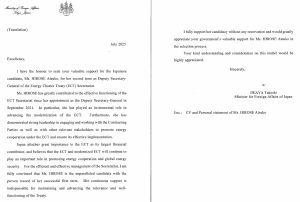
Although Japanese administrations are known to be rather scandal averse in nature, the presence of the controversy-marred Ms Hirose has not prevented Japan’s Foreign Minister, IWAYA Takeshi, to encourage other countries to support her second term through an endorsement letter.
The letter appears to have been issued by the Foreign Minister recently, although the date on the document cannot be clearly identified, which is not common practice for meticulous documents produced by the Ministry of Foreign Affairs of Japan.
The irony of the matter is that with the support of inactive countries like Romania, the likes of Greece and departing Lithuania, she may well win. ECT member countries closing their eyes to Ms Hirose’s ‘shenanigans’ for their own reasons of choice may well aid her cause. But will a Hirose victory result in a victory for Japan? Or will a Hirose victory drag Japan down into the abyss of an imploding organisation drowned by litigations currently inspiring more countries to leave the ECT?
The final word of a former-ECT Secretary General upon his departure from the organisation a few years ago – that the Treaty is a two-edged sword which should never be put into the hands of fools and arsonists – now resonates more than ever. Japan, which is now the power broker in the ECT process following the final withdrawal of the EU earlier this year, may have missed a golden opportunity to save the organisation.
With so many outstanding diplomats and energy experts at its disposal, Japan could have nominated a ‘fair-play candidate’ who would ensure compliance of the rules, transparency and further development of an organisation with so much potential to promote international energy cooperation. But we cannot be sure that this is what Tokyo wanted.



