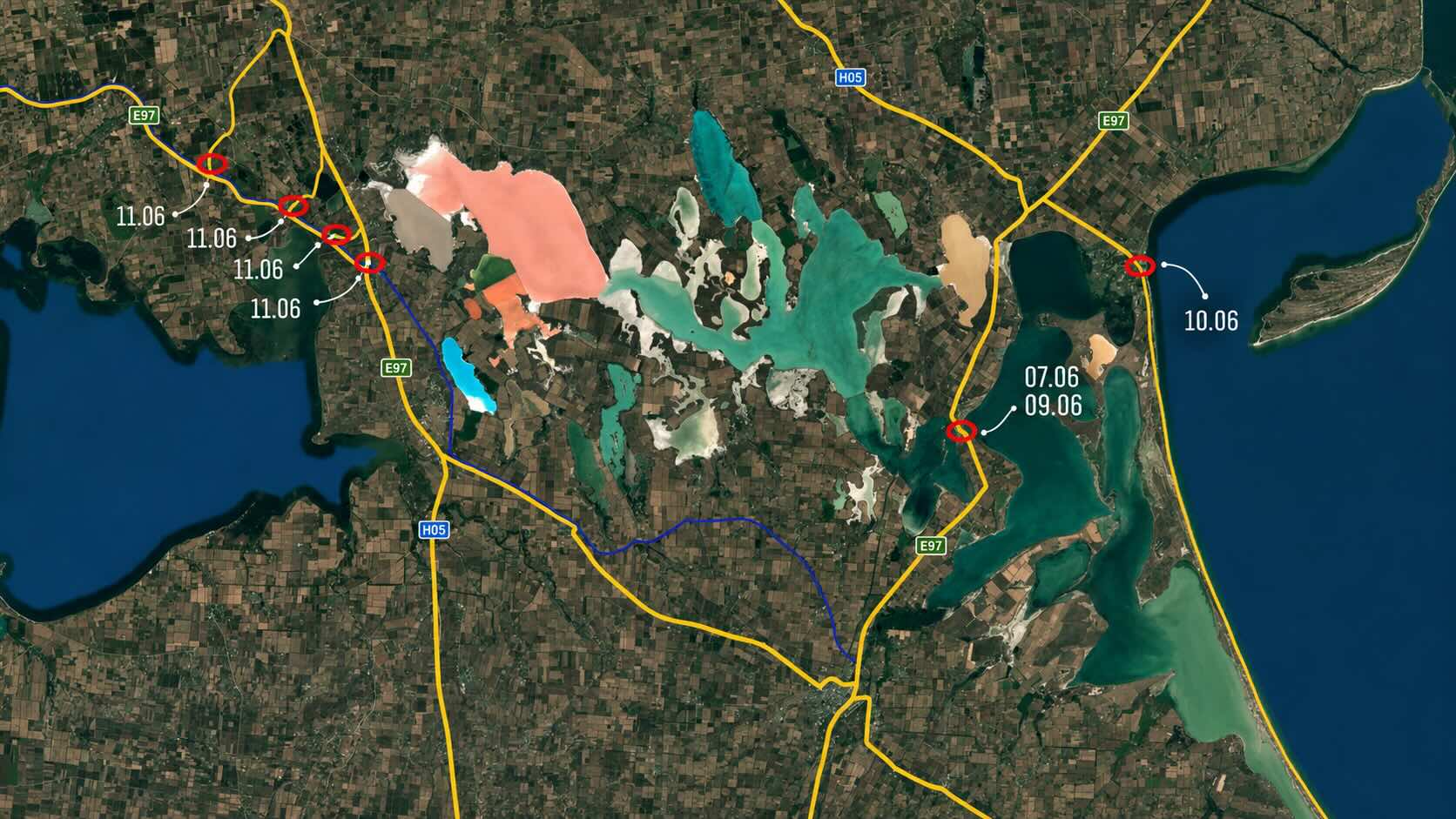
Ukraine’s latest attacks on Russian supply routes into occupied Crimea have turned a fuel shortage on the peninsula into a wider military and political problem for Moscow. What began as disruption at petrol stations has now exposed the vulnerability of the transport network on which Russia depends to sustain both the civilian occupation administration and its military presence in Crimea.
The immediate consequence was visible in Sevastopol, where the Russian-installed authorities suspended fuel distribution after tanker trucks failed to reach the city. Previously issued petrol QR codes were temporarily invalidated, while fuel was reserved for municipal services, ambulances, security structures and public transport. For ordinary residents, the message was blunt: there was little point queuing at petrol stations.
The shortages followed renewed Ukrainian strikes against the road infrastructure linking occupied Kherson region with Crimea. Local channels and Ukrainian sources reported damage to bridges on the northern approaches to the peninsula, while the Chonhar route had already been affected by earlier attacks that forced traffic to be rerouted through Armiansk and Perekop. Further reports said four bridges were targeted overnight on 11 June, affecting routes between occupied southern Ukraine and Crimea.
These are not secondary targets. The roads through Chonhar, Henichesk, Perekop and Armiansk are part of the network used to move fuel, ammunition, personnel and other military cargo into Crimea and onwards towards the southern front. By attacking bridges and fuel movements rather than only depots, Ukraine is targeting the connective tissue of Russia’s occupation system.
The effect is cumulative. One damaged bridge can be repaired. One tanker truck can be replaced. But repeated strikes over several days change the calculation for drivers, commanders and occupation officials. Deliveries slow down, convoys become more exposed, and Russia is forced to prioritise which routes, bridges, depots and fuel columns receive protection.
Crimea’s problem is structural. The peninsula is heavily dependent on external supply. Russia can move goods through the Kerch bridge, by sea, by rail and through the occupied land corridor in southern Ukraine, but each of these options has limits and vulnerabilities. If road routes from the north are degraded, more pressure falls on the Kerch bridge and other predictable channels. That creates a concentration of traffic and a concentration of risk.
The comparison with Ukraine’s earlier campaign against the Antonovsky bridge during the battle for Kherson is not exact, but it is relevant. In 2022, Ukraine repeatedly damaged a critical crossing until Russian forces on the right bank of the Dnipro became harder to sustain. Crimea is more complex geographically, with more routes and a deeper rear area. Yet the logic is similar: make movement uncertain, force the occupier to spend resources on repairs and protection, and reduce the reliability of supply.
Drones have changed the economics of this campaign. Long-range missiles are expensive and limited in number. Drones can be used repeatedly against bridges, lorries, depots, rail infrastructure and refineries. Recent reporting on Ukraine’s “middle strike” campaign described a sustained effort to target Russian logistics along supply routes running through occupied southern Ukraine and towards Crimea, including fuel and military transport moving between 20 and 200 kilometres behind the front.
The fuel problem is not confined to Crimea. Ukrainian strikes have also targeted Russian energy infrastructure, including the Afipsky oil refinery in Krasnodar region and the Kuibyshev refinery in Samara region, which halted processing after damage to two crude distillation units. These attacks matter because Crimea’s fuel shortages are linked not only to damaged roads, but also to the broader pressure on Russia’s refining and distribution system.
For Moscow, the dilemma is acute. Crimea is politically symbolic, militarily useful and logistically expensive. The Kerch bridge remains a flagship project for President Vladimir Putin and a key artery for occupation supply. If more fuel and military cargo are forced onto that route, it becomes both more important and more exposed. Protecting it requires air defence systems, crews and ammunition that cannot be deployed elsewhere.
Ukraine does not need to isolate Crimea completely in order to alter its military value. It needs to make supply less predictable, more expensive and more vulnerable. A peninsula that once served as a rear base can become a drain on Russian resources if every delivery requires route planning, air defence cover, repair capacity and political management.
There are still reasons for caution. Crimea has not been fully cut off. Russia retains alternative routes, emergency supply methods and the ability to prioritise military needs over civilian demand. It can impose rationing, use temporary crossings and attempt rapid repairs. Claims of imminent Russian withdrawal from Crimea go beyond the evidence currently available.
However, the latest fuel disruption is a warning sign for Moscow. The occupation of Crimea depends on logistics that Ukraine is now attacking systematically. If the tempo of strikes continues, the central question will not be whether Russia can deliver fuel to Crimea on any given day. It will be how much of its wider war effort must be diverted to keep the peninsula supplied, defended and politically manageable.