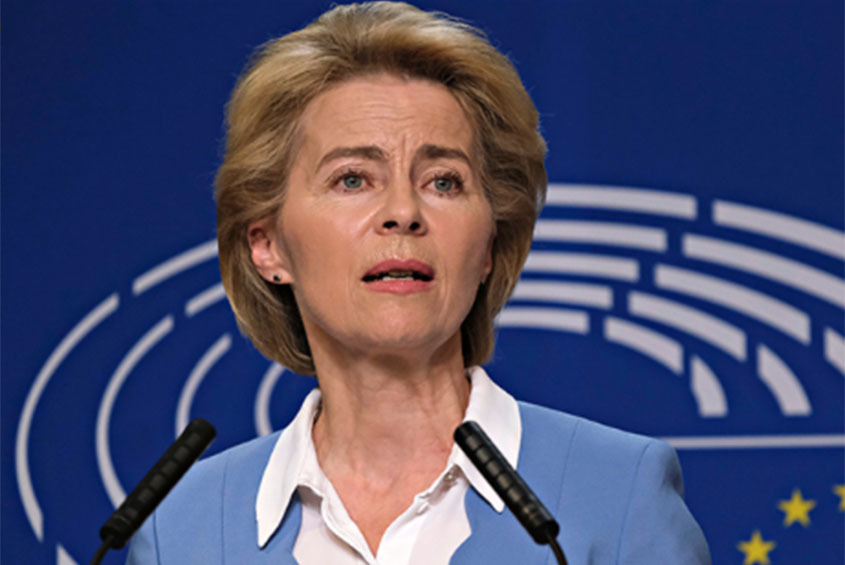
A transatlantic row over free speech, digital regulation and political power has erupted into something far more revealing: a demonstration of how decisively the United States can still act, and how feebly the European Union, under Ursula von der Leyen, now responds when its authority is challenged.
The immediate cause of the dispute was Washington’s decision to impose visa bans on five European figures accused of encouraging censorship of American speech. Among them is Thierry Breton, the former EU Commissioner for the Internal Market and the chief architect of the Digital Services Act (DSA), alongside four civil society activists from Britain and Germany. The U.S. State Department framed the move as a defence of free expression against what it called “extraterritorial censorship”.
The reaction in Europe was swift in tone, if not in substance. Emmanuel Macron denounced the decision as an act of intimidation, insisting that Europe’s digital rules were adopted democratically and could not be dictated by foreign powers. Brussels echoed the outrage, asserting that the DSA has no reach beyond EU borders and warning darkly that it would not tolerate interference in its regulatory sovereignty.
Yet behind the rhetorical indignation lies a more troubling reality. The United States acted — immediately, unambiguously, and with consequences. Europe complained — loudly, ceremonially, and without effect.
The Digital Services Act has long been a point of contention across the Atlantic. Designed to rein in the excesses of the largest technology platforms, it imposes obligations on content moderation, transparency and risk management. In Brussels, it is hailed as a landmark assertion of European values. In Washington, particularly among conservatives, it is increasingly portrayed as a bureaucratic weapon aimed at American companies and American speech.
That tension has simmered for years. What is new is the method Washington has chosen to address it. Rather than pursuing endless diplomatic exchanges or legal arguments, the U.S. administration opted for a blunt instrument: personal sanctions. By denying visas, it sent a message that regulatory decisions made in Brussels can carry personal costs — and that the United States is prepared to impose them.
Europe’s response has exposed just how poorly equipped the European Union now is to operate in such an environment.
President Macron and senior Commission figures spoke of principle, process and legality. The French foreign minister insisted that Europe would not allow others to “impose rules” on its digital space. A Commission spokesperson said Brussels might act “swiftly and decisively” if required.
It was precisely that phrase — “may act swiftly and decisively” — that captured the EU’s malaise. In geopolitical terms, it was not merely inadequate; it was faintly ridiculous. The United States had already acted swiftly and decisively. Europe, by contrast, was still contemplating whether it might do so at some undefined point in the future.
This is not a minor diplomatic misstep. It is the product of a deeper institutional decay.
The European Union has become weak not because it lacks market size, regulatory reach or intellectual capital, but because its executive arm no longer thinks in terms of power. The European Commission has evolved into an organisation dominated by lawyers, risk managers and career administrators — supremely comfortable drafting complex rules, and profoundly uncomfortable exercising authority in real time.
When confronted with a direct challenge, its instincts are paralysing: consult, reflect, coordinate, draft language, avoid escalation. These habits may suit internal governance. They are disastrous in an external confrontation with a state that understands leverage.
Washington understands leverage. It understands speed. It understands that in modern power politics, narrative control matters as much as formal authority. By the time Brussels finished expressing its “concern”, the United States had already framed the issue as a defence of free speech and a rebuke to European overreach.
This is what happens when an institution substitutes regulation for strategy. The Commission speaks endlessly of “digital sovereignty”, yet shows little evidence that it understands what sovereignty requires. Sovereignty is not a slogan; it is the ability to impose costs, to respond instantly, and to make others think twice before acting against you.
On all three counts, Brussels failed.
The EU’s defenders argue that restraint is a virtue, that escalation would be irresponsible, that diplomacy takes time. Perhaps. But there is a difference between restraint and irrelevance. The Commission’s response conveyed neither confidence nor control — only hesitation.
The consequences are predictable. Allies learn that Brussels cannot be relied upon to defend its own officials when pressure is applied. Adversaries learn that there is little price to pay for humiliating it. And Washington learns that Europe’s threats are safely ignorable.
Thierry Breton himself accused the United States of engaging in a modern-day McCarthyism, insisting that censorship was not where Washington claimed it to be. He is right on one point: the DSA was passed democratically, with the backing of elected governments and the European Parliament. But democratic legitimacy does not automatically translate into geopolitical credibility.
That credibility must be exercised. It must be defended. And it must, at times, be enforced.
Instead, the Commission reverted to its default posture: moral indignation without consequence. It lectured Washington on values while signalling, inadvertently, that it lacked both the unity and the nerve to respond in kind.
This episode will not seriously trouble the United States. It will, however, further entrench a perception that Europe talks like a power but behaves like a committee. A power that cannot act decisively in defence of its own authority is not a power at all.
If the European Commission cannot respond forcefully to visa bans imposed on its former commissioners, one shudders to imagine how it would fare against a genuinely hostile adversary. The language of strength remains. The rituals of sovereignty continue. But the substance — the willingness to act, to retaliate, to impose costs — has quietly drained away.
In the unforgiving world of modern geopolitics, that weakness is not just embarrassing. It is dangerous.
Click here for more News & Current Affairs at EU Today
Click here to check out EU TODAY’S SPORTS PAGE!
____________________________________________________________________________________________________________________________