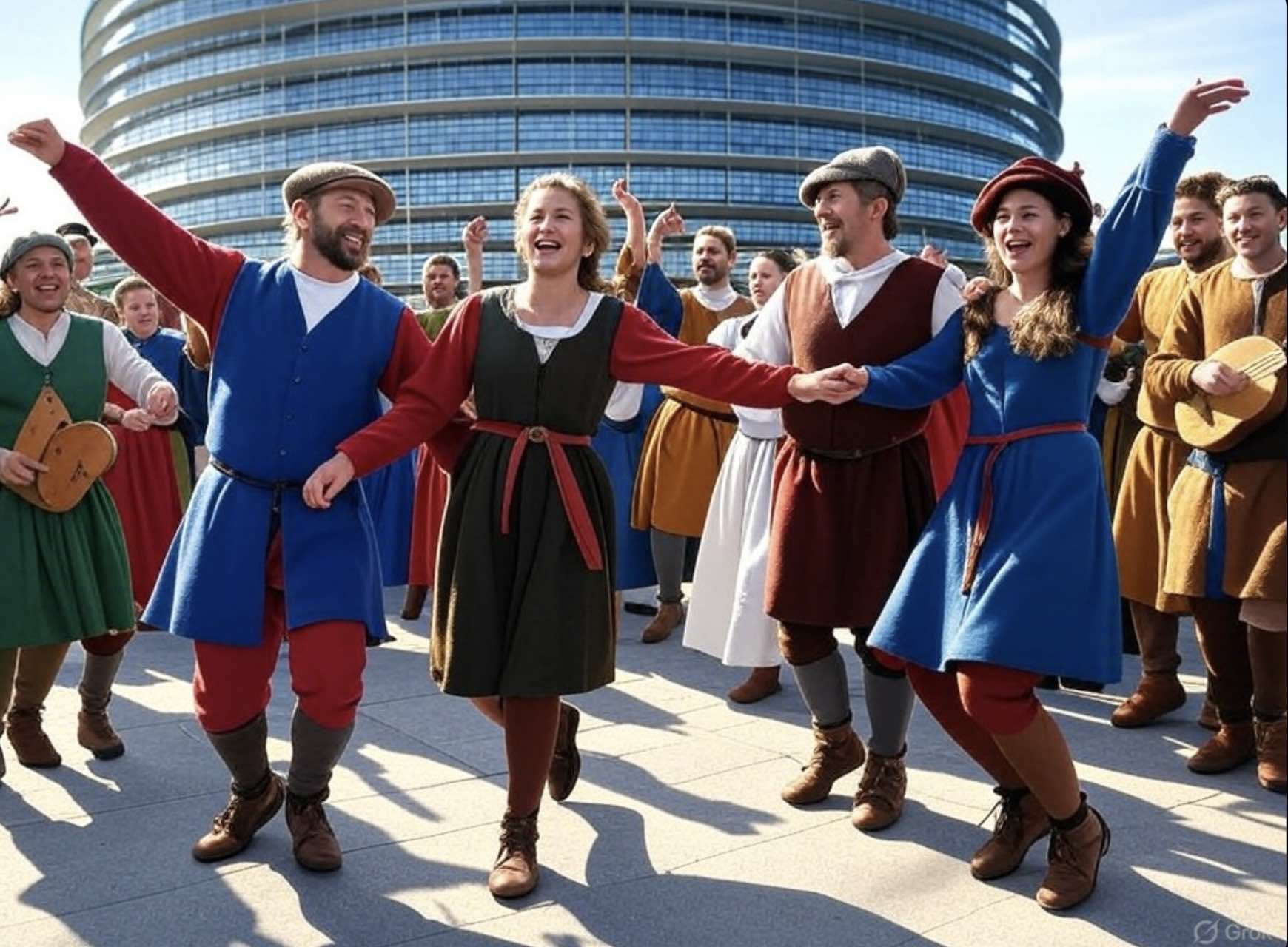
With the European Parliament sitting this week in Strasbourg, perhaps it’s worth turning our thoughts—not to legislation or acronyms—but to an event that once made this beautiful city the stage for one of history’s most bizarre and haunting mysteries: the Dancing Plague of 1518.
Over five hundred years ago, in July of that year, a woman known only as Frau Troffea stepped into a narrow street in Strasbourg (then a part of the Holy Roman Empire) and began to dance. There was no music. No celebration. No explanation. But she danced. And danced. And danced.
Within days, dozens of others had joined her—men, women, even children—caught in what appeared to be an unstoppable compulsion to move. They twitched, leapt, spun, and flailed, reportedly for days on end. By the end of the summer, contemporary reports claimed that as many as 400 people had joined this macabre procession. Several are said to have died of exhaustion, heart failure, or stroke. The authorities, baffled and panicked, at one point even hired musicians to accompany the dancers—on the theory that, perhaps, the music might help bring the episode to a harmonious conclusion. It didn’t.
That it happened is not really in doubt. The Strasbourg city archives and several 16th-century chroniclers document the event in detail. What has remained elusive—century after century—is the “why.”
Some historians have speculated that the dancers were suffering from ergotism, a form of poisoning caused by eating rye bread contaminated with Claviceps purpurea, a fungus that can induce hallucinations and convulsions. This theory links the Strasbourg outbreak to the same fungus that would later form the scientific basis for LSD. It’s plausible—except for the sheer scale and coordination of the movements. Hallucinogenic poisoning tends to be chaotic and disabling, not rhythmically synchronized across hundreds of people.
Others point to mass hysteria, or what’s more academically termed a “mass psychogenic illness.” Strasbourg in 1518 was a city gripped by suffering. A series of famines, plagues, and the ever-looming threat of divine punishment had left its citizens spiritually and physically depleted. In such fertile ground, a collective breakdown—one expressed through the cultural idiom of dance—could well have taken root. After all, similar dancing outbreaks were recorded elsewhere in medieval Europe, albeit none quite as extensive or as fatal.
Still others suggest more esoteric causes: demonic possession, religious ecstasy, or even a form of protest or penitence gone wrong. Some theologians of the era believed the dancers were heretics or sinners under divine punishment. Others saw them as martyrs. But none could stop the dancing. It simply fizzled out in September, almost as inexplicably as it had begun.
Today, as Members of the European Parliament file in and out of Strasbourg’s sleek, modern glass buildings, they might spare a thought for the spectral echoes of those frantic dancers on the cobbled streets outside. What might an MEP from Bavaria or Brittany make of it? Perhaps a lesson in how shared delusions—or shared despair—can drive communities to unthinkable acts. Perhaps a warning about the dangers of ignoring mental health, poverty, or spiritual need until they quite literally spill into the street.
Or perhaps they’d just see a metaphor.
Because the truth is, the Dancing Plague has never really stopped beguiling us. It’s been cited in books, operas, and psychological case studies. Pop culture occasionally nods to it—as a curio, a freak event, or a cautionary tale. And in our own age, it resonates in strange ways. In the age of TikTok trends, crowd psychosis, and internet “challenges” gone wrong, one wonders whether Strasbourg’s 16th-century outbreak was not so much an anomaly as an early glimpse of a recurring pattern in human behaviour. A collective lurch into madness, driven by fear, fatigue, or perhaps a desperate need to connect.
In some ways, the dancers of 1518 were ahead of their time. They reminded the world, long before neurology or psychiatry emerged, that bodies and minds are not easily separated. That trauma can take physical form. That society, when pushed to the brink, does not always break quietly.
In our more secular, rational age, the temptation is to dismiss such events as mere footnotes. Oddities. But the Dancing Plague deserves better than that. It was—and remains—a mirror held up to European civilisation, reflecting our long-standing tension between order and chaos, faith and fear, reason and mystery.
Strasbourg today is a city of suits and microphones, of policy debates and procedural votes. But just beyond the parliamentary chamber, beneath the arches and spires of the old city, the memory of 1518 lingers. It invites us to consider what happens when a community is overwhelmed by forces it cannot explain—and how, even centuries later, we are still dancing around the answers.