
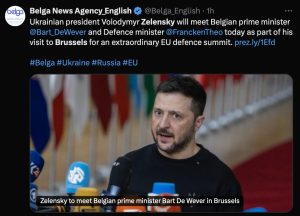
Ukrainian President Volodymyr Zelenskyy is set to join European Union leaders in Brussels today for a pivotal summit aimed at bolstering the continent’s defence industry, enhancing military capability, and securing urgent support for Ukraine.
The €800 billion (£660 billion) initiative under discussion marks one of the most ambitious attempts yet to reinforce Europe’s defence infrastructure in response to the ongoing war in Ukraine and the broader threat posed by Russian aggression.
French President Emmanuel Macron, in a striking television address on Wednesday evening, issued a stark warning that Moscow’s ambitions would not stop at Ukraine. He described Russia’s actions as a direct threat to both France and Europe.
Macron used the opportunity to signal a significant shift in strategic thinking, declaring his intention to open discussions on the role of France’s nuclear deterrent in protecting European allies. However, he was careful to reiterate that any decision regarding France’s nuclear arsenal would remain exclusively within the purview of the French presidency.
“I want to believe the US will stay by our side. But we have to be ready if that isn’t the case,” Macron said. “Europe’s future should not be decided in Washington or Moscow, and yes, the threat from the east is returning. The innocence of these 30 years since the fall of the Berlin Wall is over.”
Macron’s remarks come amid a renewed European debate on security, spurred in part by recent comments from Friedrich Merz, leader of Germany’s victorious CDU party in last year’s elections. Although not yet Chancellor, Merz has pushed for closer European cooperation on nuclear deterrence, raising the idea of “nuclear sharing” with France.
He will also be present in Brussels today for informal discussions with EU leaders, underscoring his commitment to an assertive defence policy. His ambitious “bazooka” plan for German defence and infrastructure signals a readiness to overhaul Berlin’s approach to military spending and security.
Zelenskyy, responding to Macron’s declaration, expressed gratitude for France’s continued support. “Peace must be real, not just a word – it cannot mean Ukraine’s capitulation or collapse,” he said. “It must be just, reliable, and lasting, and this can only be achieved through strong and long-term security guarantees – for Ukraine, Europe, and the entire world.”
The summit takes place against the backdrop of Poland’s ongoing military assistance to Ukraine. In a joint press conference with his Ukrainian counterpart Rustem Umerov, Polish Defence Minister Władysław Kosiniak-Kamysz reaffirmed Warsaw’s commitment to logistical and military support. The latest aid package, worth up to €200 million, is Poland’s 46th such delivery to Ukraine since the war began.
Kosiniak-Kamysz emphasised the crucial role of the logistics hub in Rzeszów-Jasionka, which continues to facilitate military assistance and training. Nearly 28,000 Ukrainian soldiers have received training in Poland so far.
“We continue to support Ukraine as we have from the first day of the war. It is incredibly important for us,” he stated.
The Polish minister also pointed to the resumption of dialogue between Ukraine and the United States as a positive step towards securing a lasting and just peace. “Poland remains a strong supporter of both transatlantic relations and increasing European defence capabilities,” he added.
The Brussels summit is expected to yield crucial agreements on increasing European defence production and improving the bloc’s military readiness. Discussions will also focus on expanding long-term security commitments to Ukraine, with leaders seeking to ensure that support remains steadfast in the face of potential geopolitical shifts, particularly concerning the future stance of the United States.
As European leaders gather to navigate this complex geopolitical landscape, the discussions in Brussels will be closely watched not only for their immediate outcomes but also for the long-term security architecture they seek to build. With the war in Ukraine still raging and Russian threats looming, the decisions made at this summit could shape the continent’s defence strategy for decades to come.



