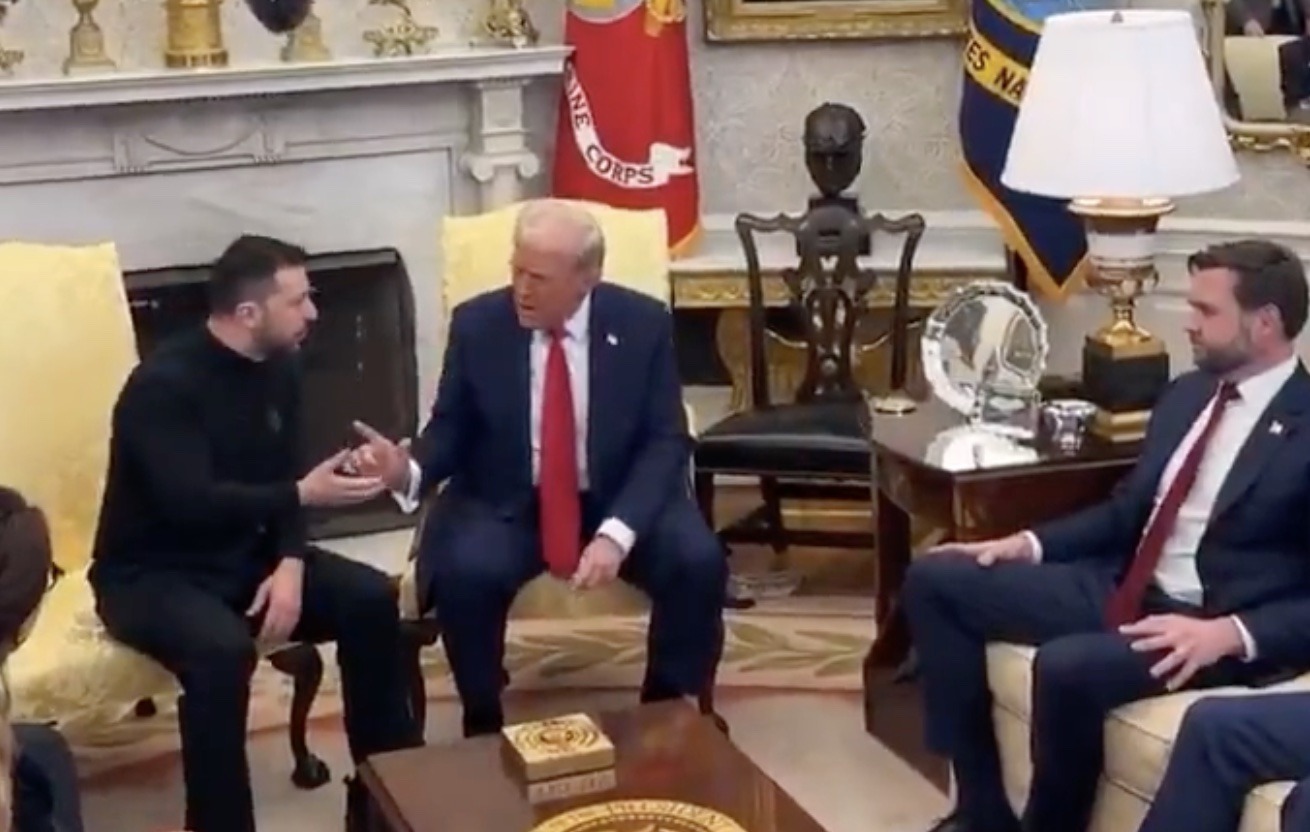
President Donald Trump has frequently made statements about Ukraine and NATO that somewhat contradict established facts. These statements, despite being publicly refuted multiple times, continue to shape his narrative on foreign policy.
This article critically examines some of his most recent claims, providing factual counterpoints to his misleading or false assertions.
False Claim: The U.S. Provides More Aid to Ukraine Than Other Countries
Trump has repeatedly claimed that Ukraine’s international allies have provided “much less” aid than the United States.
However, this is demonstrably false. In reality, non-American allies have delivered about 60 percent of all aid sent to Ukraine, while the U.S. has contributed approximately 40 percent. French President Emmanuel Macron directly refuted Trump’s claim during a public exchange on February 25th, reiterating that European nations have played a substantial role in supporting Ukraine.
Misleading Assertion: Security Guarantees for Ukraine Are a Minor Issue
Trump has stated that providing security guarantees to Ukraine is an “easy” issue, accounting for only “two percent of the problem.” This claim is misleading at best. Security guarantees for Ukraine are, in fact, one of the most significant obstacles to both a ceasefire and a long-term peace agreement.
Russia has explicitly stated that any security guarantees for Ukraine, particularly those involving NATO troops stationed in Ukraine, would be a deal-breaker for negotiations. Meanwhile, European leaders, including those from France, the U.K., and Italy, have expressed that security guarantees must include U.S. participation. Furthermore, Ukrainian President Volodymyr Zelensky has made it clear that Ukraine would only agree to a ceasefire if iron-clad security guarantees were in place to prevent a repeat Russian invasion.
Distorted Perspective: NATO’s Contribution to Collective Defence
Trump frequently claims that NATO members are not contributing sufficiently to collective defence and that the U.S. is disproportionately committed to the alliance. He has argued that NATO countries should “equalise” their contributions.
While it is true that the U.S. defence budget is significantly larger than those of other NATO nations—standing at $860 billion —this does not mean the U.S. spends most of its military resources on European defence.
The U.S. is a global power with commitments around the world, and only a fraction of its defence budget is dedicated to NATO operations in Europe. Moreover, the actual U.S. troop presence in Europe is minimal, consisting of just three combat brigades out of a total force of 81-82 brigades.
Odious Falsehood: Vance’s Propaganda Claim
J.D. Vance, a prominent Trump supporter, recently made a deeply troubling statement regarding Ukraine. In response to an invitation from President Zelensky to visit Ukraine and witness the situation firsthand, Vance dismissed the idea as “propaganda.”
This assertion is both false and offensive. Foreign dignitaries visiting Ukraine are routinely given access to survivors of Russian war crimes and are taken to sites of massacres, such as Irpin and Bucha. Russian forces committed documented atrocities in these areas, murdering hundreds of Ukrainian civilians. Calling these visits “propaganda” is an attempt to deny and downplay war crimes, a stance that should be condemned by the U.S. Congress and the international community.
Trump’s Dangerous Warning to Zelensky
During a recent interaction, Trump issued a warning to Zelensky, suggesting that Ukraine should be grateful to the U.S. and should allow the U.S. to engineer a ceasefire deal. He implied that failing to comply would result in Ukraine’s destruction:
“You’re right now not in a very good position. You’ve allowed yourself to be in a very bad position. He [Vance] happens to be right about that. You’re not in a good position. You don’t have the cards right now. With us you start having cards. Right now…you’re playing cards. You’re playing cards. You’re gambling with the lives of millions of people. You’re gambling with World War Three! You’re gambling with World War Three! And what you’re doing is very disrespectful. Disrespectful! To the country. This country. That’s backed you. Far more than a lot of people said.”
This statement is problematic for several reasons. First, Zelensky has consistently expressed gratitude to the U.S. and its allies for their support. He has done so publicly on numerous occasions, including at the start of the very press conference where Trump and Vance made these “misleading” remarks.
Second, Trump’s characterisation of Ukraine’s geopolitical position fails to acknowledge that, since February 2022, Ukraine’s strategic standing has improved significantly due to closer ties with NATO and European nations. The U.S.’s wavering stance under Trump has, in fact, pushed European powers to increase their commitments to Ukraine’s defence.
Exaggeration: The $350 Billion Aid Claim
Trump has claimed that the U.S. has provided Ukraine with $350 billion in aid. This figure is significantly exaggerated. The actual amount of aid provided by the U.S. to Ukraine stands at around $110-120 billion, including military, humanitarian, and financial assistance. By inflating the figure, Trump seeks to portray the U.S. as disproportionately burdened by Ukraine’s defence, ignoring the substantial contributions made by European allies.
Unfounded Claim: U.S. Aid as the Decisive Factor in the War’s Early Days
Trump has also claimed that had the U.S. not provided military aid, Ukraine would have collapsed within two weeks of Russia’s invasion. This assertion echoes early Russian propaganda, which predicted a swift victory over Ukraine regardless of Western support.
While it is impossible to definitively prove or disprove such a hypothetical scenario, most military analysts agree that Ukraine’s resilience in the initial weeks of the war was primarily due to its population’s strong will to resist, and to the leadership of Zelensky.
The country’s well-organised defence, aided by pre-2022 Western military assistance, played a crucial role in stopping Russia’s advance. The first two weeks of the war were defined more by Ukrainian tenacity and strategic defence than by American intervention.
Trump’s repeated falsehoods about Ukraine and NATO serve a clear political agenda: to undermine support for Ukraine, shift blame onto European allies, and present himself as a dealmaker who can resolve international conflicts effortlessly.
However, the facts tell a different story. European allies have contributed more to Ukraine’s defence than the U.S., security guarantees are a major hurdle to peace, and NATO is not as disproportionately reliant on the U.S. as Trump claims.
Moreover, dismissing war crimes evidence as “propaganda” and issuing thinly veiled threats to Ukraine’s leadership undermine global efforts to hold Russia accountable and achieve a just resolution to the conflict. As Trump continues to push his narrative, it is essential to challenge misinformation with verified facts and ensure that U.S. foreign policy remains grounded in reality, not political posturing.