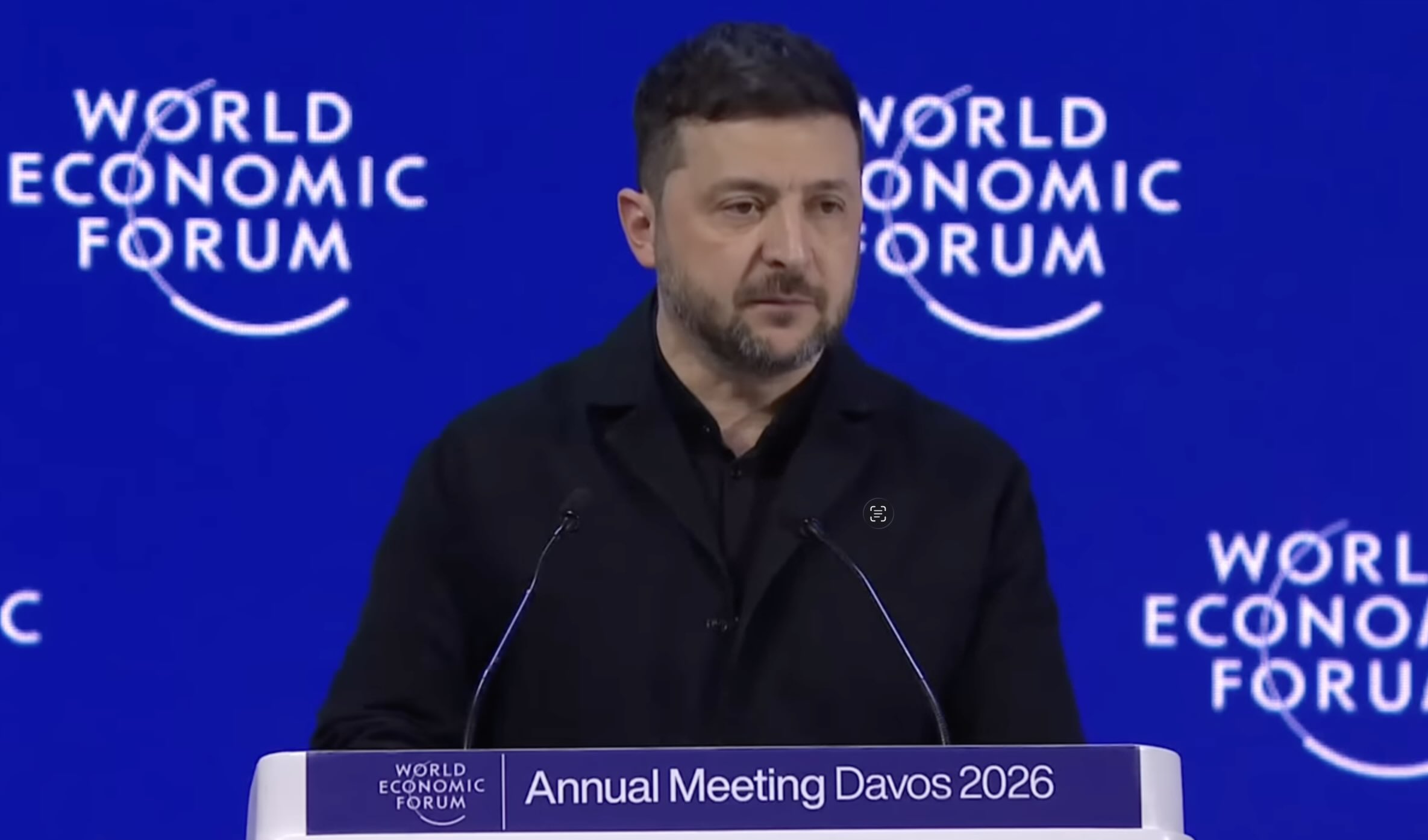
Volodymyr Zelenskyy used his Davos address on 22 January to argue that Europe’s approach to security is weakening the rules-based international order and raising the eventual cost of deterring aggression.
Speaking at the World Economic Forum’s annual meeting in Switzerland, the Ukrainian president framed his remarks as a repeat performance, opening with a reference to the film Groundhog Day and saying that, a year after he told Davos “Europe needs to know how to defend itself”, he was still delivering the same warning.
His central charge was that European politics has become conditioned to delay. Zelenskyy cited a series of crises to illustrate what he described as a pattern: European leaders debate positions while events move on, leaving Europe reacting to faits accomplis shaped by others. In the speech, he referred to Europe’s attention being drawn to the recent row over Greenland, and portrayed this as another example of a continent waiting to see what Washington decides before settling its own stance.
Zelenskyy linked this hesitation to the erosion of what European officials routinely call the rules-based order: accountability, credible enforcement and deterrence. He argued that when authoritarian regimes face limited consequences, the lesson absorbed by “bullies” is that violence can secure survival. In that context, he contrasted the treatment of Venezuela’s Nicolás Maduro with Vladimir Putin, saying that Maduro had been arrested and was facing trial in New York while Putin remained free despite launching the largest war in Europe since the Second World War.
From there, he moved to the legal architecture around the war. Zelenskyy said there had been no meaningful progress on establishing a special tribunal to prosecute the crime of aggression, and suggested that “something else is always more urgent than justice” in European decision-making. His remarks cut against the fact that Ukraine and the Council of Europe signed an agreement in July 2025 on creating a Special Tribunal for the Crime of Aggression, but the speech’s point was operational: he argued that Europe had yet to produce the institutional, staffing and political momentum that would make such a mechanism unavoidable for Moscow.
He also treated the sanctions regime as a test of seriousness, pointing to Russian oil exports and what European governments describe as Russia’s “shadow fleet” of vessels used to evade restrictions. Zelenskyy asked why the United States could seize tankers while European states, with Russian oil moving near European shores, did not take comparable action. His argument was that inaction carries a measurable price: continued revenue for Russia’s war effort, continued leverage for Moscow, and continued exposure for Europe to coercion funded from that trade.
On frozen Russian assets, Zelenskyy acknowledged the EU decision to keep Russian central bank funds immobilised, but suggested Europe had faltered when faced with the step of using those resources more directly for defence against Russian aggression. The question, he said, was whether Europe was prepared to turn immobilisation into strategic leverage. (EU policy debates over the assets have been shaped by legal and financial concerns in member states where large volumes are held.)
A second theme was capability. Zelenskyy argued for “united armed forces” for Europe and questioned the assumption that NATO’s Article 5 would automatically translate into US action in a crisis. He said that European leaders were already contemplating the risk that Washington might not respond as expected, and he presented Europe’s reliance on US pressure to raise defence spending as evidence of structural dependency. In the same vein, he described Europe as “beautiful but fragmented”, suggesting that internal rivalries and taboos constrain policy options, including on weapons and enforcement.
Zelenskyy tied these points back to the international order in explicitly practical terms:
“world order comes from action”, Zelenskyy said, and “you can’t build the new world order out of words”.
The cost of inaction, in his framing, is not only paid in Ukraine but accumulates as precedent: delayed justice, porous sanctions and hesitant deterrence invite replication elsewhere.
The speech came after Zelenskyy met US President Donald Trump in Davos, which both sides described in positive terms. Zelenskyy said documents aimed at ending the war were “nearly ready” and that technical-level talks involving Ukraine, Russia and the United States were expected in the United Arab Emirates over the coming days.