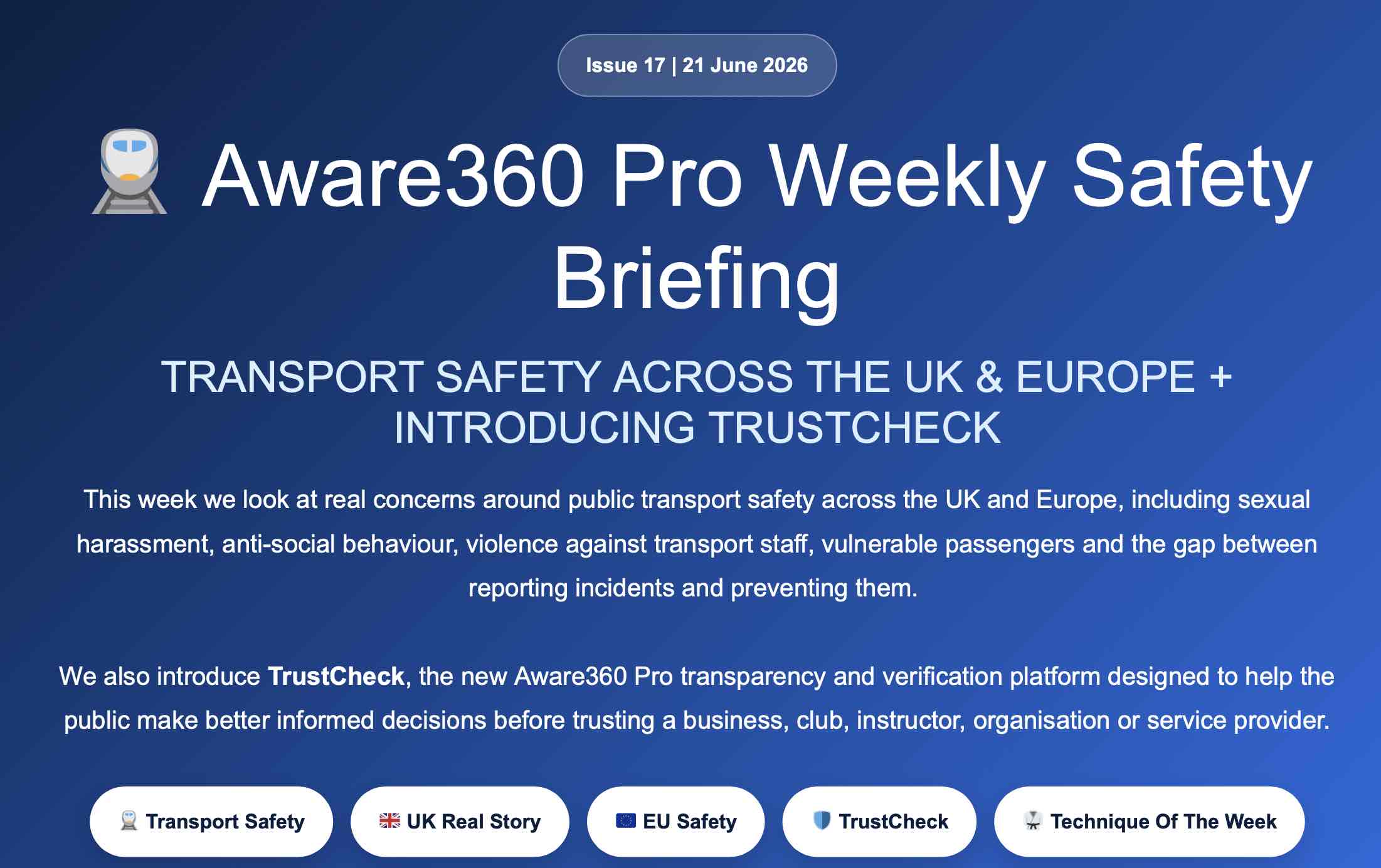
The newsletter’s ambition is larger than its modest format suggests. In just two pages, Aware360 Pro Weekly Safety Briefing attempts to connect three themes that increasingly occupy policymakers, businesses and the public alike: personal safety, transport security and consumer trust.
The result is a publication that sits somewhere between a public-awareness campaign, a training bulletin and a policy discussion paper.
Issue 17, published on 21st June 2026, focuses on safety across the UK and Europe while introducing TrustCheck, a proposed transparency and verification platform designed to help consumers assess organisations before engaging with them. The publication also continues its regular emphasis on practical self-defence and situational awareness training.
What is most striking is the publication’s insistence that safety should be viewed not merely as a reactive function of policing or regulation, but as a proactive exercise in awareness and decision-making. This argument runs throughout the newsletter. Whether discussing harassment on public transport, the challenges faced by frontline transport staff or the prevalence of misleading online reviews, the editors repeatedly return to a central proposition: prevention begins long before an incident occurs.
The transport safety section is particularly timely. Public transport networks across Europe remain under pressure from a range of social and security challenges, many of which are difficult to quantify through conventional crime statistics alone. The newsletter highlights concerns ranging from sexual harassment and anti-social behaviour to violence against transport workers and the targeting of vulnerable passengers. These are hardly new issues, but the publication succeeds in presenting them in a manner that is accessible to a general audience while retaining a degree of policy relevance.
The discussion of recent sexual harassment cases on London’s rail network is handled carefully. Rather than dwelling on sensational details, the article focuses on behavioural lessons and reporting mechanisms. The observation that busy public spaces are not necessarily safe spaces is a simple but important reminder. Equally noteworthy is the emphasis placed on the role of bystanders, many of whom may recognise inappropriate behaviour yet remain uncertain about how best to respond.
Where the publication becomes more interesting is in its critique of existing public policy. The editors acknowledge government initiatives such as Transport Safety Officer pilots and campaigns encouraging incident reporting. However, they argue that official efforts remain weighted towards response rather than prevention. Their contention is that members of the public are frequently told how to report incidents but receive comparatively little guidance on recognising warning signs before situations escalate. It is a persuasive argument and one that echoes broader debates in public safety policy, where prevention often receives less attention than enforcement.
The European dimension broadens the discussion effectively. Rather than focusing exclusively on crime, the newsletter highlights the wider ecosystem of transport safety, including passenger rights, infrastructure resilience and cross-border coordination. This reflects a more mature understanding of what constitutes security in modern transport systems. The inclusion of cyber resilience and accessibility issues demonstrates awareness that safety is increasingly multidimensional.
The publication’s proposed transport safety simulator is perhaps its most innovative idea. The concept of allowing users to explore realistic scenarios before encountering them in real life aligns with contemporary thinking around behavioural learning and risk management. Whether such tools can be delivered effectively remains to be seen, but the principle is sound. Simulation-based learning has become commonplace in sectors ranging from aviation to healthcare, and there is no obvious reason why personal safety education should not benefit from similar approaches.
The second half of the newsletter shifts focus to TrustCheck, a proposed verification framework intended to help consumers assess businesses, clubs, instructors and service providers. Here the publication touches upon a growing challenge in the digital economy: the difficulty of establishing trust online. Consumers increasingly rely on reviews, social media profiles and marketing materials when making decisions, yet these indicators are often imperfect proxies for credibility.
The newsletter’s use of recent Competition and Markets Authority investigations into alleged fake review practices provides useful context. The editors argue that while reviews remain valuable, they rarely answer fundamental questions regarding qualifications, insurance, safeguarding procedures or ownership structures. The proposed Bronze, Silver and Gold verification tiers are designed to address precisely this gap.
There is an appealing practicality to the TrustCheck concept. Rather than attempting to rank organisations, it seeks to verify information that consumers may regard as important. In theory, such an approach could encourage higher standards of transparency without creating a simplistic ratings culture. Whether businesses would embrace the additional scrutiny is another question, but the proposal reflects genuine concern about information asymmetry in consumer markets.
Not everything is fully developed. Some sections feel more promotional than analytical, particularly where future platform features are described. Readers may also wish to see more empirical evidence supporting certain claims about training effectiveness and public awareness outcomes. Yet these limitations are understandable in what is fundamentally a newsletter rather than an academic publication.
The self-defence content, meanwhile, remains consistent with the publication’s broader philosophy. The featured techniques emphasise escape, distance and risk reduction rather than confrontation. The repeated message that personal safety is the priority, not victory in a physical encounter, is both responsible and welcome.
Overall, Issue 17 succeeds because it recognises an increasingly important reality: trust and safety are converging. Whether travelling on a train, selecting a service provider or navigating an unfamiliar environment, individuals are constantly making risk assessments based on incomplete information. Aware360 Pro’s contribution is not to provide definitive answers but to encourage better questions.
In an age characterised by information overload, manipulated reviews and rising concerns about personal security, that may be a more valuable objective than it first appears.
Download the full report here: Aware360 Pro
___________________________________________________________________________________________________________________
Click here for more News & Current Affairs at EU Today
Click here to check out EU TODAY’S SPORTS PAGE!
___________________________________________________________________________________________________________________