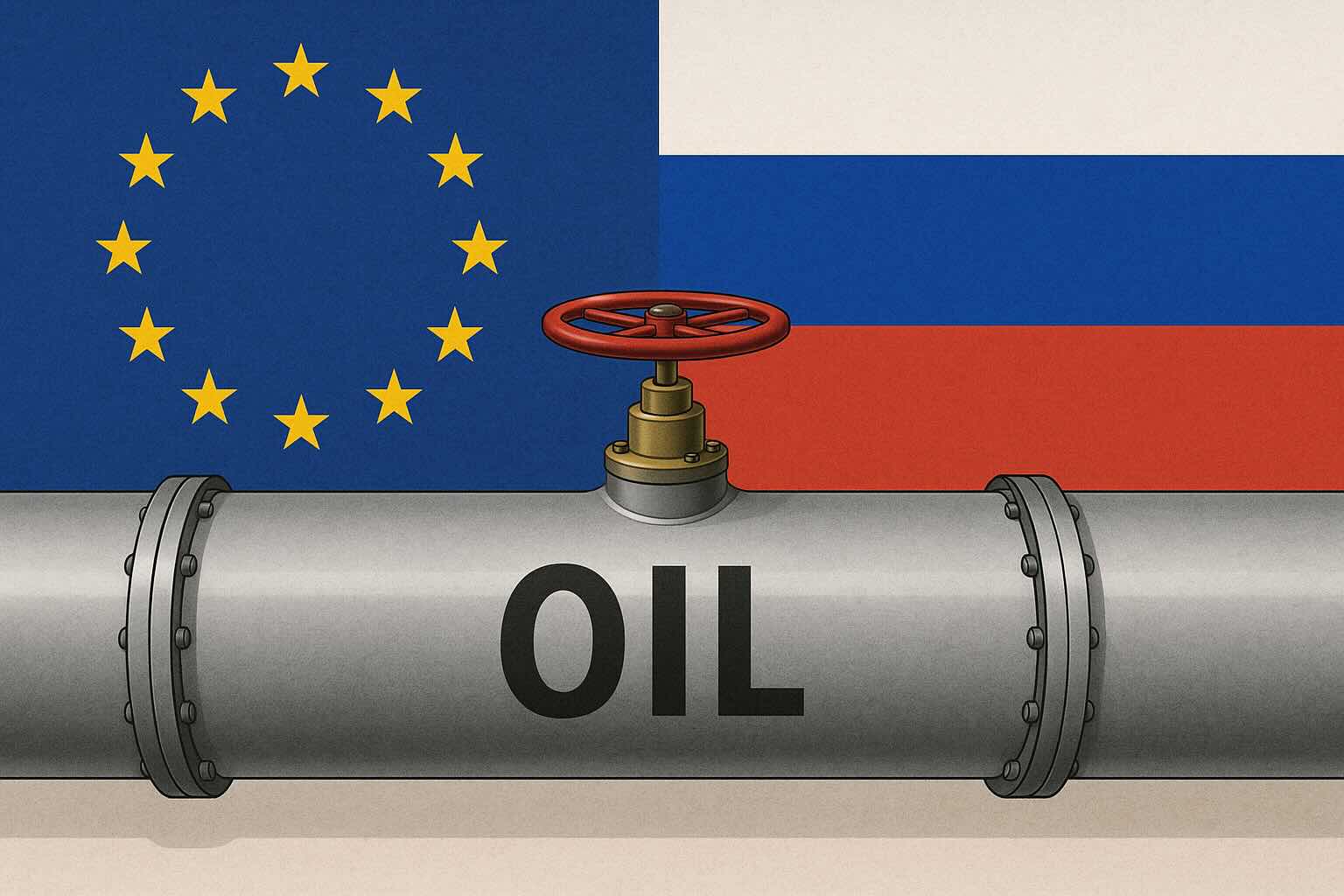
The European Commission has postponed a legal proposal to lock in a permanent ban on Russian oil imports, as the war involving Iran and the disruption of Gulf shipping push energy security back to the centre of EU policy.
The European Commission has delayed a proposal that would permanently ban Russian oil imports into the European Union, as the war involving Iran and the disruption of global oil flows force Brussels to reassess the timing of one of its remaining energy separation measures against Moscow. The draft law, previously expected on 15 April, has been pushed back, although the Commission still intends to bring forward the measure.
The proposal is intended to turn a political commitment into law. According to the Commission’s REPowerEU material, Brussels plans legislation to ban Russian oil imports “as soon as possible, but not later than 2027”. A separate Commission overview states that the EU aims to stop Russian oil imports by the end of 2027, as part of the wider phase-out of Russian fossil fuels.
In immediate commercial terms, the proposed measure would have only limited impact. By the final quarter of 2025, Russian oil accounted for roughly 1% of the EU’s remaining imports, reflecting the extent to which earlier sanctions had already curtailed seaborne crude purchases and reduced overall dependence. In February, Energy Commissioner Dan Jørgensen said the phase-out of the remaining volumes would be completed no later than the end of 2027.
That does not make the proposal unimportant. Its purpose is strategic and legal. A permanent ban would make it harder for Russian oil to return to the EU market in any future political scenario, including one in which sanctions were partially eased as part of a settlement related to the war in Ukraine. In that sense, the legislation is less about current volumes than about preventing any later reversal of Europe’s energy realignment.
The delay comes at a difficult moment for Europe’s energy position. The war in the Middle East has driven up oil prices, heightened concern over shipping through the Strait of Hormuz and fed wider economic anxiety across the euro area. Oil prices have risen sharply since the start of the year. The resulting increase in energy costs is contributing to inflation, supply disruption and near-stagnation in the euro zone economy.
The broader political context is also clear. EU leaders have called for the reopening of the Strait of Hormuz and an end to strikes on energy and water infrastructure, reflecting concern that the conflict is no longer only a foreign-policy issue but an economic one. The surge in oil and gas prices have already pushed EU leaders into discussions on how to contain the fallout for households and industry.
Against that backdrop, the Commission appears to have concluded that pressing ahead immediately with a permanent oil ban law would add political friction without delivering a near-term energy benefit. That calculation is particularly sensitive because two member states, Hungary and Slovakia, remain the principal recipients of the last significant Russian oil flows into the EU system. Hungary has been openly opposed to the proposed ban.
The oil issue also intersects with wider tensions over Ukraine. Reporting in March showed that disputes around the Druzhba pipeline and the delivery of Russian oil to Hungary and Slovakia had fed into broader rows inside the EU, including Hungary’s obstruction of financial support for Kyiv. That gives the delayed proposal an added political dimension: it is not only about energy policy, but also about one of the remaining channels through which intra-EU divisions over Russia and Ukraine continue to surface.
For Brussels, the underlying direction has not changed. The EU has already fixed into law the phase-out of Russian gas by late 2027, with the Commission presenting that step in February as a move towards permanent energy independence from Russia. The oil legislation remains part of the same architecture. What has changed is the external environment in which the final measure must be introduced.
The delay therefore should not be read as an abandonment of the policy. It is better understood as a sign of how rapidly the EU’s energy strategy can be affected by events beyond Europe’s eastern frontier. Three years ago the immediate pressure came from Russia’s invasion of Ukraine. In March 2026, the pressure point is broader: the interaction between the Ukraine war, the Gulf conflict, shipping security and the EU’s own weak growth outlook. Brussels still wants a legal end-point for Russian oil. It is simply choosing its moment more carefully.