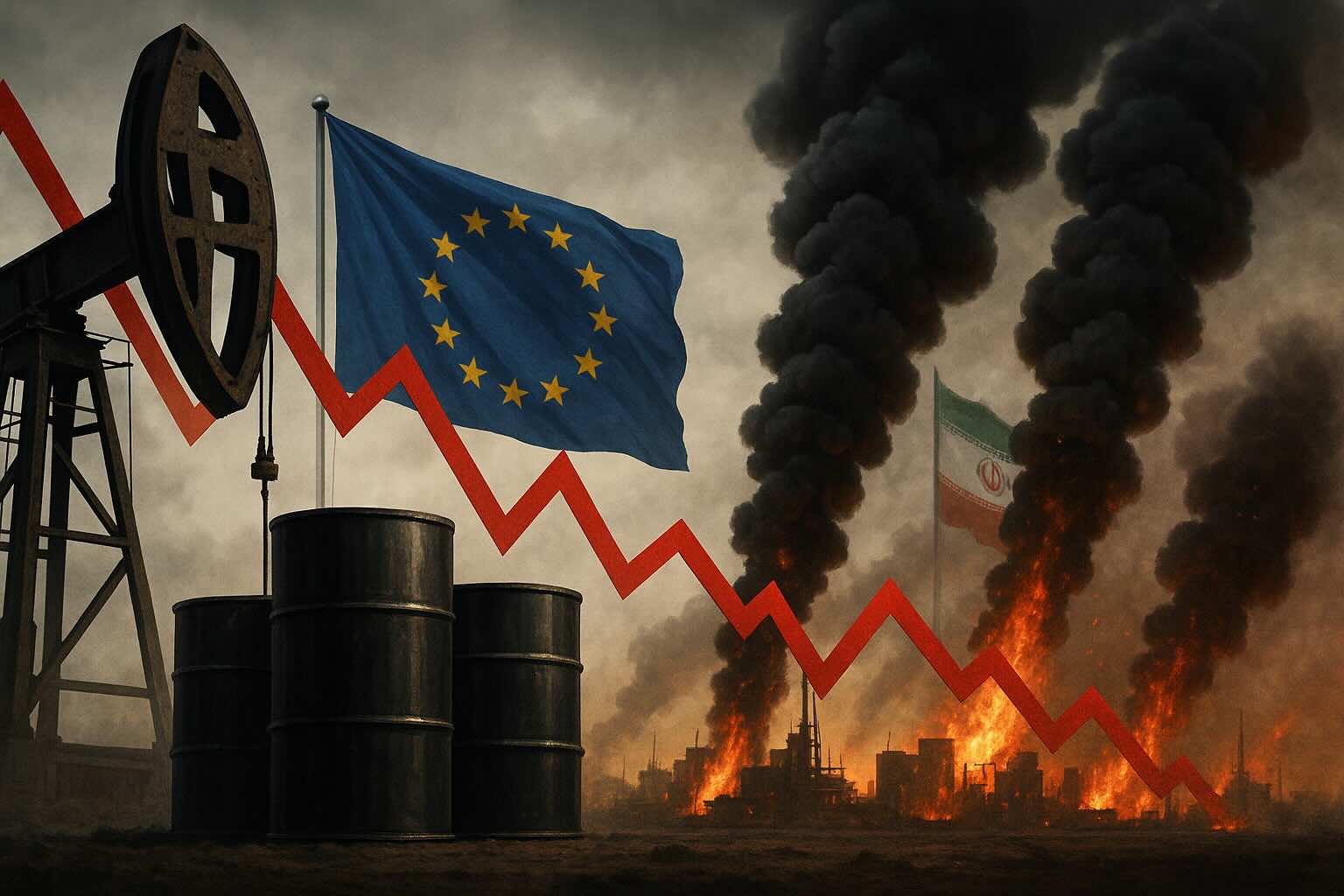
The European Union has postponed its proposal to reduce the price cap on Russian oil exports, citing growing instability in the Middle East and associated risks of global price surges.
The decision comes amid heightened military confrontation between Israel and Iran, which has caused sharp fluctuations in global oil prices in recent days.
According to diplomatic sources cited by Politico EU foreign ministers had been expected to discuss a proposed reduction of the existing cap from $60 to $45 per barrel. However, the escalation of hostilities in the Middle East has rendered the measure politically and economically unfeasible at this time.
“The idea of lowering the cap is unlikely to proceed given the international situation and current market instability,” one EU diplomat stated. “At the G7 summit this week, all member countries agreed that this is not the moment for such a move. Prices had been close to the cap, but recent volatility has made the market too unpredictable.”
The European Commission had reportedly been considering the change as part of ongoing efforts to tighten enforcement of sanctions on Russian energy exports, which continue to generate significant revenue for the Kremlin’s war effort in Ukraine. However, officials have concluded that immediate action could inadvertently lead to a spike in global oil prices, undermining both the European economy and broader international energy security.
At the G7 leaders’ meeting in Canada earlier this week, European Commission President Ursula von der Leyen acknowledged that while the $60 cap had produced “limited impact”, it still served a stabilising function amid renewed oil price volatility. “In recent days we have observed an increase in the price of oil, and the current cap continues to play its role,” she said. “There is therefore no strong pressure to adjust it at present.”
Oil prices have surged since Israel and Iran began exchanging direct strikes earlier this month – a development that has injected new uncertainty into global markets already strained by the war in Ukraine, sanctions regimes, and shifting production levels among OPEC+ members. Analysts warn that any tightening of sanctions on Russian oil must take into account broader geopolitical developments, particularly those that affect supply from the wider Middle East.
The EU’s price cap on Russian oil was introduced in December 2022 as part of a coordinated measure by the G7, the EU, and Australia. The mechanism allows Russian oil to be transported using Western shipping and insurance services only if it is sold at or below a specified threshold. The aim is to limit Moscow’s oil revenues while maintaining a stable global supply.
Despite the policy, Ukraine has repeatedly called for a more stringent cap. Kyiv has argued that the $60 level is outdated and insufficient to curtail Russia’s war financing, with President Volodymyr Zelenskyy’s administration urging a reduction to $30 per barrel. Ukrainian officials maintain that tighter restrictions would significantly weaken Russia’s ability to sustain its military operations.
Washington has also signalled support for measures aimed at lowering global oil prices. US President Donald Trump has previously stated that reducing international oil prices would be a key tool in forcing an end to Russia’s full-scale invasion of Ukraine. However, no formal proposals for a revised price cap have been adopted by the G7.
While discussions around the oil price cap are ongoing, EU officials are also monitoring the implementation of existing sanctions and potential circumvention via third countries. A recent focus has been placed on strengthening enforcement and improving coordination with global partners, rather than introducing new levels of restriction.
Read also:
Kremlin Decries Talk of Regime Change in Iran Amid Escalating Middle East Tensions