
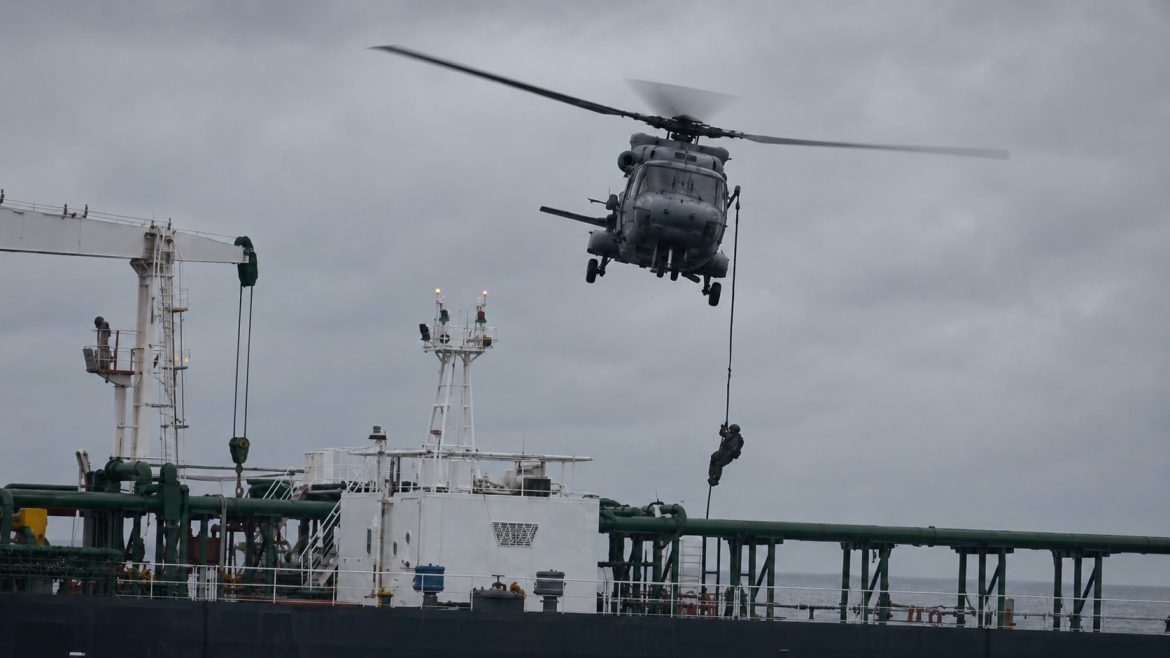
France has intercepted a sanctioned Russian-linked oil tanker in the Atlantic Ocean, in one of the latest European operations aimed at disrupting Moscow’s use of opaque maritime networks to sustain oil revenues during the war against Ukraine.
President Emmanuel Macron said the French Navy boarded the tanker Tagor on 31 May in international waters, more than 400 nautical miles west of Brittany. The vessel had reportedly sailed from the Russian port of Murmansk and was suspected of operating under a false flag while being subject to international sanctions. According to Reuters, the operation was conducted with support from Britain and other partners.
Macron said the interception was carried out in strict compliance with maritime law. In a statement on X, he said it was unacceptable for vessels to circumvent international sanctions, violate the law of the sea and contribute to the financing of Russia’s war against Ukraine. He also warned that ships operating outside normal regulatory standards posed risks to maritime safety and the environment.
La Marine nationale a arraisonné hier matin un nouveau pétrolier sous sanctions internationales en provenance de Russie : le Tagor. Notre détermination est constante et totale.
Cette intervention a été effectuée en Atlantique, en haute mer,… pic.twitter.com/zxEslYjbUE
— Emmanuel Macron (@EmmanuelMacron) June 1, 2026
French maritime authorities said the operation was launched to verify the tanker’s nationality. The vessel was suspected of sailing under a false flag, an allegation that, if confirmed, can provide legal grounds for boarding under international maritime rules. Reports differ over the precise flag irregularity involved, with some accounts citing Cameroon and others Madagascar, but the central issue appears to be the vessel’s registration status and documentation.
The Tagor has been identified by Ukraine’s military intelligence database as part of Russia’s so-called shadow fleet, a network of tankers used to transport Russian crude oil and petroleum products despite Western restrictions. The vessel is listed in the Ukrainian database on Russia’s shadow fleet as having been sanctioned by the United States in July 2025 and by the European Union in October 2025.
The European Union has increasingly targeted vessels linked to Russia’s energy trade. In December 2025, the Council of the European Union imposed restrictive measures on an additional 41 vessels described as part of Russia’s shadow fleet, saying they contributed to Moscow’s energy revenues. The measures restrict access to EU ports and services and are designed to make it more difficult for sanctioned ships to obtain insurance, maintenance, financing and other maritime support.
The shadow fleet has become a central feature of Russia’s sanctions-evasion system since the full-scale invasion of Ukraine in February 2022. It usually involves ageing tankers, opaque ownership structures, frequent changes of management, reflagging, and the use of jurisdictions with limited enforcement capacity. The system allows Russia to continue exporting oil to non-Western buyers while reducing exposure to European and G7 restrictions.
Risk in European Waters: The Shadow Fleet, Sanctions Evasion and Safety Gaps
The problem for European governments is not limited to sanctions enforcement. Maritime authorities have warned that some shadow fleet tankers may operate without adequate insurance, transparent ownership or proper technical oversight. Such vessels may also switch off automatic identification systems, conduct ship-to-ship transfers, or alter routes and documents to obscure the origin of cargoes. In the event of an oil spill or collision, liability could be difficult to establish.
France has already taken similar action against vessels suspected of belonging to the shadow fleet. Earlier this year, French forces intercepted the tanker Grinch in the Mediterranean, also after it had sailed from Murmansk. In March, the French Navy boarded the Deyna, another tanker suspected of false flagging and involvement in Russian oil transport, according to a previous Reuters report.
The latest operation also reflects closer coordination between European states. Britain’s support is significant because London has been among the most active European governments in sanctioning Russian-linked vessels and service networks. The UK has repeatedly described the shadow fleet as a mechanism used by Moscow to fund its war economy while evading international restrictions.
Russia has condemned Western action against its shipping networks and has described some interceptions as unlawful interference with freedom of navigation. Moscow argues that such operations amount to pressure on legitimate maritime trade. European governments maintain that boarding may be lawful where a vessel is suspected of being stateless, falsely flagged, or involved in sanctions breaches.
The detention of the Tagor is therefore likely to add to the legal and diplomatic dispute between Russia and Western states over maritime enforcement. On the high seas, boarding another state’s vessel is normally restricted, but international law provides exceptions in cases involving suspected statelessness or false registration. France’s public emphasis on maritime law suggests that Paris intends to frame the operation around those provisions.
For Ukraine, the issue is strategic. Russian oil revenues remain a major source of funding for Moscow’s war economy, even after successive rounds of Western sanctions. Although sanctions have complicated parts of Russia’s trade, they have not prevented Moscow from exporting large volumes of oil through indirect routes and non-transparent shipping networks.
The Tagor operation shows that European enforcement is moving beyond designating vessels on sanctions lists. France and its partners are increasingly prepared to act at sea when ships are suspected of using false documentation or operating outside recognised maritime rules.
Whether such operations can significantly reduce Russian oil income remains uncertain. The shadow fleet is large, dispersed and adaptable. But each interception increases pressure on flag registries, insurers, ship managers, brokers and buyers involved in the trade. It also signals that Europe intends to treat Russia’s maritime sanctions evasion not only as a financial issue, but as a security and environmental risk.

