For much of the past two decades, Europe’s counter-terrorism strategy has been built around identifying organisations, disrupting networks and intercepting communications between known extremists.
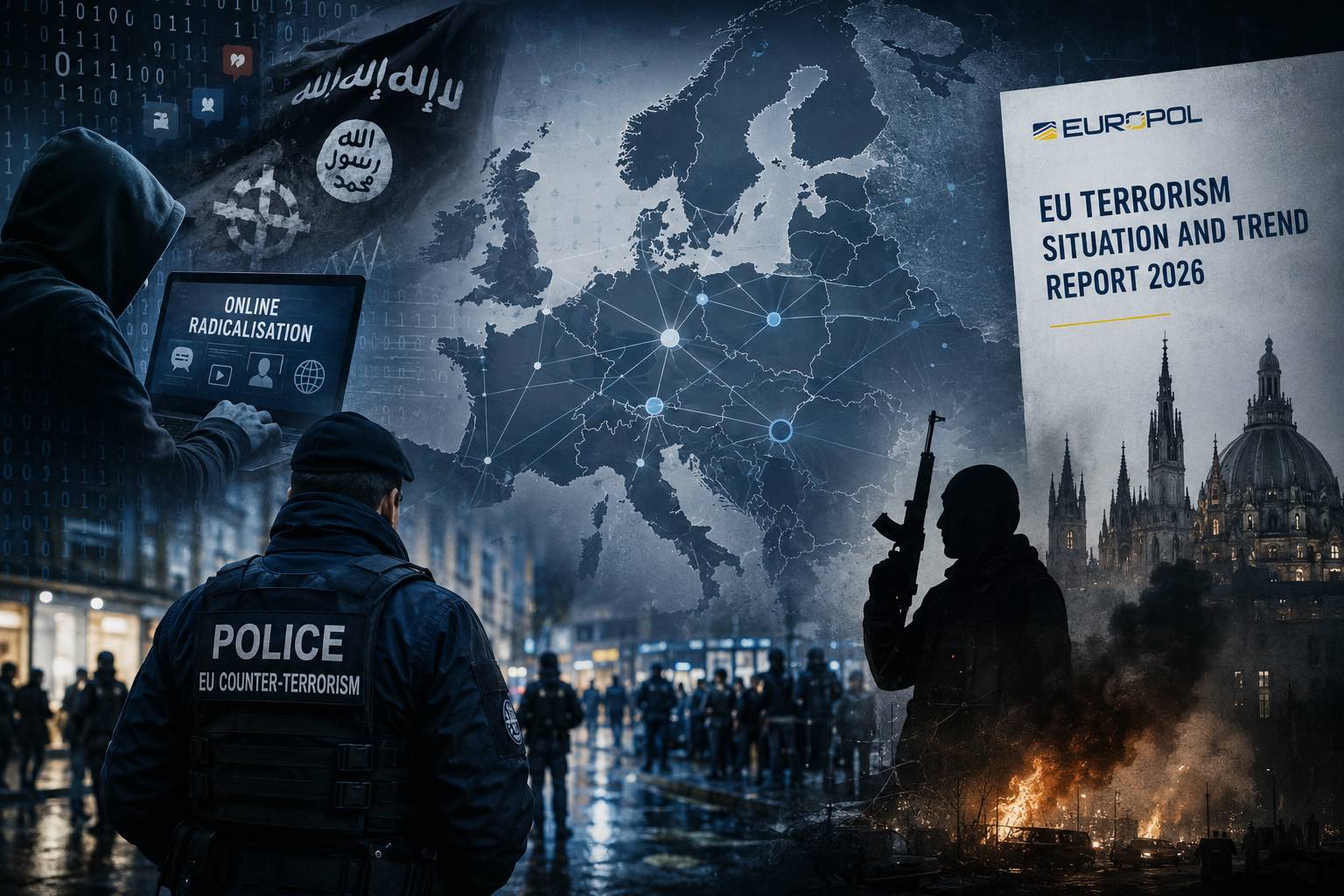
Europol’s European Union Terrorism Situation and Trend Report 2026 suggests that model, while still necessary, is becoming increasingly insufficient. The threat has evolved faster than many institutions designed to combat it.
The report paints a picture not of a continent facing a single dominant terrorist movement but of an increasingly fragmented ecosystem in which ideology, technology and geopolitics intersect in unpredictable ways.
.
Terrorist organisations remain active, but individuals radicalised online, often acting alone, now occupy an increasingly prominent place in Europe’s security calculations.
This represents more than a tactical evolution. It reflects a structural shift in how extremism develops, spreads and manifests itself.
One of Europol’s clearest conclusions is that the internet has ceased to be merely a communication tool for extremists. It has become the environment in which radicalisation itself increasingly occurs. Social media platforms, encrypted messaging services, gaming communities and increasingly sophisticated digital ecosystems enable extremist narratives to reach audiences at unprecedented speed while allowing individuals to construct ideological identities largely outside traditional organisational structures.
Artificial intelligence threatens to accelerate this trend further.
The report warns that generative AI has already begun lowering the barriers to producing sophisticated propaganda, translating extremist material into multiple languages and creating convincing multimedia designed to evade detection.
Although AI has yet to transform terrorism operationally, it is becoming a significant force multiplier for recruitment, persuasion and disinformation.
For European security services, this presents an uncomfortable dilemma. Counter-terrorism has traditionally relied upon identifying communications between conspirators.
Increasingly, however, there may be no conspiracy to intercept. Individuals may consume thousands of hours of extremist material, develop operational knowledge independently and proceed to violence without meaningful contact with organised groups.
That growing prominence of lone actors is perhaps the report’s most important strategic observation.
While jihadist terrorism continues to represent a substantial threat, Europol makes clear that no single ideological current dominates the European landscape. Islamist extremists, violent right-wing actors, left-wing extremists and ethno-nationalist movements all continue to pose security concerns, with their relative prominence varying considerably between member states.
This diversity complicates intelligence work. Security agencies can no longer concentrate resources on a handful of established organisations. Instead, they face an expanding spectrum of threats whose ideological boundaries are becoming increasingly blurred.
Online communities frequently recycle narratives across ideological divides. Anti-government conspiracy theories, antisemitism, anti-Muslim rhetoric and accelerationist ideologies increasingly overlap, producing hybrid forms of extremism that resist conventional categorisation. The internet encourages precisely this cross-pollination, allowing individuals to assemble personalised ideological worldviews from disparate sources.
The international environment further compounds these risks.
Europol identifies several geopolitical conflicts that continue to shape radicalisation inside the European Union. The war between Israel and Hamas, Russia’s invasion of Ukraine and instability across parts of Africa and the Middle East have all generated narratives that extremist groups exploit for recruitment and mobilisation. International events increasingly produce immediate domestic security consequences through digital information networks.
The report therefore reinforces an increasingly accepted reality among intelligence professionals: domestic and international security can no longer be treated as separate policy domains.
Migration flows, organised crime, cybercrime and terrorism likewise demonstrate growing convergence. Criminal networks provide logistical support, forged documentation and financial channels that extremist actors can exploit. Meanwhile, encrypted communication technologies simultaneously facilitate organised crime and terrorist planning.
Financial investigations consequently become as important as traditional intelligence gathering.
Yet perhaps the most striking feature of the report is its absence of complacency. Despite years of successful law enforcement cooperation, numerous disrupted plots and improved intelligence sharing across member states, Europol argues that the threat environment is becoming more—not less—complex. European authorities have undoubtedly become better at disrupting organised terrorist networks. The adversary has responded by becoming less organised.
This adaptation mirrors developments seen elsewhere in security policy. Cybercriminals have decentralised. Disinformation campaigns increasingly rely upon loosely connected online communities rather than central command structures. Terrorism appears to be following a comparable trajectory.
The policy implications are significant.
Counter-terrorism strategies built primarily around surveillance of known organisations must increasingly incorporate behavioural analysis, digital literacy, online intervention and cooperation with technology companies. Preventing radicalisation may prove as important as disrupting operational planning.
Artificial intelligence will also require new regulatory thinking. While the technology offers law enforcement powerful analytical capabilities, it simultaneously provides extremists with scalable tools for persuasion, translation, image generation and increasingly personalised propaganda.
Europol’s assessment ultimately offers neither alarmism nor reassurance. Europe does not face an unprecedented wave of terrorism comparable to that experienced a decade ago. Instead, it confronts something arguably more challenging: a threat that is becoming increasingly decentralised, technologically adaptive and ideologically fluid.
That evolution places a premium on intelligence cooperation, technological innovation and societal resilience. Europe’s security institutions have repeatedly demonstrated their ability to adapt to changing threats. The question raised by the 2026 TE-SAT report is whether they can adapt quickly enough to a form of extremism that evolves at the speed of the digital platforms on which it increasingly depends.
Download the full report here: https://www.europol.europa.eu/cms/sites/default/files/documents/EU-TE-SAT-2026.pdf
__________________________________________________________________________________________________________________
Click here for more News & Current Affairs at EU Today
Click here to check out EU TODAY’S SPORTS PAGE!
___________________________________________________________________________________________________________________