In an era when the architecture of public discourse is being reshaped with breathtaking speed, a remarkable document has emerged that deserves careful reading and thoughtful engagement.
The Foreign Censorship Threat, Part II, an interim staff report released on February 3rd, 2026, by the House Judiciary Committee of the United States House of Representatives, is at once a forensic investigation and a clarion call.
It addresses one of the defining challenges of the modern age: how the governance of digital speech — a realm that knows no borders — can affect the freedoms of citizens far from the offices where laws are passed.
In substance and ambition, this report is a bold pursuit of clarity in a terrain that is too often obscured by technical jargon and institutional opacity. Its central concern — the decade-long campaign by the European Commission and related institutions to influence global online speech and content moderation — is framed not merely as a matter of bureaucratic rivalry, but as a fundamental question of democratic self-determination.
As digital platforms increasingly function as the public square of the 21st century, the implications of this work extend well beyond the borders of the United States. For readers in Europe, Asia, Africa or the Commonwealth, it offers a valuable lens through which to examine our own commitments to liberty, pluralism and governance in the digital age.
The Report’s Core Premise: Transatlantic Tensions over Speech and Regulation
At its heart, the report lays out a thesis that may surprise those accustomed to viewing European regulatory initiatives — from the Digital Services Act (DSA) to assorted codes of practice — primarily as efforts to curb harmful content or protect citizens from misinformation. Instead, the Judiciary Committee’s investigation assembles evidence showing that, over a period of some years, EU institutions have not only developed such frameworks, but have also actively and consistently sought to influence the global content moderation policies of social media platforms.
The report is painstaking in its documentation. Over 100 closed-door meetings between European Commission officials and major technology platforms such as X (formerly Twitter), TikTok, Facebook, Instagram and YouTube feature prominently, alongside internal communications that were obtained under subpoena. The narrative that emerges is one in which regulatory dialogue — often presented publicly as consensual and voluntary — can, behind the scenes, operate in ways that pressure platforms to adopt content moderation rules that affect users worldwide, including in the United States.
What makes this report especially compelling — and, to many, unsettling — is the emphasis on the extraterritorial effects of these regulatory interactions. In a world still shackled to the old notion that law is territorially bounded, the idea that one polity’s regulatory priorities might materially shape speech norms in another jurisdiction challenges conventional legal thinking. It also raises profound questions about sovereignty, the nature of online space, and the relationship between democratic accountability and technological mediation.
A Bold Narrative Built on Evidence
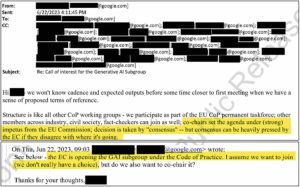
Google staff noted that participation in Disinformation Code subgroup meetings was effectively mandatory, and that the European Commission retained significant control over the agenda and group decisions.
What elevates Part II above the genre of partisan talking points is its reliance on non-public, contemporaneous communications between regulators and platform representatives.
These documents, produced under subpoena, underpin much of the report’s force.
They demonstrate how voluntary codes of practice — static texts that might otherwise seem innocuous — are in fact woven into a broader regulatory ecosystem that increasingly shapes content moderation on a global scale.
The report does not shy away from the complexity of its subject. It acknowledges the legitimate concerns that have animated European digital policy — from combating terrorist recruitment to stemming the spread of genuinely harmful disinformation. Yet it seeks to differentiate between protecting public safety and inadvertently or deliberately chilling lawful political discourse. In doing so, it invites a broader conversation about where the line should be drawn between safeguarding citizens and preserving liberty.
Particularly noteworthy are the sections that explore how history and political context have shaped regulatory priorities in Europe, informing codes of practice and subsequent legislation such as the DSA. According to the report, early EU initiatives such as the EU Internet Forum and the Code of Practice on Disinformation began as targeted efforts addressing specific harms but evolved into structures that, under close scrutiny, encouraged platforms to take down or suppress content that would elsewhere be considered lawful political speech.
A Thoughtful Examination of Extraterritorial Influence
Of the many themes the report explores, perhaps the most significant is its analysis of extraterritorial regulatory influence — the idea that a law enacted in one jurisdiction can effectively shape the rules that govern speech in another. Digital platforms, the report argues, typically maintain one set of global content moderation policies for practical reasons: enforcing different standards depending on a user’s location is expensive, technically difficult and privacy invasive. The result is that when a regulator in Brussels (or Berlin, Paris, or Amsterdam) pressures a platform to adopt certain rules, those changes often become global defaults, affecting American users as a practical matter.
This raises questions that extend beyond the immediate U.S.-EU dynamic. Should global digital platforms adopt a patchwork of region-specific norms? If so, how might this affect the unity and openness of the internet? If not, who decides which regional values shape these global defaults? The report wrestles with such questions not as abstract philosophical puzzles, but as matters of tangible consequence for the health of democratic discourse.
In drawing attention to the DSA’s role in this process, Part II captures a moment of institutional friction: one in which European aspirations toward regulatory leadership intersect with American anxieties about free speech protections. Whether one agrees entirely with the report’s characterisation of European motives, its documentation of regulatory interactions and outcomes invites serious debate — the very kind that democratic societies depend on.
Nuanced Insights into Content Moderation Dynamics
Another strength of the report lies in its granular examination of content moderation dynamics. Rather than dismissing all regulatory intervention as inevitably harmful, the authors distinguish between content that genuinely contravenes broadly accepted norms (such as incitement to violence) and political speech that is lawful, spirited and central to democratic engagement.
Through internal platform documents and meeting agendas, the report shows how pressure from regulatory bodies has in some instances led to the removal or suppression of political content — not because it was illegal or genuinely harmful, but because it ran afoul of expansive definitions of disinformation or hate speech that are embedded in European regulatory discourse.
This framing enables the report to contribute meaningfully to wider conversations about who should define the boundaries of acceptable speech online, and according to what values. Should platforms act as arbiters on behalf of regulatory bodies? Should local law enforcement or lawmakers play a larger role? Or should digital speech spaces be governed by a minimal set of universally recognised principles that prioritise freedom of expression?
These are not easy questions, and the report does not offer simplistic answers. Instead, it maps the territory with a clarity that is as illuminating as it is urgent.
Contextualising Europe’s Digital Agenda
For readers outside the United States, it is important to situate this report within the broader evolution of Europe’s digital regulatory agenda. European policymakers have often taken a proactive stance on digital governance, seeking to balance innovation with social protections. Laws such as the Digital Services Act — which imposes penalties for failure to address harmful content — emerged from a context marked by years of public debate over privacy, hate speech, extremism and foreign interference.
The Judiciary Committee’s report thus serves not only as a critique, but also as a reminder of how regulatory intentions, once translated into practice, can produce effects that extend beyond original ambitions. It underlines the need for transatlantic dialogue that acknowledges both sides’ legitimate concerns: Europe’s desire to protect its citizens and maintain democratic norms, and America’s deep-rooted commitment to free expression.
In this sense, Part II functions as a bridge between continents — a document that, with respect and critique rather than dismissal, invites policymakers to consider the unintended consequences of harmonising digital governance in a world where political cultures and legal traditions differ.
A Call to Action and Reflection
Concluding on a note that blends urgency with optimism, the report does not merely catalogue grievances. It proposes legislative and policy paths through which the United States might protect its citizens’ speech rights in the face of external pressure. Whether through greater transparency requirements, adjustments to international cooperation frameworks, or enhanced oversight of content moderation practices, the report sketches a future in which digital governance aligns more closely with democratic values rather than opaque bureaucratic imperatives.
What makes this report especially compelling for thoughtful readers is not its partisanship — though it undeniably emerges from a specific institutional perspective — but its invitation to engage with the complex interplay of law, technology and sovereignty. In an age where lines between domestic and international governance blur, where digital platforms wield power that rivals that of states, and where billions of voices intersect daily across screens and servers, the task of safeguarding freedom of expression is both more difficult and more necessary than ever.
A Significant Contribution to Global Debate
The Foreign Censorship Threat, Part II is a work that challenges complacency. It forces readers to confront the reality that digital speech is shaped by an intricate web of legal, regulatory and commercial pressures — not all of which are transparent, all of which are consequential. Whether one agrees with every assertion in the report or not, its meticulous documentation and its willingness to address uncomfortable truths mark it as a significant contribution to the global conversation about free speech in the 21st century.
In a world increasingly defined by digital borders as much as physical ones, this report is itself a testament to the enduring value of free expression. It reminds us that as technology evolves, so too must our understanding of the principles that sustain democratic life — and that the defence of these principles requires both vigilance and dialogue.
Main Image: Photographer Xavier Lejeune, Copyright European Union , 2025,
Click here for more News & Current Affairs at EU Today
Click here to check out EU TODAY’S SPORTS PAGE!
_____________________________________________________________________________________________________________________________