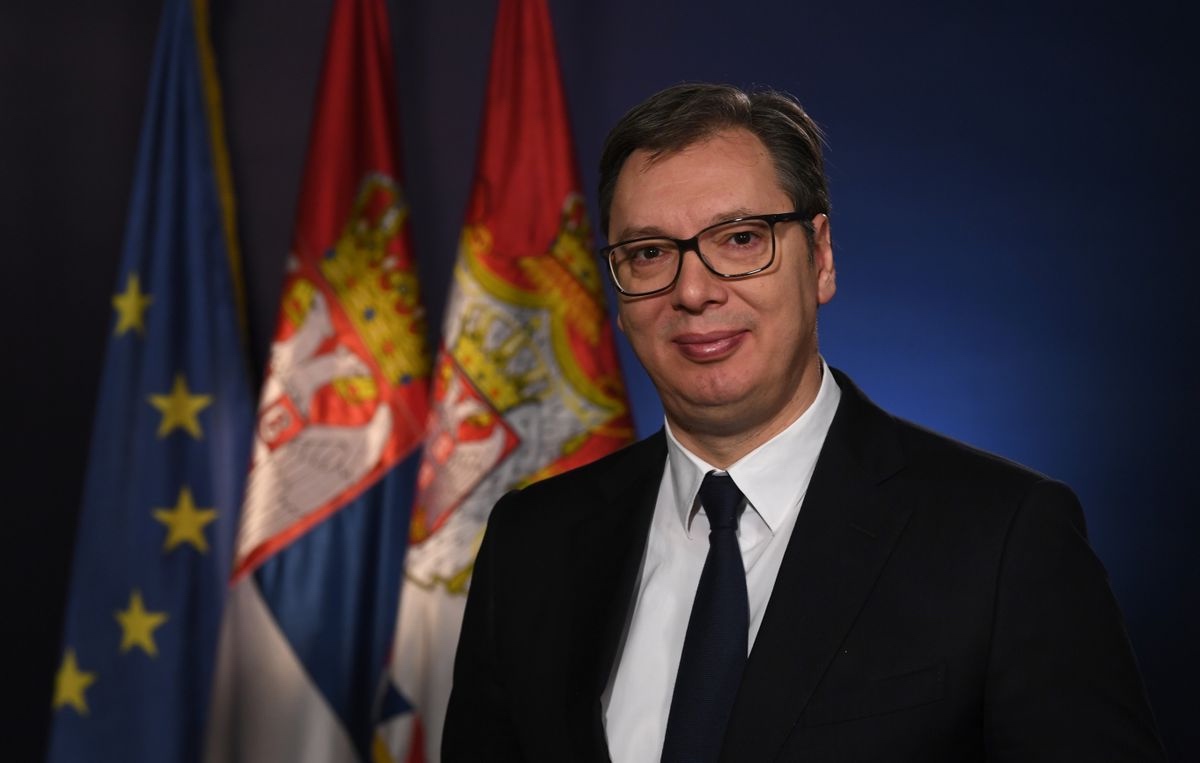
Serbia’s president says candidate countries should not expect major EU enlargement soon, highlighting the widening gap between Brussels’ geopolitical promises and the political conditions required for actual membership.
Serbian President Aleksandar Vučić has warned that EU candidate countries should not expect major enlargement in the coming years, a notably sceptical message from the leader of a state that has negotiated accession for more than a decade.
Speaking at a conference of parliamentary speakers from candidate countries in Belgrade, Vučić said the European path remained the best option for the Western Balkans, Ukraine, Moldova and Georgia, but that candidates should expect neither miracles nor rapid entry.
His intervention is politically self-interested: Serbia’s accession record is constrained by rule-of-law concerns, its relationship with Kosovo and its alignment with Russia and China. Yet the warning resonates because the EU itself has struggled to match its strategic enlargement language with credible timelines.
A process without an arrival date
Serbia became a candidate in 2012 and opened negotiations in 2014. Progress has slowed as Brussels presses Belgrade on democratic standards, media freedom, foreign-policy alignment and the normalisation of relations with Kosovo.
The Commission continues to argue that accession remains merit-based. That principle is necessary: weakening legal and institutional conditions would import unresolved governance problems into the Union. But a process can be technically open while politically stalled.
That tension contrasts with the Commission’s earlier suggestion that 2030 could be a realistic enlargement horizon for candidates that sustain reforms. Vučić’s pessimism is therefore also a challenge to Brussels to show that its timetable has political backing among member states.
The wider enlargement agenda has become more urgent since Russia’s full-scale invasion of Ukraine. The EU granted candidate status to Ukraine, Moldova and Georgia and increasingly describes enlargement as a security instrument. Recent European Parliament debates on Ukraine and Moldova have reinforced political support while also exposing bilateral disputes capable of slowing progress.
Vučić’s remarks, reported from the Belgrade conference, point to the contradiction. Candidate governments are asked to undertake costly reforms and align with EU policy, while voters receive no dependable sense of when compliance could produce membership.
Scepticism can become a political strategy
Lowering expectations can protect a government from responsibility for slow reform. Leaders can tell domestic audiences that Brussels will not admit them regardless of progress, reducing the political incentive to confront entrenched interests.
That dynamic is particularly relevant in Serbia, where the government has balanced EU economic integration against close relationships with Moscow and Beijing. The EU is Serbia’s largest trade and investment partner, but geopolitical alternatives remain useful to Belgrade as leverage and as domestic political symbolism.
Brussels therefore faces two risks. If it offers premature membership, it weakens accession conditionality. If it leaves the process indefinitely open, it strengthens those who portray EU demands as intrusive obligations without a credible reward.
Differentiation is becoming unavoidable
The candidate field is not moving at one speed. Montenegro and Albania have advanced further in negotiations than several neighbours. Ukraine and Moldova have powerful geopolitical backing but face the immense task of reform during war and under persistent Russian pressure. Georgia’s political trajectory has created a different set of problems.
The EU will need to distinguish more clearly between technical progress, staged integration and full membership. Access to programmes, infrastructure finance and parts of the single market can produce benefits before accession, but such steps must not become a permanent waiting room.
Member states also need a more honest debate about institutional reform inside the Union. Enlargement affects voting rules, budget allocations, agricultural policy and representation. Candidate credibility cannot be separated from the EU’s willingness to prepare itself.
Vučić’s prediction may prove too pessimistic. It is nevertheless a warning Brussels should take seriously. Enlargement policy depends not only on candidates believing reform is required, but on believing that successful reform can lead somewhere.