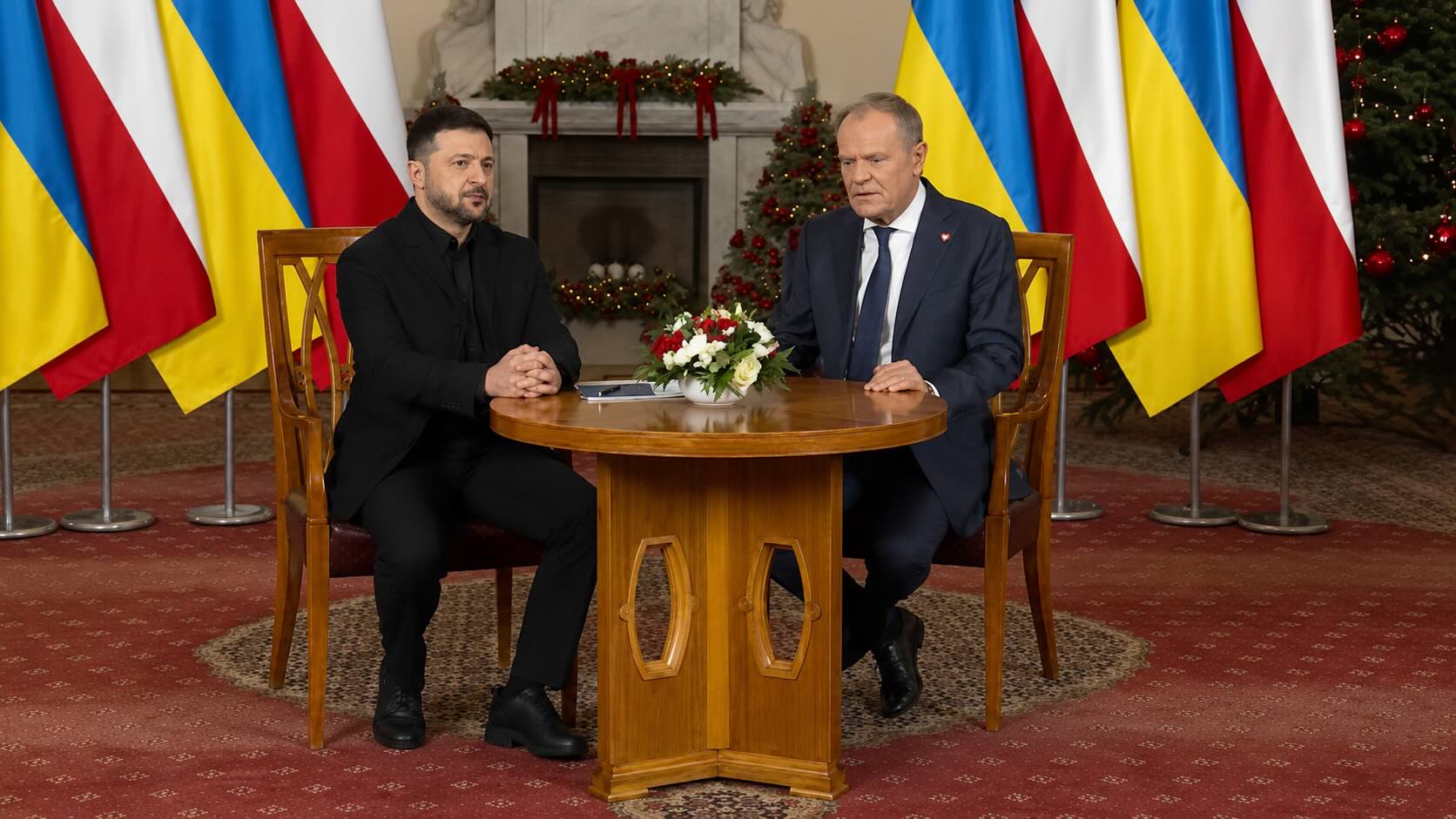
The European Parliament’s Ukraine report should not become a vehicle for Poland’s domestic memory politics. By linking Volhynia, UPA and wartime commemoration to Ukraine’s EU path, Warsaw risks turning enlargement into a tool of historical blackmail against a country fighting Russia.
The European Parliament is due to debate Michael Gahler’s report on the 2025 Commission report on Ukraine today, Tuesday, 7th July, with the vote scheduled for Wednesday, 8th July. The Parliament’s Legislative Observatory lists the file as 2025/2259(INI), an own-initiative procedure on Ukraine as a candidate country, with the plenary debate also scheduled for the 7th and the vote for 8th July. The final Strasbourg agenda also places the Ukraine report in Tuesday’s afternoon debate.
This is not a standalone European Parliament resolution on the Ukrainian Insurgent Army, or UPA. It is more serious than that. The controversy concerns amendments to the annual Ukraine report, a document that forms part of the Parliament’s political assessment of Ukraine’s progress towards the European Union. In other words, Poland’s historical dispute with Ukraine is being pushed into the EU accession file of a country fighting Russia.
According to wording reported in Polish and Ukrainian coverage, one amendment says that Ukraine’s EU accession process should be accompanied by “full recognition and proper commemoration of the victims of the Volhynia tragedy”, as well as Polish-Ukrainian historical dialogue and exhumation work. The official Parliament page confirms that amendment documents exist for the Gahler report, although the public amendment files are not all easily accessible through the Parliament’s document interface at the time of writing.
There is also an earlier and stronger committee-stage amendment, tabled by Tomasz Froelich, which condemns the glorification of “perpetrators”, including Stepan Bandera and Roman Shukhevych. It is important to be precise: the reported Polish/EPP wording does not explicitly mention UPA, Bandera or Shukhevych. But the political direction is clear. Warsaw is trying to move its one-sided historical narrative from Polish domestic politics into the European Parliament’s judgement on Ukraine.
Poland has every right to remember its dead. The massacres of Polish civilians in Volhynia and Eastern Galicia in 1943–45 were real atrocities. Polish official memory describes them as genocide, and estimates of the Polish victims are usually given in the tens of thousands, often around 100,000. No serious discussion of Polish-Ukrainian history can deny those crimes. Reuters has summarised the dispute by noting that Poland says more than 100,000 Poles were killed by Ukrainian nationalist insurgents, while Ukraine also points to thousands of Ukrainian victims and rejects Poland’s legal framing of the events as genocide.
But the issue before Europe is not whether Polish victims deserve graves, names and proper commemoration. They do. The issue is whether Poland is entitled to turn its interpretation of history into a condition of Ukraine’s European legitimacy.
This did not begin in 2026. In 2016, the Polish Sejm established 11th July as a national day of remembrance for victims of what it called genocide committed by Ukrainian nationalists. In 2018, amendments to Poland’s Act on the Institute of National Remembrance introduced criminal responsibility for denying crimes committed by Ukrainian nationalists in 1943–45. Legal commentators warned at the time that this was not simply remembrance, but the policing of historical interpretation by law.
Before Poland joined the European Union, Warsaw had good reason to keep its historical claims under control. The dominant language of Polish eastern policy after 1989 drew heavily on the ideas associated with Jerzy Giedroyc and Juliusz Mieroszewski, developed around the émigré journal Kultura. Their central argument was that an independent Poland should abandon fantasies of restoring influence over the old eastern borderlands and accept Ukraine, Lithuania and Belarus as independent political subjects. Poland’s own security, in this view, depended on a sovereign Ukraine outside Moscow’s control. The formula was simple: there could be no free Poland without a free Ukraine.
That doctrine served Poland well. It helped Warsaw present itself to the West as a responsible post-imperial state, reconciled with its neighbours and ready for NATO and EU membership. It also allowed Poland to act as Ukraine’s advocate in the 1990s and early 2000s, when Kyiv’s European ambitions were still uncertain and its international position weak.
But the Giedroyc tradition was also useful because Poland was then asking to be admitted into Europe. A country seeking entry to the EU could not easily present itself as a state driven by unresolved borderland resentment, historical grievance and claims of moral superiority over its eastern neighbours. It needed the language of reconciliation. It needed Kultura, Giedroyc, Mieroszewski, Jacek Kuroń, Józef Łobodowski, Jerzy Stempowski, Czesław Miłosz and Karol Wojtyła. It needed the appearance of a Poland that had learnt from the catastrophes of the twentieth century.
Everything changed after accession. Poland joined the EU in 2004. Once inside, it no longer needed to prove itself to the same extent. It acquired the privileges of membership, access to EU money, a stronger economy, a vote inside the institutions, and eventually a veto over the enlargement hopes of countries still outside. The old language of reconciliation did not disappear, but it became weaker, more ceremonial, and increasingly detached from the actual behaviour of the Polish state.
The shift was gradual. Poland continued to speak of strategic partnership with Ukraine, and after Russia’s full-scale invasion in 2022 it again invoked the Giedroyc logic of Ukraine as essential to Polish security. But that solidarity did not prevent the return of older habits: historical conditionality, economic protectionism and the treatment of Ukraine not as an equal partner, but as a neighbour expected to adjust itself to Polish terms.
The point is not that Giedroyc was insincere. His ideas mattered. They helped Poland break with the fantasy of restoring the eastern borderlands and gave Polish policy towards Ukraine a serious strategic foundation. The point is that, after EU accession, those ideas became less a discipline on Polish policy than a decorative reference. Poland still quotes “no free Poland without a free Ukraine”. Its practice increasingly says something else: Ukraine may be free, but only if it accepts Poland’s authority over history, memory and the conditions of its European future.
That is where Poland begins to follow a method familiar from Russian propaganda. The comparison is not that Poland supports Russia. It does not. The comparison lies in technique: take a real historical tragedy, turn it into a state doctrine, define one permitted hierarchy of victims, and treat alternative memory as hostility. The Kremlin has long used the accusation of “Nazism” and the manipulation of Second World War memory as an information weapon against Ukraine. Poland is not repeating Moscow’s content, but it is copying part of the machinery: state memory as a loyalty test.
The pressure has not only been directed at Ukraine. It has also narrowed the space for historians and minority representatives inside Poland. The most important case is Grzegorz Kuprianowicz, a historian and head of the Ukrainian Society in Lublin. In 2018 he spoke at Sahryń, where Ukrainian civilians were killed in 1944 by Polish underground forces. Przemysław Czarnek, then Lublin voivode and later education minister, denounced him and referred the matter to the authorities. The IPN prosecutor eventually refused to open an investigation, finding that Kuprianowicz’s words did not meet the statutory threshold for an offence.
That refusal did not end the matter. On 30th August 2018, the president of the Institute of National Remembrance removed Kuprianowicz from the Board for the Protection of Struggle and Martyrdom at the IPN’s Lublin branch. The IPN confirmed the recall in its own English-language statement.
The message was unmistakable. Polish suffering may be commemorated as national truth. Ukrainian suffering caused by Polish formations may be treated as provocation. A historian who spoke about Ukrainian civilians killed by Poles was exposed to public denunciation, prosecutorial scrutiny and institutional removal. A state memory system does not need to imprison every historian. It only needs to make examples.
This is why the Sahryń case matters far beyond one man. It showed that Poland’s Volhynia policy is not simply about finding graves or honouring victims. It is about deciding which historical facts may be spoken aloud and which are to be treated as offences against the nation.
A serious European discussion would have to include not only Volhynia, but also Operation Vistula. In 1947, Poland’s Soviet-installed communist authorities forcibly resettled more than 140,000 Ukrainians and Lemkos from south-eastern Poland to the north and west. Poland’s Commissioner for Human Rights has noted that some were sent to Jaworzno, where 160 people died from hunger, illness and torture.
Poland-Ukraine Military Naming Row Exposes Wartime Alliance Fault Line
Operation Vistula does not cancel Volhynia. Nothing does. But it exposes the dishonesty of a single Polish moral hierarchy in which Polish suffering is central and Ukrainian suffering is peripheral. Ukrainians remember not only UPA, but statelessness, interwar discrimination, Polish rule in Galicia and Volhynia, Soviet terror, forced resettlement and the destruction or neglect of Ukrainian memorials in Poland.
Over the past decade, Warsaw has turned these questions into a standing instrument of pressure: exhumations, monuments, Bandera, UPA, grain, transport and now Ukraine’s EU path.
That wider agenda is already visible. Poland has repeatedly raised Volhynia as an obstacle to Ukraine’s EU accession. Euractiv reported in 2024 that Warsaw would block Ukraine’s accession until Kyiv resolved the issue of exhumations. In 2026, Polish Defence Minister Władysław Kosiniak-Kamysz was widely reported as having been drawn into the same argument, with Polish and Ukrainian outlets saying that the phrase “with Bandera, Ukraine will not enter the EU” had entered the debate around his interview. Notes from Poland later clarified that the exact phrase was spoken by the interviewer rather than Kosiniak-Kamysz himself, but the fact-check did not change the wider point: Polish politicians across the spectrum were already discussing Ukraine’s EU path in the language of Bandera, UPA and historical memory.
Jarosław Kaczyński has now removed any ambiguity. According to reports citing a letter to Law and Justice members, the PiS leader wrote that Ukraine should not be admitted to the European Union unless Kyiv changes its policy towards “the cult of Bandera and other criminals” and the glorification of the UPA and OUN. He reportedly told his party that if PiS wins the next election, it will not allow Ukraine to join the EU on that basis.
This is no longer a commemorative dispute. It is a declared political instrument. Kaczyński is not asking for exhumations, graves or historical commissions alone. He is telling a candidate country at war that its path to Europe can be blocked unless it restructures its memory to satisfy a Polish party preparing for future power.
The greater failure, however, is not Kaczyński’s. It is the European Union’s. Historical memory is not a formal criterion for EU accession. Candidate countries must meet the Copenhagen criteria, align with the acquis, build institutions, fight corruption and guarantee democratic standards. They are not supposed to be admitted or excluded because an existing member state wishes to impose its interpretation of the Second World War. Yet the EU has repeatedly allowed precisely that kind of bilateral historical blackmail to enter the accession process.
The most obvious precedent is Bulgaria’s treatment of North Macedonia. Since 2020, Bulgaria has blocked or delayed Skopje’s accession path over disputes involving language, identity, history and constitutional recognition. Bulgarian demands have included changes to North Macedonia’s historical narrative, including pressure over the use of the term “Bulgarian fascist occupation” for the Second World War period.
The lesson for Ukraine is stark. Bulgaria, a state that was allied with Nazi Germany for much of the Second World War, has used its EU membership to pressure North Macedonia over how that history is described. Poland, a state that rightly presents itself as a victim of Nazi and Soviet aggression, is now using its EU position to pressure Ukraine over Ukrainian nationalist memory. The two historical narratives are not the same. They are in many respects opposite. But the EU has shown itself willing to accommodate both, because the real principle is not historical truth. It is the power of the member state over the candidate.
That is the corruption of enlargement. Once a country enters the EU, it can use the accession process not to defend European standards, but to settle national memory wars. The candidate country is told to amend textbooks, constitutions, monuments, terminology and public memory, not because Brussels has defined a European standard, but because Sofia, Athens, Warsaw or any other capital can make unanimity conditional on its own grievance.
If the EU allows Poland to import Volhynia into the Ukraine report, it will be repeating the North Macedonia mistake. It will teach every member state that the accession process can be used as a historical cudgel. It will also teach every candidate country that European integration is not only about reform, but about submitting to whichever neighbour joined first.
This is exactly what the European project was supposed to prevent. Europe was built so that historical conflicts would be contained inside common institutions, not turned into veto weapons by those already inside the club.
If a member state uses enlargement to wage a memory war, the EU should not indulge it. It should punish it. Brussels should create mechanisms to remove bilateral historical disputes from accession decisions, restrict the ability of directly interested member states to block negotiation chapters, and apply financial sanctions against governments that abuse EU procedures for national historical blackmail.
That means more than another statement of concern. Countries that misuse accession policy in this way should face suspension or reduction of access to EU funds. Their role in the relevant accession decisions should be limited where they are a direct party to the dispute. The principle should be simple: a member state may raise genuine rule-of-law or institutional concerns about a candidate country, but it should not be allowed to turn the Union’s enlargement process into a weapon for settling historical scores.
That would apply not only to Poland over Ukraine, but also to Bulgaria over North Macedonia. If Sofia blocks Skopje because it wants to impose its own version of language, identity and Second World War memory, it should face consequences. If Warsaw seeks to block Kyiv because Ukraine refuses to adopt Poland’s official hierarchy of wartime memory, it too should face consequences. EU membership is not a licence to hold future members hostage.
This may sound severe. It is less severe than allowing the enlargement process to be destroyed by national mythologies. The EU has already used budgetary and legal pressure against member states over rule-of-law disputes. It should be able to act when a member state uses the Union’s procedures to sabotage a candidate country for reasons unrelated to European standards.
The same pattern appeared in economic disputes. Poland banned imports of Ukrainian grain and food products in 2023 to protect local agriculture, later extending restrictions even after the European Commission moved in another direction. Those disputes were not about Volhynia, but they showed the same structure: Poland using its EU membership and border position to defend national advantage over a weaker neighbour at war.
Poland is doing this for domestic reasons. Historical grievance mobilises nationalist voters, pressures centrists, and allows politicians to pose as defenders of national dignity. The rise of President Karol Nawrocki has made the problem sharper. His election was expected to complicate Poland’s relations with both Ukraine and the EU; only days ago, Polish-Ukrainian tensions again surfaced over historical disputes and military cooperation.
There is also a party-political future to consider. PiS is now in opposition, but the next parliamentary election is due in 2027. Kaczyński’s letter is therefore not an abstract historical statement. It is a manifesto line. It tells Polish voters that Ukraine’s EU path can be used as a weapon in domestic politics. It also signals to harder nationalist and Eurosceptic forces that PiS is prepared to compete on their terrain.
That is dangerous for Poland as well as for Ukraine. The further Polish politics moves into memory wars, anti-Ukrainian mobilisation and EU conditionality, the more it strengthens forces that do not merely dislike Ukraine’s historical symbols, but dislike the European project itself. It is no accident that parties most eager to turn history into a weapon often drift towards Euroscepticism, xenophobia and the politics of resentment. They use the privileges of EU membership while corroding the Union from within.
For the European Parliament, the question is simple. Should a member state’s national memory campaign be written into a report on Ukraine’s accession progress?
Ukraine is fighting Russia, the state that has most systematically weaponised history in Europe. For Parliament to import Poland’s one-sided memory politics into the Ukraine file would not advance reconciliation. It would reward history as leverage.
Poland may mourn its dead. It may ask for graves to be found and victims to be buried. But it has no right to use those dead as a political checkpoint through which Ukraine must pass on its way to Europe.
Nor should the European Union allow it. If Brussels, Berlin and Paris still believe enlargement is a strategic project rather than a hostage-taking mechanism, they should say so now, before Wednesday’s vote.
Ukraine, Poland and the problem of memory without clean hands: EU Today podcast