
Bart Dickens, chair of Farmers Defence Force (FDF) Vlaanderen, and his wife, Isabel Proost, say a mix of regional rules on nitrogen in the soil, protected-area constraints and investment uncertainty left the family enterprise without a viable path.
“You make the decision with your mind, but not with your heart,” Bart said. “The truck comes, the cattle go, and then silence.”
The farm at Arendonk was founded in 1952 by Bart’s grandparents and, until recently, was a compact unit of around 115 milking cows with young-stock, milked twice daily in a 24-point parlour. The plan was to reach roughly 150 milkers while staying family-run. “Only family, no outside staff — that was our vision,” Bart said.
Isabel added: “We couldn’t imagine life without our cows.”
Their yard sits beside the Turnhouts Vennengebied — known locally as the Turnhoutse vennen — a protected mosaic of heaths, fens and wetlands spread across sixteen sub-areas in six municipalities of the Noorderkempen. The Natura 2000 site covers 7,964.57 hectares, shelters 20 listed habitats and 20 protected species, and remains largely open country with little housing or industry.
In the nineteenth century, canals were cut through the Kempen to lift poor soils and scarce surface water; irrigation improved yields, and agriculture took root. That legacy endures: roughly half the area is still zoned for farming, with about 415 active holdings, alongside public and private nature ownerships (the Flemish Agency for Nature and Forests owns about 18%, municipalities and the military a further 8%, and the NGO Natuurpunt about 7% plus areas under management). It is, in short, a working landscape as well as a protected one — a fact that frames the Dickens family’s story.
What changed, Bart and Isabel argue, is the regulatory setting around nitrogen. EU law sets three broad duties: protect sensitive habitats; cut air pollution by reducing ammonia (NH₃) and nitrogen oxides (NOₓ); and limit nitrates in water.
In Belgium, the regions decide how to meet those aims, and in Flanders, applications near Natura 2000 sites are screened by a model that estimates how much additional nitrogen deposition a project would add to nearby habitats. If the modelled increase is tiny, permits are simpler; above a very low threshold, the evidence required rises sharply and mitigation can be costly. “Authorities should look at the actual emissions of a company, not just a model,” Isabel said.
The science, set out plainly, is this. When extra reactive nitrogen lands on the ground it acts like fertiliser. On nutrient-poor habitats — heath, bog and species-rich grassland — fast-growing plants out-compete slower specialists; over time the plant community shifts and rarer species decline. In the air, ammonia and nitrogen oxides can combine into fine particles (PM2.5) linked to heart and lung disease.
Nitrogen is certainly not the chief driver of climate change — carbon dioxide and methane are — but it can put significant local pressure on sensitive habitats and be a contributor to harmful particulates. That is the rationale for policy. The contention in Flanders, in Bart’s view, is where and how the lines are drawn.
For the family, proximity to protected heath and fen meant increasingly tight margins. Bart said he was told a single emissions-reduction technique — costed to him at about €400,000 — could keep the business compliant, but there was no assurance it would still be accepted after a review due in 2030.
“You are asked to invest hundreds of thousands with no guarantee the technique will count later,” he said. Staged herd cuts towards 2030 would at the same time have reduced output and cash flow. Isabel described the day-to-day arithmetic: stricter limits on spreading manure on their own fields, more bought-in feed, and paid removal of surplus manure — “costs in opposite directions”.
Belgium’s split governance sharpened the edge. Environmental permitting differs across Flanders, Wallonia and Brussels. “In Flanders it’s a very big problem… in Wallonia it isn’t,” Bart said. When the herd was dispersed, many animals went south. The couple say the asymmetry is highly prejudicial to Flemish family farms trading in the same national market.
Health played a part, Bart said. After a shoulder operation this summer, outside help did the milking. In late 2024 he enrolled in a buy-out for the Turnhout maatwerkgebied (customised zone). Two weeks after the youngstock left, the milking herd followed on 16 July 2025.
As described by Bart, the package paid €3.2 per nutrient emission right, plus the value of cows, dairy-specific equipment and buildings, with a demolition premium; he retains about 60 hectares, mainly maize and grass, and has sold forage to neighbours. “The compensation clears the bank loans, not more,” he said. “It’s not a pension.”
According to Bart, a condition of the settlement is that he may not keep livestock anywhere in Europe again under his name. “On my private name… you may never be a farmer again,” he said. Isabel believes restrictions also attach to the address. These points are their account of the terms.
The day the sheds fell silent was, Bart said, the hardest of his career. “Three generations gone in five minutes.”
Isabel spoke about the domestic shift as he retrains to drive lorries: “Our youngest asks why he isn’t at the table for lunch — he always was.” Both say the psychological toll is underestimated. Isabel also described the pressure of frequent inspections: “They will find something every time they come here and then you get a fine.”
Their broader concern is food security in a region where agriculture and nature have long co-existed. The canals that once lifted the Kempen’s soils still feed wetlands and fields alike; the site’s open spaces are both habitat and farmland. Bart worries that as local output declines, exposure to supply shocks grows.
“It’s one per cent of the people who feed the other 99 per cent,” he said. “When you don’t control your food supply, what price are you going to have to pay?” The couple also fear the loss of practical expertise: “A cow that isn’t happy won’t produce a lot of milk,” Isabel said.
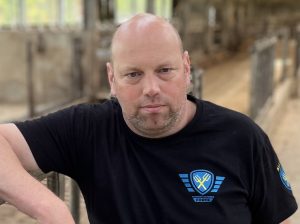
“When you hit on a cow, you hit on your wallet,” Bart added. “You must take care of it.” Skills acquired over decades, they argue, cannot be not quickly relearnt if policy later turns back towards domestic production.
Bart remains in post at FDF Vlaanderen. He does not urge others to take a buy-out, saying each case is different, but he intends to keep campaigning on permitting, measurement and cumulative burdens on family farms.
“People asked if I’ll stop working with FDF Belgium. No,” he said. “I have more time now to fight for farmers’ interests!”
___________________________________________________________________________________________________________________________



