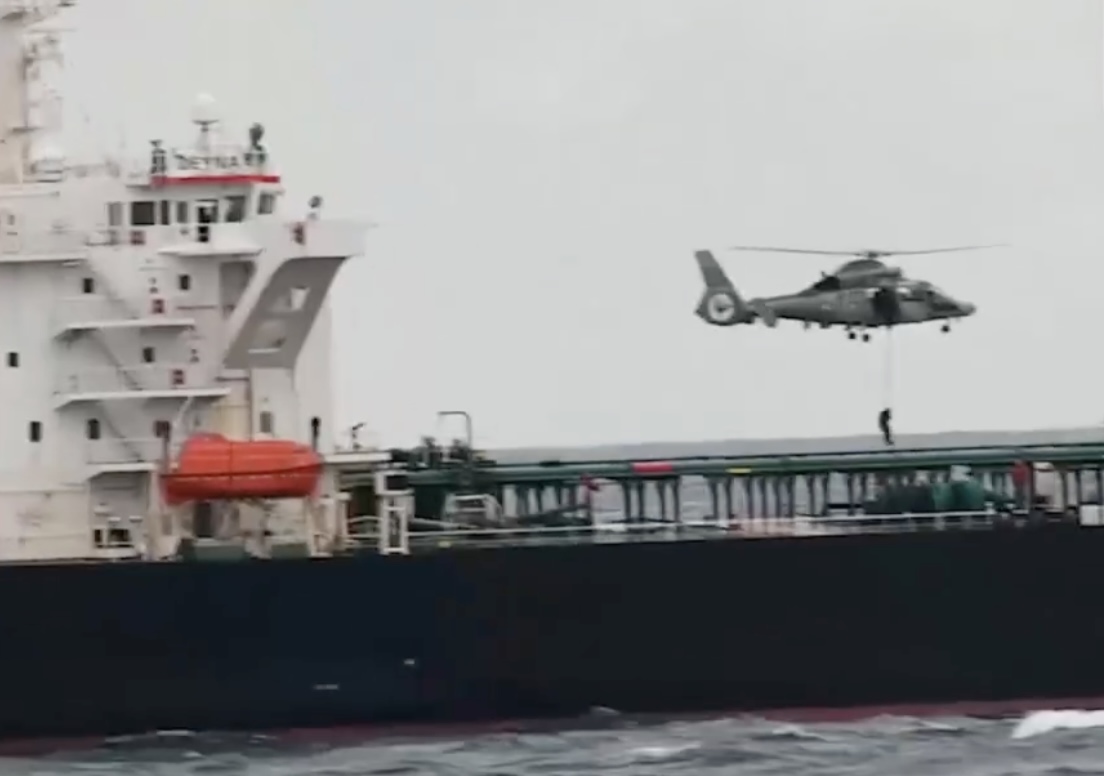
France on Friday intercepted and boarded the oil tanker Deyna in the western Mediterranean, in what appears to be the latest European move against vessels suspected of helping Russia evade sanctions on its oil trade.
French authorities said the ship, sailing under the flag of Mozambique, was suspected of using false registration documents and was taken to a secure anchorage for further inspection.
President Emmanuel Macron said the operation showed that the conflict in the Middle East would not distract France from supporting Ukraine or from enforcing measures designed to limit Russia’s capacity to finance its war. Macron described shadow fleet operators as profiting from the circumvention of sanctions and helping to sustain Moscow’s war effort.
The Deyna had travelled from Murmansk, a key Russian export port, and was carrying crude oil. French maritime authorities said inspectors who boarded the vessel found grounds to question the authenticity of its nationality claim. The case has been referred to prosecutors in Marseille, and the tanker is now undergoing checks on its documentation, insurance and operating status. British support was involved in the operation, according to the French side.
The incident matters because it points to a firmer European approach towards the so-called shadow fleet that has emerged since Western sanctions were imposed on Russian energy exports after the full-scale invasion of Ukraine. These vessels typically operate through opaque ownership structures, frequently change flags, and are widely suspected of moving Russian oil above the G7 price cap or outside normal regulatory oversight. Western officials have also repeatedly warned that many such ships are ageing, poorly insured and present a significant environmental risk.
Friday’s interception was not an isolated case. Reuters reported that this was the second such action by France this year, following the January detention of another tanker, Grinch, which had also departed from Murmansk and was suspected of sailing under a false flag. French authorities later detained that ship’s Indian captain as part of the investigation. France had already boarded another suspected shadow fleet vessel, Boracay, off its Atlantic coast in September 2025.
Other European states have also stepped up enforcement. Belgium seized the tanker Ethera at the start of March, also on suspicion of operating under false documentation, and later imposed a €10 million bail as part of the case. Sweden, meanwhile, has intercepted two vessels in the Baltic within the past two weeks in separate investigations involving false flags, suspected document fraud and concerns over seaworthiness.
Taken together, these cases suggest that parts of Europe are moving from rhetoric to active maritime enforcement. The emphasis has not only been on sanctions compliance but also on the legal and safety vulnerabilities of the vessels themselves. False flag use, forged certificates and deficient safety standards give coastal states a more immediate legal basis for intervention than broader geopolitical arguments alone. In practice, European governments appear to be using maritime law, port state control and criminal investigation to put pressure on the logistics chain that enables Russian oil exports outside the formal sanctions framework.
That pressure is being applied against a wider backdrop of growing concern over maritime security. Separate from the Deyna case, several Mediterranean states have warned of the environmental danger posed by another Russian-linked tanker, Arctic Metagaz, which has been drifting damaged in the region. That episode has reinforced the argument in European capitals that shadow fleet shipping is not merely a sanctions issue but a direct threat to coastal security, shipping lanes and the marine environment.
Russia has previously denounced such seizures and boardings as piracy. Yet the pattern of enforcement is becoming harder to dismiss as an isolated initiative by one country. France, Belgium and Sweden have all acted within weeks of one another, and British support has featured at least in the Mediterranean case announced on Friday. Whether this develops into a sustained European campaign remains to be seen, but the direction is now clearer than before: European states are showing greater readiness to challenge suspect Russian-linked shipping directly in their surrounding waters.
First published on euglobal.news.
Risk in European Waters: The Shadow Fleet, Sanctions Evasion and Safety Gaps