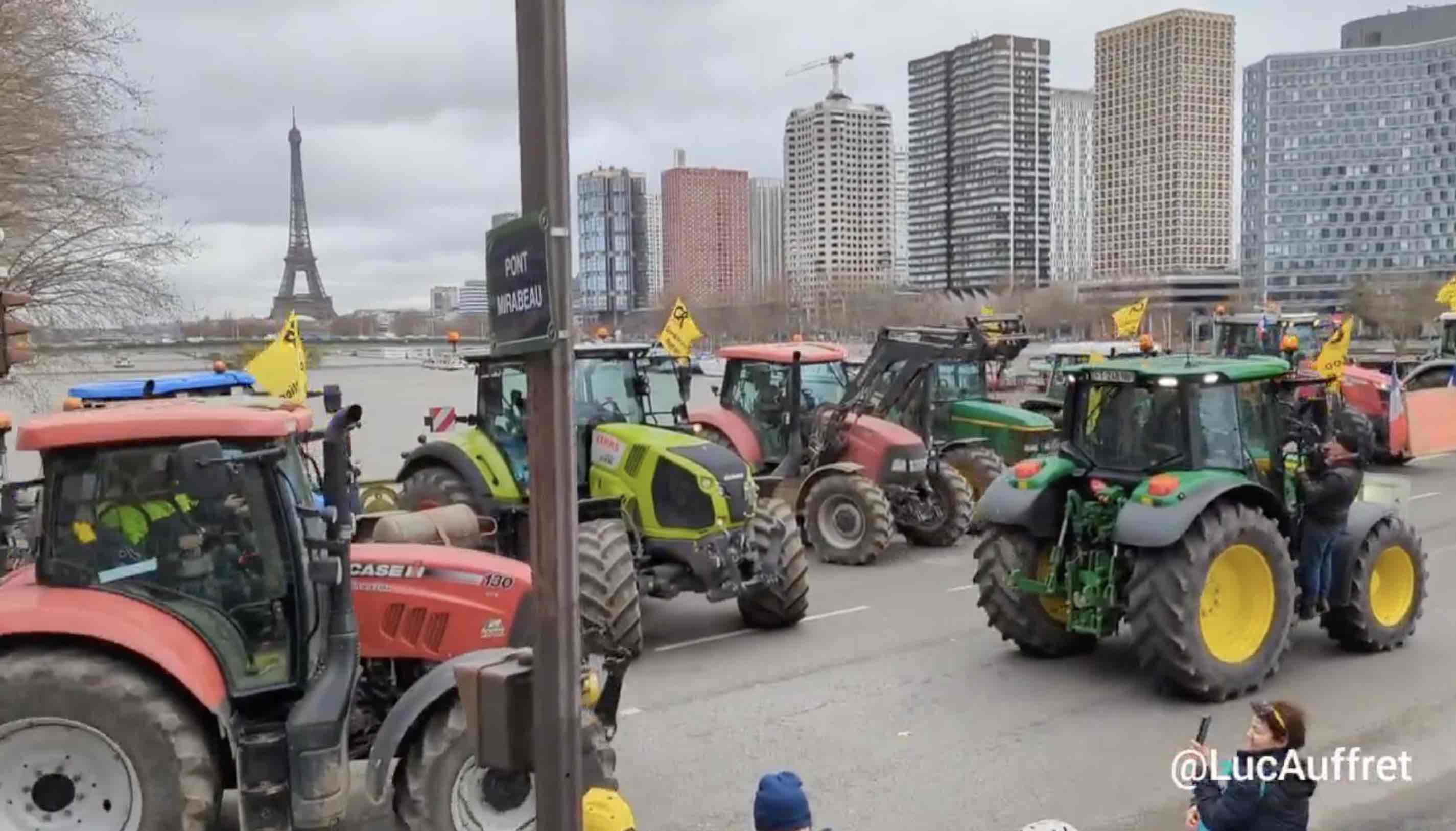
The latest protest by French farmers, which brought much of the city to a standstill on Monday, marks a dramatic turning point in the simmering battle between rural France and the green zealotry increasingly emanating from both Brussels and the Élysée Palace.
Hundreds of farmers descended on the capital, their tractors emblazoned with banners reading “Non à la dilution des règles!” and “Nos terres, nos lois”—a clear rebuke to government plans to relax key environmental regulations. Ironically, their fury has been sparked not by a tightening of restrictions, but by a perceived betrayal of the rules designed to protect France’s farmland, water reserves, and future as a European agricultural powerhouse.
At the heart of the unrest is a controversial legislative package backed by President Emmanuel Macron’s government which would ease longstanding limits on pesticide use, irrigation rights, and land management—changes that environmental groups say would gut France’s ecological standards. But for farmers, the issue is less about green ideology and more about sovereignty.
“We have followed the rules for decades,” said Jean-Michel Dupont, a fourth-generation farmer from the Dordogne, who drove 500km overnight to join the protest. “Now they want to change everything to suit EU free-market logic and big agribusiness. These so-called reforms are not about helping farmers—they’re about weakening us.”
The government insists the reforms are necessary to “modernise” French agriculture and make it more “competitive” in light of new EU trade dynamics and the ongoing energy crisis. A spokesman for the Ministry of Agriculture said the changes would ensure “a more flexible and pragmatic approach to environmental stewardship,” particularly in drought-hit regions where farmers have long pleaded for more irrigation leeway.
Yet critics argue the plan is a thinly veiled capitulation to Brussels’ lobbying machine, aimed at harmonising standards across the single market at the cost of national autonomy. Marine Le Pen’s National Rally has been quick to pounce on the unrest, accusing Macron of “selling out the French farmer to the EU technocrats and climate fanatics.”
This is not the first time French farmers have rallied against green diktats. Earlier this year, tractors blocked border crossings in protest of EU-Mercosur trade negotiations, and there have been simmering tensions over the bloc’s “Farm to Fork” strategy, which many see as naïve and detached from on-the-ground realities. But this week’s demonstration is different. It reflects a broader fear among farmers that their traditional way of life is being dismantled piecemeal—first by the bureaucrats in Brussels, and now by the bureaucrats in Paris.
“There is no such thing as a ‘flexible’ regulation,” said Elise Laurent, a 32-year-old winegrower from the Rhône-Alpes region. “Once you weaken protections on pesticides or water rights, you open the floodgates. The only winners are the industrial-scale farms that can afford to bend the rules to breaking point.”
For environmental activists, however, the farmers’ outrage is misplaced. Greenpeace France issued a statement accusing agricultural unions of “weaponising populist rhetoric” to preserve unsustainable practices. “Loosening regulations is not the answer to climate change or food security,” the group said. “If anything, we need stricter enforcement, not rollbacks.”
In truth, both sides are grappling with the same dilemma: how to reconcile environmental urgency with economic survival. But for many rural French, the latest reforms feel like yet another decree handed down without consultation, reflective of a top-down system in which Paris and Brussels treat farming as an abstract policy problem rather than a living heritage.
And in the background looms a deeper political reckoning. Macron’s embrace of EU-aligned reforms has alienated swathes of his traditional centrist base and opened new ground for nationalist parties to exploit. The government is under pressure to quell the unrest without appearing to reverse course—a delicate dance that may prove impossible.
For now, the tractors remain parked along the Champs-Élysées, symbols of a countryside that refuses to be ignored. The message from the protestors is unmistakable: agriculture is not merely a sector, but a culture—and one that will not go quietly into the regulatory night.
As Dupont put it, “They want to call this progress. But what kind of progress destroys the very soil it claims to protect?”
Main Image: via X