Reported production of China’s first home-grown immersion lithography machines does not erase ASML’s technical lead. It does show how controls designed to deny advanced tools can accelerate the creation of a rival supply chain.
China has reportedly begun manufacturing domestically developed immersion deep-ultraviolet lithography systems, prompting a sharp fall in European semiconductor-equipment shares and turning a long-running industrial ambition into an immediate commercial question for ASML.
The initial volumes are small. Reuters reported, citing an investigation by The Information, that about five of the Chinese machines are expected to be produced in 2026 and roughly 20 next year. Prospective recipients include Semiconductor Manufacturing International Corporation, Hua Hong Semiconductor and memory-chip producer ChangXin Memory Technologies.
Nor is the new machine described as an equal substitute for ASML’s current equipment. The reported Chinese system still lags in performance and reliability and needs further testing before it can be regarded as ready for mass production. The state-backed manufacturer was not identified in the report, and ASML declined to comment.
Those caveats explain why the development is not the sudden collapse of Europe’s most important technology monopoly. They do not make it immaterial. ASML shares fell more than 7 per cent after the report, while BE Semiconductor Industries, Soitec and Infineon also declined. Investors were not pricing the loss of ASML’s global position overnight. They were reassessing the duration of its exceptional dependence advantage inside the Chinese market.
The machine between mature and leading-edge chips
Lithography systems project circuit patterns on to silicon wafers. The precision, speed and repeatability of that process help determine which chips can be manufactured economically and at what yield.
Extreme-ultraviolet, or EUV, machines occupy the leading edge. ASML is their sole commercial supplier, and export restrictions have prevented their sale to China. Immersion DUV uses a longer wavelength and a thin layer of highly purified water between the lens and wafer to improve resolution. It is older than EUV, but “older” is a misleading description of its industrial importance.
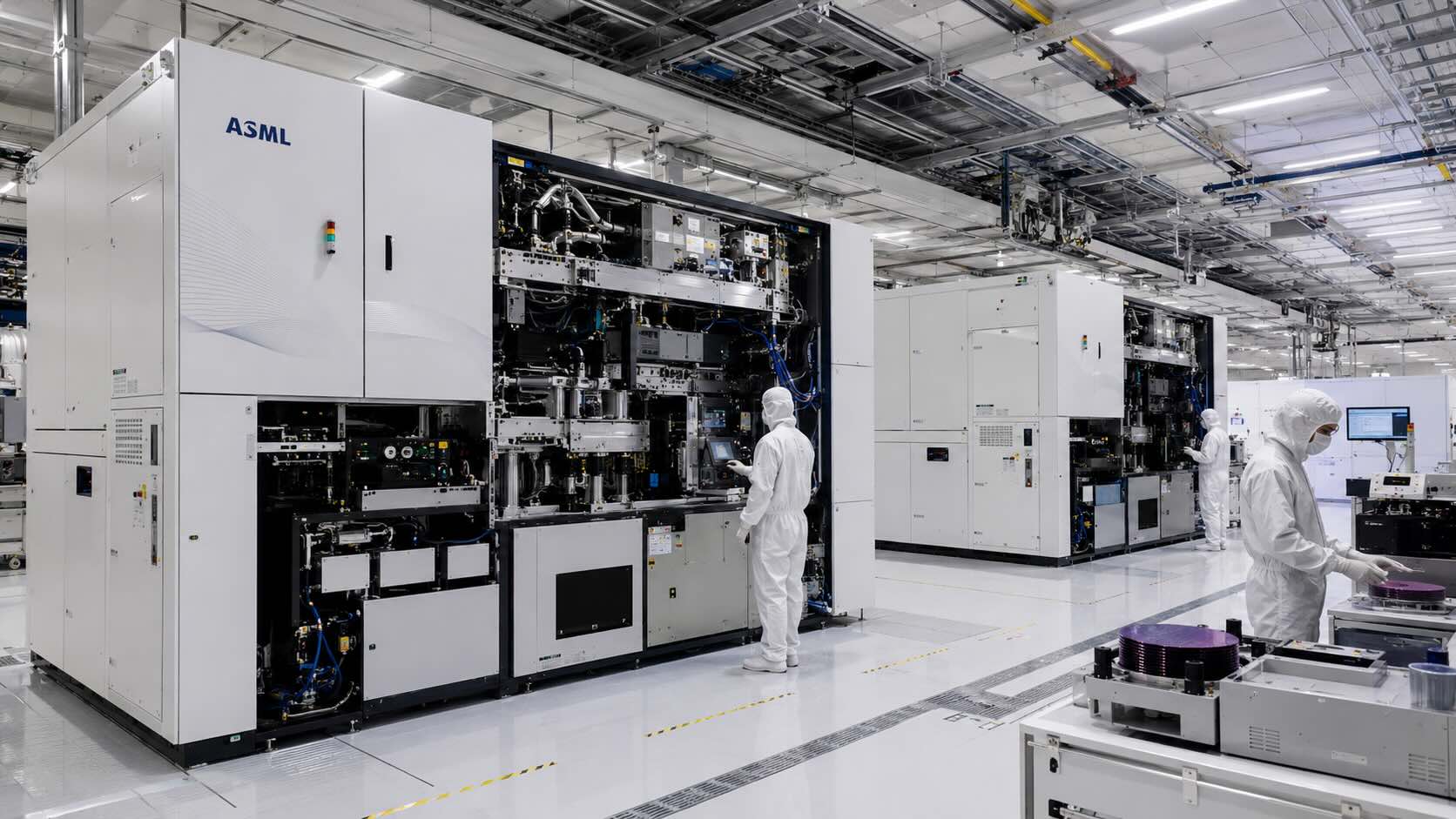
ASML calls its immersion systems the industry’s workhorses. Its own DUV product description says the latest NXT machines can process more than 6,000 wafers a day. Such tools are used for advanced logic and memory layers, and they can also support smaller features through multiple patterning, although at greater cost and complexity than EUV.
The distinction matters because most semiconductor demand is not confined to the most advanced artificial-intelligence processor. Cars, industrial equipment, communications systems, power electronics and consumer devices require enormous volumes of chips made with mature or moderately advanced processes. Even leading-edge chips contain layers for which DUV remains the economically sensible tool.
ASML’s April presentation to shareholders described DUV as a product family that “will remain a workhorse”. The company said it recognised revenue on 279 DUV systems in 2025, of which 47 per cent were immersion machines, generating €12bn in DUV system sales. Against that scale, five Chinese systems are experimental industrial capacity rather than a market revolution.
Yet a lithography programme does not need to displace ASML globally to change the strategic balance. Its first task is to give Chinese fabs an alternative where access to imported equipment, parts, upgrades or service may be restricted. Twenty machines used intensively for learning can be more significant than their immediate share of production suggests.
Export controls can delay and stimulate at the same time
The case for Western controls is rooted in security. Advanced semiconductors enable high-performance computing, artificial intelligence, surveillance and military systems. The Dutch government has progressively brought specified lithography and related manufacturing technologies under national licensing requirements.
When the Netherlands tightened the measure in 2025, it said uncontrolled access to relevant equipment created increased security risks and could contribute to advanced military applications. The system is formally a case-by-case authorisation requirement applying to exports outside the EU, not a universal ban.
Controls can still produce two effects at once. In the short term they deny or delay access to superior equipment, raising China’s cost of producing advanced chips. In the longer term they increase the commercial and political value of replacing the foreign supplier. Chinese laboratories, equipment manufacturers and chipmakers are given a common customer: a state-supported domestic industry that cannot assume continued access to Western tools.
This does not prove that the restrictions have failed. Without them, Chinese fabs might possess more capable systems today and face less pressure to accept the defects, downtime and lower throughput of a new domestic machine. Time has strategic value. A technical lead preserved for several years can shape military capability, corporate investment and the location of production.
But policy should be judged against a realistic objective. Export controls can obstruct diffusion; they rarely freeze engineering knowledge permanently. If success is defined as preserving ASML’s monopoly in China indefinitely, the policy is vulnerable to the very substitution effort it encourages. If success is defined as keeping the frontier out of reach while Europe continues to innovate faster, the relevant measure is the performance gap, not the absence of any Chinese machine.
ASML’s protection is an ecosystem, not simply a patent portfolio
The hardest part of reproducing a lithography system is not building a single prototype. Commercial fabs require machines that expose wafers quickly, align successive layers with extraordinary accuracy, operate for long periods and integrate with metrology, software, masks, light sources and factory processes.
ASML’s advantage rests on that accumulated system: specialist suppliers, decades of operating data, field engineers, upgrades and close work with chipmakers. Its installed-base business generated €8.2bn in 2025, according to the company’s shareholder presentation. That service relationship is both a source of revenue and a barrier to a new entrant.
A Chinese system that is slower or less reliable can nevertheless be useful if domestic customers are instructed or subsidised to adopt it. The initial production run will create operating data, reveal component failures and train engineers. SMIC, Hua Hong and CXMT are not merely buyers in that process; they can become development partners.
This is why the market reaction should not be dismissed as panic. A domestic alternative can first take the least demanding layers, then improve. It may reduce new Chinese orders for imported DUV equipment before it approaches ASML’s technical frontier. It can also weaken the leverage associated with servicing restrictions if Chinese fabs gradually build production lines that do not depend on Dutch maintenance.
Europe’s policy test is now commercial
EU Today previously examined how an ASML warning exposed tensions in Brussels’ technology-sovereignty agenda. The latest development brings the external side of that argument into sharper focus. Europe wants to protect a strategic lead while retaining the revenue, talent and research scale that make the lead possible.
China has historically been an important market for ASML, particularly as customers accelerated purchases of equipment still available under changing rules. If local replacement begins, the cost will not be confined to forgone machine sales. Fewer new systems eventually mean fewer upgrades and service contracts. The effect would be gradual, but the high-margin installed base makes it economically important.
Europe therefore needs a policy more demanding than repeated additions to a control list. It must protect research, retain specialist engineers, support the supplier network and ensure that ASML has growing customers in Europe and allied markets. Coordination with the United States and Japan also matters: restrictions that differ widely by country can divert orders without delivering a coherent security result.
The immediate evidence remains incomplete. Production targets can slip, and a tool that works in a controlled demonstration may fail the yield and uptime requirements of a commercial fab. The unnamed manufacturer’s output and customer acceptance will need independent confirmation.
Even so, the strategic warning is clear. ASML still owns the superior technology and the industrial system around it. China is trying to make dependence itself temporary. Western policy bought time; the appearance of a domestic immersion machine is a reminder that the value of that time depends on what Europe builds while it lasts.