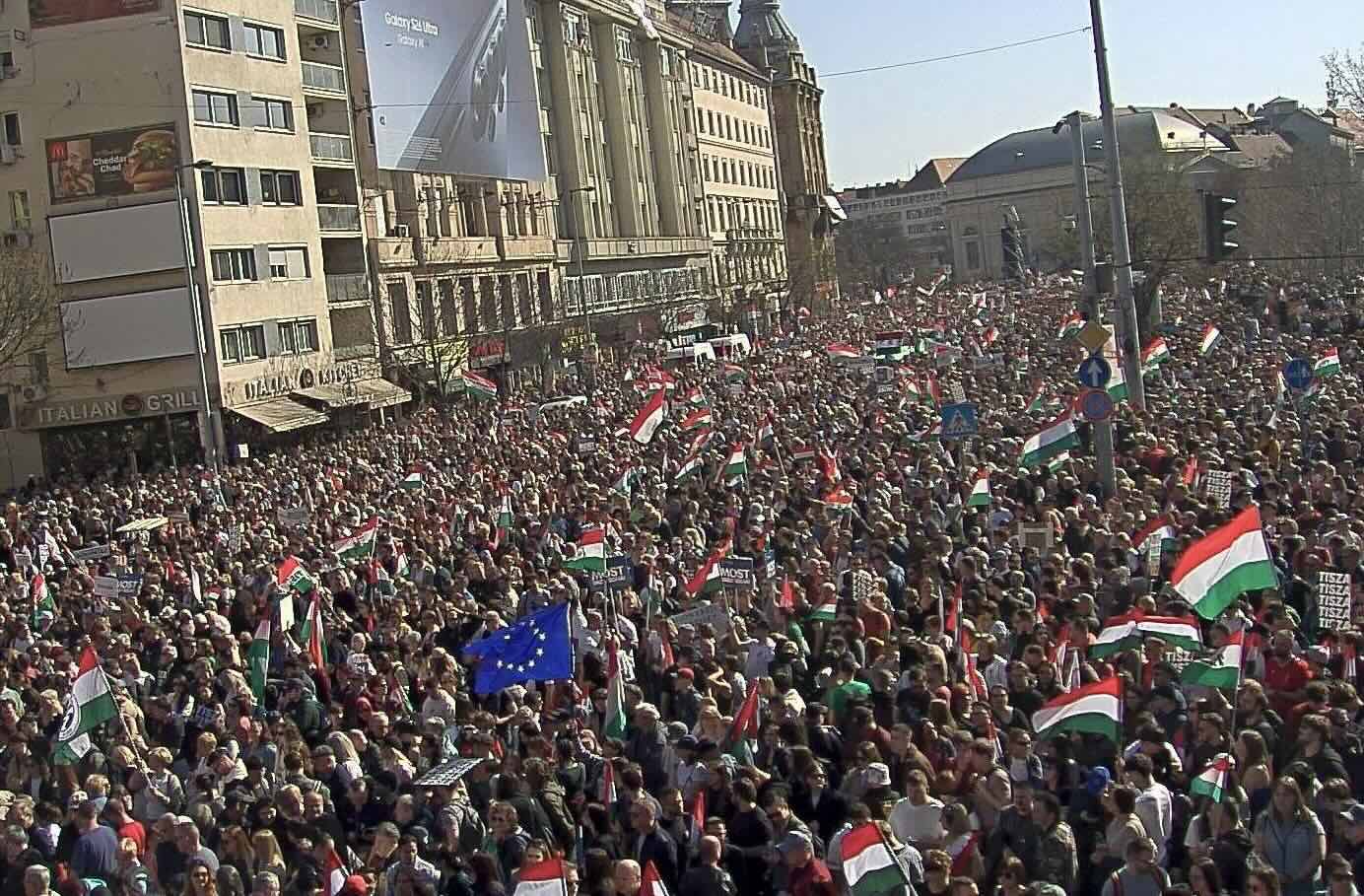
Rival rallies in Budapest on Hungary’s national day have turned a symbolic anniversary into a display of political strength, with Viktor Orbán facing his most serious electoral challenge in years from Péter Magyar.
Hungary’s National Day has become an early measure of political momentum, with rival demonstrations in Budapest on Sunday underlining how sharply the country’s election campaign has polarised. Prime Minister Viktor Orbán and his challenger Péter Magyar each sought to turn the 15 March commemoration of the 1848 revolution into a show of strength before the parliamentary election set for 12 April.
The contest matters well beyond Hungary’s borders. Orbán, who has been in power since 2010, has become one of the European Union’s most disruptive internal actors, frequently clashing with Brussels over rule-of-law standards, migration, media freedom and the bloc’s policy towards Russia and Ukraine. The election is shaping up as a significant challenge to his rule, with Magyar’s Tisza party leading in most recent polls.
Orbán has sought to frame the campaign in familiar terms. He has presented the election as a choice between “war and peace”, accusing the opposition of wanting to draw Hungary into the war in Ukraine, an allegation Magyar denies. That line fits Orbán’s wider political method: linking domestic opposition, Brussels and Ukraine to a single external threat narrative aimed at consolidating his base.
Magyar, a former insider who broke with the governing camp, has positioned himself as a pro-European conservative alternative rather than a conventional liberal opponent. That gives him a broader reach in a country where scepticism towards Brussels does exist, but where frustration over economic stagnation, rising living costs and corruption allegations has also deepened. Reuters reported earlier this week that a poll by the 21 Research Centre put Tisza on 53 per cent among decided voters, against 39 per cent for Fidesz.
Sunday’s rival events were therefore more than campaign theatre. They were an attempt by both camps to demonstrate turnout potential, discipline and enthusiasm at a point when the political race appears more competitive than at any stage in Orbán’s recent rule. Both leaders used the national holiday to urge maximum mobilisation, while anti-Ukraine rhetoric remained a prominent element of Orbán’s message.
For the EU, the election is important not because Hungary is likely to alter its geography or alliances overnight, but because a shift in Budapest would affect decision-making inside the bloc. Orbán has repeatedly used Hungary’s position to delay or complicate common EU positions, particularly where sanctions, aid to Ukraine and enlargement politics are concerned. Even if Magyar has also taken a cautious line on fast-tracking Ukraine’s EU membership, a government less willing to turn disputes with Brussels into a permanent political strategy would change the internal balance of the Union.
That does not mean Orbán is finished. Fidesz still benefits from entrenched media influence, a strong rural base and a political machine built over more than a decade. Poll leads in opposition-friendly surveys do not automatically translate into victory, especially in a system where turnout, constituency dynamics and campaign control matter.
But the political atmosphere has clearly changed. The key point from Sunday is not that the result is already settled, but that Hungary’s governing party is being forced into a visibly competitive fight. For a leader long accustomed to defining the terms of domestic politics, that is in itself significant.
The coming weeks will show whether Magyar’s challenge can survive the pressures of a national campaign. Sunday’s rival rallies suggest that, for the first time in years, Orbán is not simply staging a march to another victory. He is fighting to preserve a political system that has long seemed unshakeable.