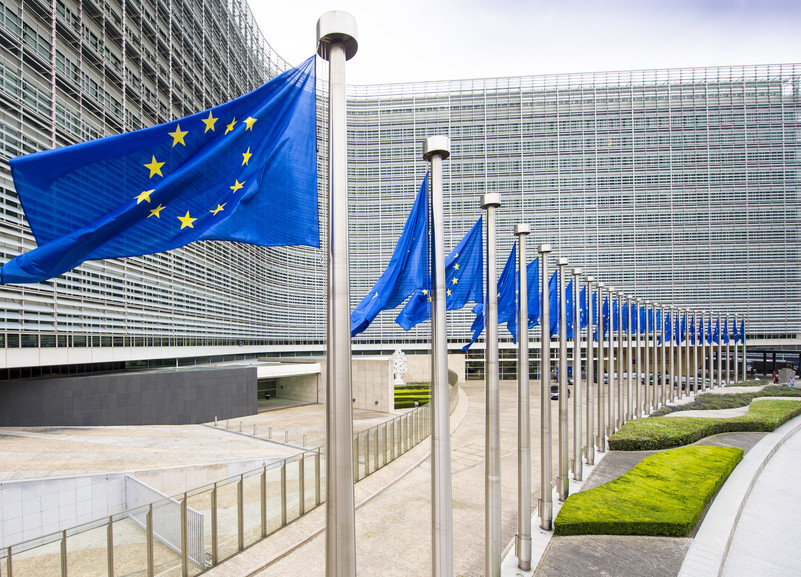
Senior figures in Brussels are openly at odds over how the European Union should respond to the war involving Iran, exposing a familiar weakness in Europe’s foreign policy: agreement on general principles, but division over how, and how firmly, those principles should be applied.
The latest dispute has centred on the language used by EU leaders in addressing the US-Israeli military campaign against Iran and the broader question of whether Europe is still prepared to anchor its external policy in international law. According to Financial Times reporting published on 11 March, European Commission President Ursula von der Leyen drew criticism from within the Commission after remarks seen by some colleagues as placing less emphasis on a strict legal reading of the conflict. The report said Commission Executive Vice-President Teresa Ribera pushed back, insisting that the defence of international law remained essential.
That disagreement matters beyond personalities. It goes to the centre of a long-running European argument: whether the EU should define itself primarily as a rules-based actor, or whether it must accept a harsher geopolitical environment in which legal consistency gives way to strategic expediency. In Brussels, those two instincts increasingly sit in tension.
The EU’s formal position has, until now, been more cautious than confrontational. In June 2025, after the first phase of direct military escalation between Israel and Iran, the EU’s High Representative, Kaja Kallas, said member states agreed on the need for de-escalation and called on all sides to abide by international law, while maintaining that Iran must never acquire a nuclear weapon and that diplomacy remained the only lasting solution.
That same line was later reflected in European Council conclusions. On 26 June 2025, EU leaders welcomed the cessation of hostilities, urged all parties to respect international law, and stated that the Union would continue diplomatic efforts aimed at a negotiated solution to the Iranian nuclear issue.
But the current dispute suggests that the apparent consensus was thinner than it appeared. Some officials and governments argue that, whatever their concerns about Iran’s nuclear ambitions and regional role, the EU cannot afford to appear selective in its invocation of legal norms. Others are more inclined to frame the confrontation through a security lens, with less appetite for public criticism of Western or Israeli military action. The result is a recurring ambiguity in the European message.
That ambiguity is now feeding into wider debate in the European Parliament. Parliament’s March 2026 plenary agenda specifically included a debate on the US-Israel military operation against Iran, its consequences, and the need to support Iranians, linking the issue directly to expectations for the 19-20 March European Council. Parliament had already devoted significant attention to the Middle East crisis in June 2025, when MEPs debated the risk of further instability after the Israel-Iran escalation.
The Parliament’s role is not decisive in foreign policy, but it is politically important because it amplifies the divisions already visible among member states. Some capitals, notably in southern and western Europe, have shown greater readiness to stress legality, restraint and the dangers of further escalation. Others have placed more weight on deterrence, Iran’s record of regional destabilisation, and the strategic importance of remaining aligned with Washington. Reuters reported in June 2025 that Britain, France and Germany jointly urged Iran not to take steps that would further destabilise the region after US strikes on Iranian nuclear facilities, illustrating how Europe’s largest powers sought to combine calls for restraint with continued pressure on Tehran.
This leaves the EU in a difficult position. It wants to be seen as a geopolitical actor, yet its influence remains constrained by internal fragmentation and by its limited hard-power capacity. It wants to defend international law, yet its credibility suffers whenever senior officials appear divided over when that law should be invoked and against whom. It wants a diplomatic role, yet major decisions in crises involving Iran, Israel and the United States are still shaped primarily outside Brussels.
There is also a broader institutional issue. The EU’s foreign policy is often strongest when it speaks in carefully drafted conclusions after prolonged negotiation. It is weaker when events move quickly and individual leaders speak first, before a common line has been fixed. In such moments, Europe’s internal contradictions become visible.
The argument now unfolding over Iran is therefore not only about one war. It is about whether the European Union can present a coherent external doctrine at a time when the international order is under strain. If Brussels cannot reconcile strategic realism with legal consistency, it risks sounding divided precisely when it is trying to be heard as a serious foreign-policy power.