There was a time—not so long ago—when Ireland was known as the land of saints and scholars, however the nation’s moral compass, once magnetised by the teachings of Christianity, has now swung wildly off course.
Today, the once deeply religious island seems to be erasing not just its Christian heritage, but even the basic liberties that are supposed to underpin Western democracy. Nowhere is this cultural transformation more chillingly illustrated than in the surreal and punitive saga of Enoch Burke.
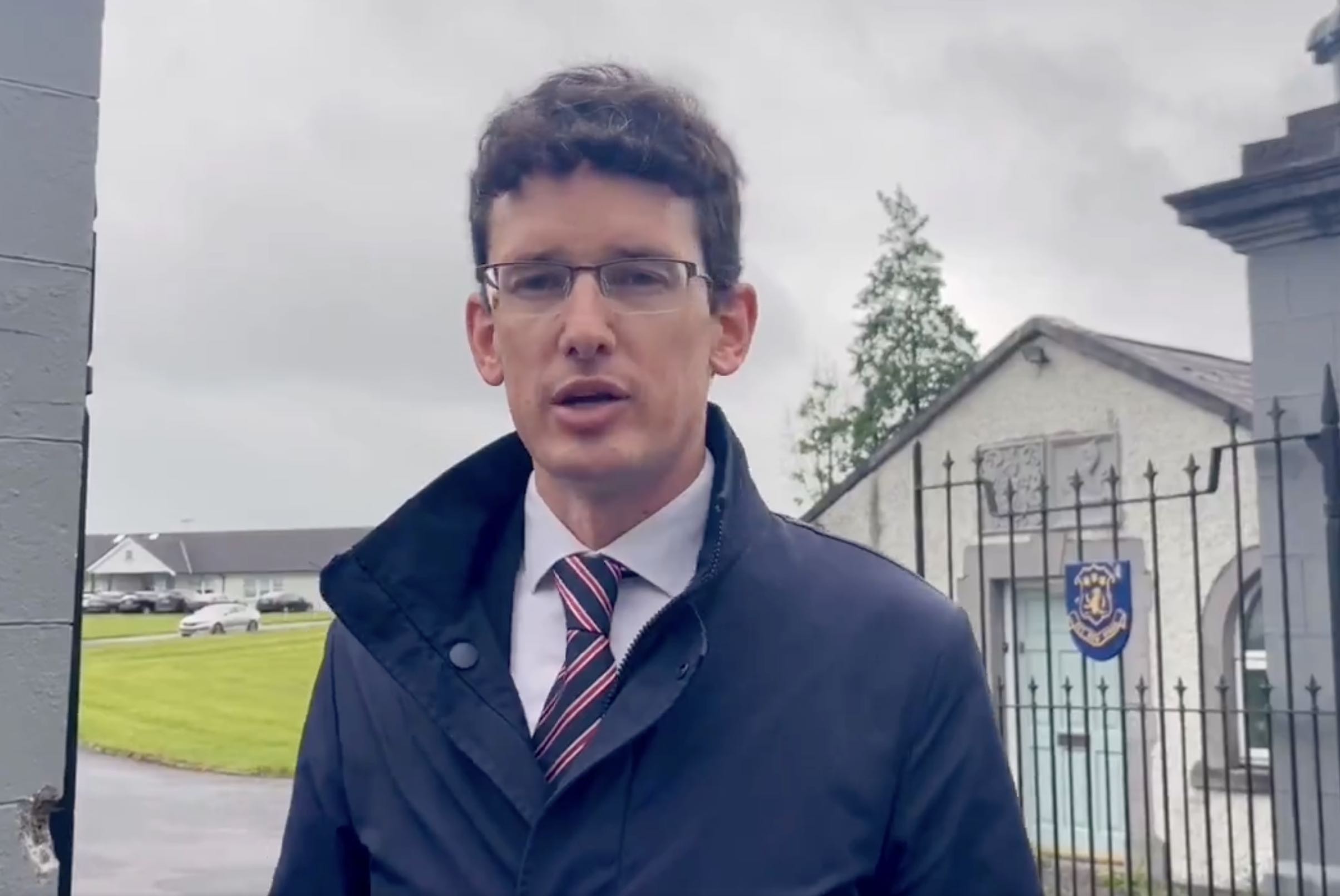
Burke, a devout Christian and teacher, taught at Wilson’s Hospital School—an institution nominally affiliated with the Church of Ireland. That affiliation, he mistakenly believed, implied a fidelity to Biblical principles. In particular, Burke maintained the traditional Christian view of sex as a God-given binary—a view which, until very recently, was considered so uncontroversial as to be common sense.
But common sense is a dangerous heresy in Ireland’s new orthodoxy. When a student in his class asked to be referred to with a different gender identity, Burke refused to comply, on the grounds that doing so would violate both his conscience and his understanding of truth. He did not shout. He did not abuse. He simply declined to say something he believed to be false. For this, Burke has been hounded, suspended from his job, jailed, fined, and ultimately impoverished by the state.
This isn’t justice. It is an ideological inquisition.
The Irish state’s position is that Burke’s punishment is not for his beliefs but for his refusal to obey a court order to stay away from the school. Technically, this is true. But it is also wilfully obtuse. Burke would never have been dragged into court had the school not insisted that he affirm something he considered a lie. It is like burning someone at the stake for failing to kneel before a false idol, then insisting their crime was merely “refusing to vacate the temple steps.” The pretext doesn’t erase the underlying cause.
Burke has now spent over 500 days in prison, amassed more than €79,000 in fines, and had both his salary and his bank account seized by the High Court of Ireland. One might think this is the sort of fate reserved for terrorists, fraudsters, or organised criminals. Instead, it has been meted out to a schoolteacher whose only offence was to live according to his convictions.
Those who shrug this off by muttering about the rule of law fail to ask a deeper question: what sort of law is it that punishes dissent in matters of conscience? That Burke’s treatment is cloaked in legalisms does not make it any less tyrannical. After all, every historical despot—from Torquemada to Robespierre to Stalin—had courts and paperwork.
What makes this even more grotesque is the context in which it is unfolding. Ireland, while quick to crush Christian dissenters, seems remarkably hesitant to offend newer religious sensibilities. Islam, for instance, is now the country’s third-largest faith. Many Muslims, whose own religious teachings affirm a clear sexual binary, would almost certainly sympathise with Burke’s stance. But unlike devout Christians, they are highly unlikely to be publicly challenged or penalised for their beliefs.
This double standard is not lost on the public. Burke, for all his stubbornness, is not a man of violence. He has not called for censorship, nor for anyone’s dismissal. He simply would not bend the knee. Yet in modern Ireland, such steadfastness is met with official ruin. Meanwhile, the state wraps itself in rainbow flags while nervously avoiding any confrontation with religious minorities whose views on gender are markedly similar to Burke’s. One suspects that, in Ireland’s new secular priesthood, Christian conviction is the only real blasphemy.
The treatment of Burke also speaks to a broader and more disturbing trend across Western Europe. We are seeing the rise of what could only be described as “progressive theocracy”: a regime that enforces its moral dogmas not with holy writ, but with HR policies, judicial orders, and financial ruin. Freedom of conscience—the bedrock of liberal democracy—is quietly being replaced by compelled speech and thought-policing.
Ireland’s political and media establishment, for the most part, remain shamefully silent. To question the logic of Burke’s persecution is to risk being labelled a bigot. But where are the supposed defenders of civil liberties? Where are the human rights watchdogs? Had Burke been an atheist teacher jailed for refusing to say grace before meals, the global outcry would be deafening.
In many ways, this silence is more frightening than the punishment itself. It suggests that Burke is not merely a victim of state overreach, but of a societal shift—a collective abandonment of the principles that once defined the West. The freedom to dissent, to follow one’s conscience, to speak what one believes to be true: all of these are now conditional upon whether that speech aligns with the ruling ideology.
It is no longer enough to tolerate new social norms. You must celebrate them, enforce them, and actively punish those who don’t. The Irish authorities could have allowed Burke to quietly decline participation and found a compromise. Instead, they chose to make an example of him. The message is clear: “Think as we do—or suffer.”
There is a bitter irony in the fact that this drama is unfolding in a country so proud of its hard-won independence. Having shaken off the yoke of colonial rule and broken with the authoritarianism of the Catholic hierarchy, Ireland now finds itself ensnared in a different kind of tyranny—one of ideological conformity masquerading as tolerance.
Burke’s defiance, whether one agrees with his views or not, should be recognised for what it is: a defence of conscience in an age that no longer values it. His story ought to trouble anyone who believes in the freedom to dissent, particularly within institutions that claim to value diversity.
For if we cannot tolerate the existence of a teacher who speaks what he believes to be true—without mobbing him, jailing him, and destroying his livelihood—then we are not a liberal society at all. We are merely a polite totalitarianism, armed not with truncheons but with tribunals and fines.
Ireland must decide whether it will continue down this path. If Burke’s case stands, it will not be the last. Today it is a Christian schoolteacher. Tomorrow it may be a feminist academic. Or a gay rights advocate who objects to the trans agenda. Ideological purges do have a way of devouring their own.
Enoch Burke is not a martyr. But he is a warning.