
Recent events across multiple countries have reignited fears of a resurgence of the Islamic State (ISIS), a terrorist organisation that once dominated vast regions of Iraq and Syria.
Despite suffering significant territorial and leadership losses in recent years, the group continues to inspire violence worldwide. Analysts and policymakers are voicing concerns about the group’s evolving strategy and its potential to destabilise regions far beyond its original strongholds.
ISIS-Inspired Attacks in the West
The West has witnessed a string of attacks in recent months that bear the hallmarks of ISIS’s ideological influence. In the United States, a particularly alarming case involved a U.S. Army veteran who flew an ISIS flag on his truck before driving into a crowd of New Year’s revellers in New Orleans.
This attack underlines how the group’s propaganda still has the power to radicalise individuals, even years after its territorial defeat.
In Germany, similar concerns have arisen over sporadic acts of violence linked to ISIS-inspired individuals. European nations have long struggled with the challenge of combatting homegrown terrorism, which remains a persistent threat despite enhanced surveillance and counter-terrorism measures.
Sharia Courts and UK Concerns
In the United Kingdom, concerns have shifted towards the emergence of Sharia courts operating openly, albeit illegally.
While not directly tied to ISIS, these courts—which apply Islamic law—are seen by some as creating parallel justice systems that could potentially fuel radicalisation. Critics argue that the presence of such institutions undermines national law and could provide fertile ground for extremist ideologies to take root.
High-Casualty Attacks in Russia and Iran

Crocus City Hall, By Mosreg.ru, CC BY 4.0, https://commons.wikimedia.org/w/index.php?curid=146810986
The impact of ISIS is not limited to the West. In March 2024, gunmen targeted a Russian music hall, killing at least 143 people.
This tragic event highlighted the group’s ability to orchestrate or inspire attacks in countries with robust counter-terrorism frameworks.
Similarly, in January 2024, two explosions at an official ceremony in the Iranian city of Kerman claimed nearly 100 lives.
These incidents demonstrate ISIS’s capacity to strike in regions with differing political and security dynamics, showcasing its adaptability and resilience.
The Rise and Fall of the Caliphate
At the height of its power between 2014 and 2017, ISIS established a self-declared “caliphate” that spanned large areas of Iraq and Syria.
Under the leadership of Abu Bakr al-Baghdadi, who declared himself the caliph of all Muslims, the group imposed brutal rule marked by executions, torture, and systemic oppression.
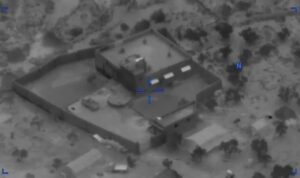
Abu Bakr al-Baghdadi’s compound, photographed by a U.S. drone
Baghdadi’s death in 2019 during a U.S. special forces raid in northwestern Syria dealt a symbolic blow to the group, but it did little to erase its influence.
The collapse of the caliphate—first in Iraq in 2017 and later in Syria in 2019—was the result of a sustained military campaign led by a U.S.-led coalition. Thousands of ISIS fighters were killed or captured, and the group’s territorial ambitions were dismantled.
However, ISIS’s response to these losses was to decentralise its operations, scattering into autonomous cells that continue to pose a threat.
The Persistent Threat
The United Nations estimates that ISIS retains around 10,000 fighters in its heartlands of Iraq and Syria. While the group’s leadership operates in secrecy, its decentralised structure makes it difficult to fully eradicate. Autonomous cells carry out attacks independently, often inspired by the group’s propaganda rather than direct orders from a central command. This decentralised model has allowed ISIS to maintain its relevance despite losing its territorial base.
Moreover, the group has leveraged digital platforms to spread its message and recruit new followers. Online propaganda and encrypted communication channels enable it to reach a global audience, circumventing traditional counter-terrorism measures. This adaptability underlines the challenge of combating an organization that has evolved beyond conventional definitions of a terrorist group.
Global Implications
The recent attacks highlight the need for international cooperation to address the persistent threat posed by ISIS. While military campaigns have been effective in dismantling its territorial stronghold, a comprehensive strategy that includes counter-radicalisation efforts, intelligence sharing, and community engagement is essential.
The resurgence of ISIS-inspired violence also serves as a reminder that the fight against terrorism is far from over. Governments and societies must remain vigilant to prevent the group from exploiting vulnerabilities and spreading its extremist ideology. The lessons of the past decade emphasise the importance of addressing the root causes of radicalisation while maintaining a robust security apparatus.
While ISIS no longer commands the same level of power it once did, its capacity to inspire and orchestrate violence remains a significant concern. The recent spate of attacks across the globe emphasises the need for sustained vigilance and international collaboration to prevent a full-scale revival of the group.



