
For decades, Moscow’s Victory Day parade has served as the Kremlin’s annual exercise in imperial nostalgia: a thunderous procession of tanks, missiles and choreographed patriotism intended to remind Russians — and the wider world — that their country remains a fearsome military colossus.
However this year’s May 9th spectacle in Red Square felt less like a celebration of strength than a nervous performance staged by a regime acutely aware that history may be catching up with it.
The so-called Victory Parade of 2026 was, by almost every measure, a diminished affair. Gone were many of the grand displays of heavy military hardware that once rumbled triumphantly through the heart of Moscow. Instead, giant television screens substituted for much of the missing machinery, while the parade itself was shortened and heavily constrained amid persistent fears of Ukrainian drone attacks.
It is difficult to project invincibility when one is visibly afraid of explosions overhead.
The Kremlin naturally attempted to package the event as proof of resilience. Vladimir Putin delivered his familiar sermon about Russia’s eternal destiny, historical sacrifice and inevitable victory. But there was something curiously weary about the entire production. Even the choreography seemed tired — less Soviet grandeur than regional theatre struggling through a reduced budget.
Most revealing of all were Putin’s remarks afterwards, when he declared that he believed the Ukraine war was “coming to an end”. For a leader who spent four years insisting that Russia could fight indefinitely, such language sounded remarkably like the rhetorical softening of a man preparing his public for an outcome far less glorious than originally promised.
One suspects the Kremlin has finally realised what much of the world understood long ago: wars of attrition have a nasty habit of devouring the political futures of the men who start them.
This is not to suggest that Putin’s system is about to collapse tomorrow morning. Russia remains authoritarian, heavily militarised and ruthlessly controlled. Yet authoritarian systems rarely implode with theatrical suddenness. More often, they decay slowly, hollowing out behind the façade until even the ceremonial pageantry begins to betray the strain.
And strain was everywhere visible in Moscow this weekend.
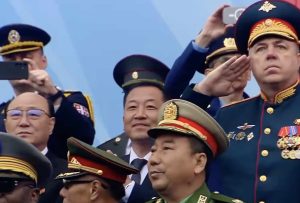
The parade reportedly lasted barely 45 minutes, a striking contrast to the extravagant demonstrations of previous years. Foreign attendance was thin, consisting largely of the usual collection of dependent allies, diplomatic opportunists and assorted anti-Western fellow travellers.
The conspicuous absence of many major international figures only reinforced the sense that Russia’s geopolitical orbit has narrowed dramatically since the invasion of Ukraine in 2022.
Even more embarrassing was the lack of military hardware itself. The annual Victory Day parade has long functioned as Russia’s showroom of intimidation — the public exhibition of tanks, missile systems and mechanised columns intended to evoke Soviet-era military supremacy. This year, however, security concerns and battlefield realities appear to have intervened.
One cannot help but notice the symbolism: the army once presented as NATO’s existential nightmare now appears reluctant to expose its own equipment in the centre of its capital.
Meanwhile, ordinary Russians face rising inflation, economic exhaustion and the quiet social corrosion that accompanies endless war. The Kremlin can still manufacture patriotic spectacle, but it cannot entirely conceal the fact that the conflict in Ukraine has become a grinding burden with no obvious strategic triumph to justify the cost.
Putin’s language increasingly reflects this reality. His suggestion that Europe should begin discussing future security arrangements sounded less like confident diplomacy and more like a tacit admission that Russia cannot continue indefinitely on its current trajectory.
There was once a swagger to Putinism — the cultivated image of a cold-eyed tactician always several moves ahead of his opponents. Yet the Moscow spectacle of 2026 revealed something different: a leadership obsessed with optics, haunted by vulnerability and desperate to maintain the illusion of permanence.
History offers many examples of regimes staging increasingly elaborate ceremonies precisely as their authority begins to weaken. The louder the orchestras play, the more one suspects the leadership can already hear the distant creaking of the floorboards beneath them.
Victory Day, once a genuinely solemn commemoration of Soviet sacrifice during the Second World War, has gradually become absorbed into the mythology of Putin’s personal rule. This year, however, the mythology looked threadbare. The symbolism no longer matched the reality.
A parade without tanks. A “victory” celebration overshadowed by fear of attack. A wartime leader suddenly speaking about endings.
For all the martial music echoing across Red Square, the dominant impression was not confidence but apprehension. Putin may still occupy the Kremlin, but increasingly he resembles an ageing ruler attempting to choreograph one final image of strength before events move beyond his control.
Old Wine, New Bottles: Putin’s Latest ‘Peace Offer’ Is Nothing More Than a Trap
Click here for more News & Current Affairs at EU Today
Click here to check out EU TODAY’S SPORTS PAGE!
___________________________________________________________________________________________________________________



