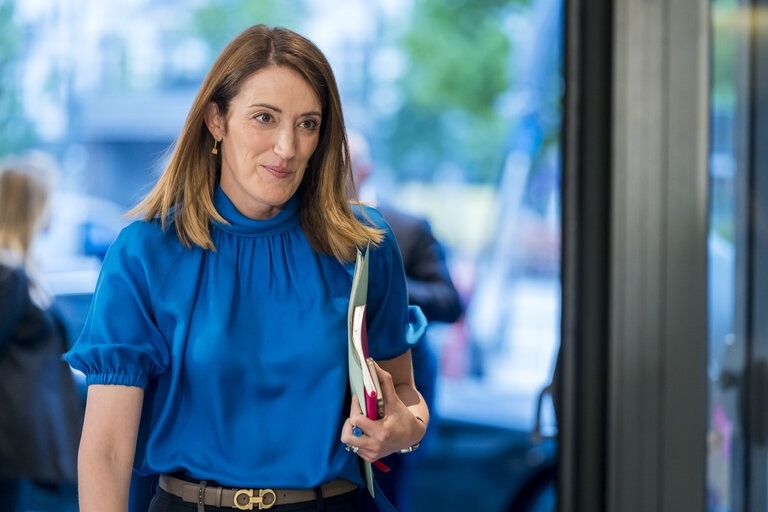
In a striking and wide-ranging address delivered to EU leaders today in Brussels, European Parliament President Roberta Metsola warned that the fragile ceasefire between Israel and Iran, the threat of a nuclear-armed Tehran, and continued instability in Gaza represent a defining test for Europe’s credibility on the world stage.
“I just came back from the Middle East,” Metsola told the assembled leaders, “and the situation there is still volatile, and deeply concerning.” Citing the recent truce between Israel and Iran as a “hopeful step forward,” she cautioned that Tehran’s decision to halt cooperation with the International Atomic Energy Agency had exposed just how precarious peace remains.
“The world understands that Iran cannot acquire a nuclear bomb,” she said bluntly. “That is a threat not just to the region, but to the world.”
Metsola’s address, notable both for its diplomatic clarity and political urgency, comes amid increasing fears that the Middle East could again erupt into wider conflict. She urged EU leaders to keep open “all channels” to ensure the Israel-Iran ceasefire holds and to reinforce support for a two-state solution that offers security for Israel and a “credible perspective” for Palestinian leadership.
“The path to peace may be difficult, but it is not impossible,” she insisted. “That makes it necessary for us to have a coherent and united front in our approach to the Middle East.”
Europe’s Eastern Front
Turning to the continent’s own periphery, Metsola was unequivocal: “When it comes to Ukraine, our support must remain strong.”
She hailed the European Union’s adoption of a 17th package of sanctions against Russia, calling for swift agreement on an 18th round to further tighten the noose around the Kremlin. Emphasising the strategic significance of enlargement, she welcomed Ukraine and Moldova’s progress in meeting accession criteria.
“The ball is now in our court,” she said. “We cannot lose sight of the fact that a merit-based enlargement—with clear goals and criteria—is the smartest investment we can make in our continent’s stability, prosperity, and peace.”
Metsola dismissed the notion that Kyiv was being granted a shortcut, framing its progress as “deserved, not fast-tracked.”
Defence, Energy and Urgency
The speech came just one day after NATO allies agreed to raise defence spending targets to five percent of GDP, a move Metsola enthusiastically endorsed. She also welcomed proposals to finally end Europe’s dependence on Russian energy—something the European Parliament has long championed.
But she warned that phasing out Russian imports is only “one part of the equation.”
“What’s just as important is what comes next,” she said, stressing the need for alternative energy supplies that do not compromise security or affordability. “We need to explain why we’re doing this. Why this matters in an era where our way is not as self-evident as we thought.”
With an eye to domestic scepticism, Metsola argued that such monumental shifts require more than elite consensus—they require public support. “We cannot afford to move forward without bringing our people along.”
She outlined the Parliament’s commitment to fast and efficient lawmaking, citing examples where urgent legislation—such as ammunition production (ASAP) and common procurement—had passed in weeks rather than months. She vowed to apply that same urgency to upcoming negotiations on the Defence Omnibus package.
On the EU’s long-term budget—the Multiannual Financial Framework—she reiterated Parliament’s readiness to engage. “We are eagerly awaiting the Commission’s proposal, due next month,” she said, adding that a full parliamentary report will follow by autumn 2025.
A Parliament Transformed
In one of the most striking passages of the address, Metsola described a newly reformed European Parliament: faster, more responsive, and less bogged down by bureaucratic delay.
“Processes that used to take months now can take just a few hours,” she declared. “Yes, we have our processes—and rightly so. But that doesn’t mean we are not fully committed to delivering with speed. On the contrary, we have shown that we can do both.”
This, she suggested, is the direction Europe must take if it is to be “faster, smarter, and more business-friendly”—particularly for SMEs and strategic industries. She warned against “cosmetic changes” and called for “predictability” in policymaking to support the continent’s industrial base.
A New Right for Women in Politics
Metsola closed her speech with an unexpected but symbolically powerful proposal: a targeted amendment to the EU Electoral Act allowing pregnant or recently postpartum female MEPs to delegate their votes.
“No country, no institution, and no democracy should ever penalise elected representatives for choosing to start a family,” she said, appealing for unanimous support. “Representation should never come at the cost of parenthood—and with this step, we choose to stand by both.”
It was a deeply personal and political note on which to end a speech that spanned conflicts and crises from Gaza to Kyiv and Brussels to Strasbourg. Yet it reflected Metsola’s broader message: that Europe’s strength lies not just in hard power or diplomacy, but in its capacity to adapt, reform and lead with both principle and resolve.
As EU leaders digest the Parliament President’s message, the real question will be whether the bloc can rise to meet the challenges she laid bare—with unity, urgency, and understanding.