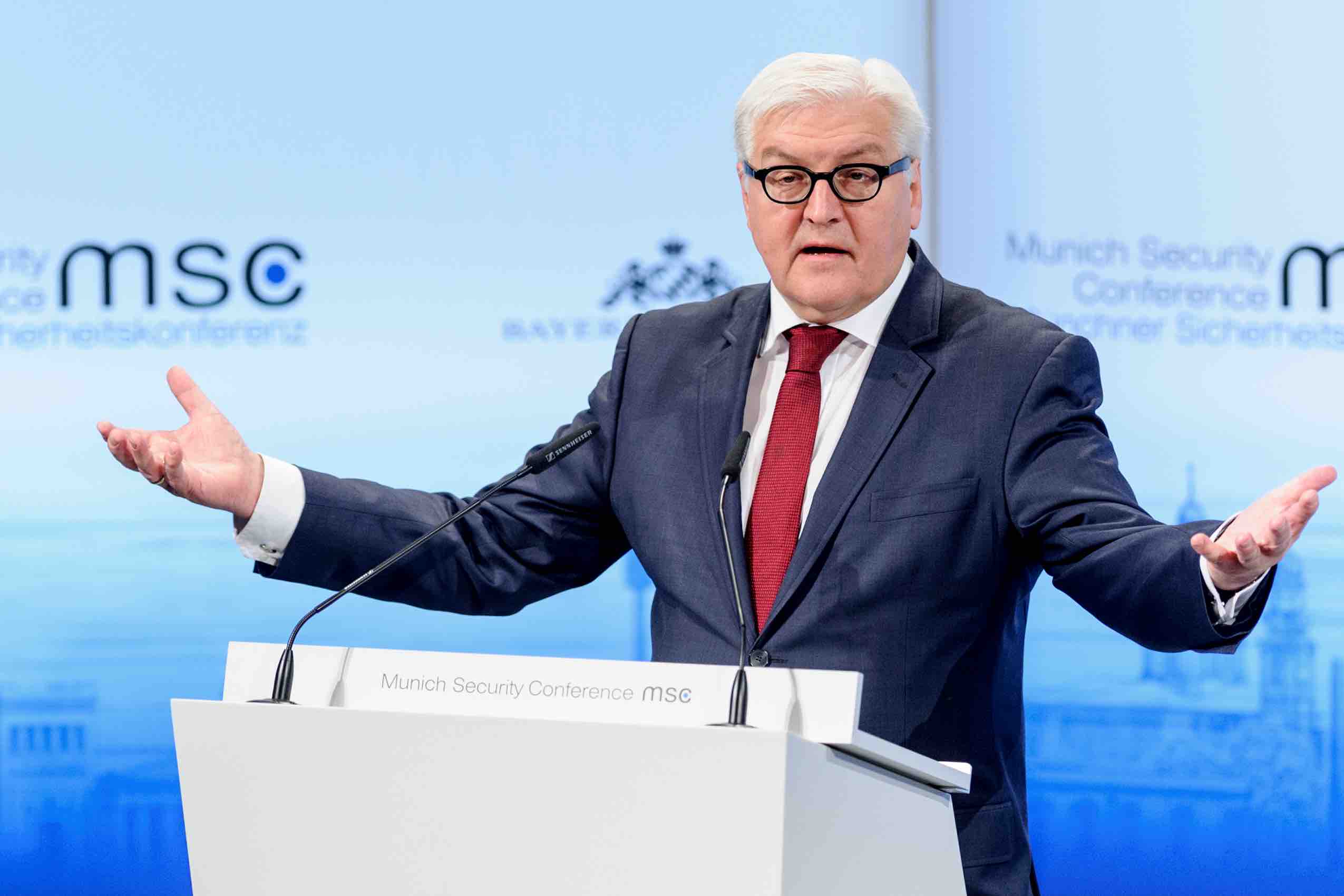
When Germany’s President Frank-Walter Steinmeier accused the United States this week of “destroying the world order”, he was giving voice to a widespread European anxiety.
Yet the deeper significance of his remarks lies elsewhere. Beneath the criticism of Washington sat a far more uncomfortable truth: Europe’s real problem is not Donald Trump, but Brussels’ inability to understand — or respond to — the kind of power politics America once practised openly.
Steinmeier understands this. His speech in Berlin was not merely a lament for a fading rules-based system, but an implicit indictment of a European Union that has spent decades convincing itself that history had ended, strategy had softened, and power had become impolite.
Trump’s “America First” doctrine has certainly unsettled Europe. His intervention in Venezuela, followed by the blunt assertion that US oversight could last for years, sent tremors through Brussels. Yet none of this should have come as a surprise. Trump has never concealed his worldview. He sees sovereignty as paramount, alliances as conditional, and international institutions as tools — not lodestars.
In this, he is less a revolutionary than a revivalist.
The irony, which Steinmeier appears to grasp even if Brussels does not, is that Trump’s approach bears striking similarities to Reagan-era realism — a period many European leaders now romanticise while failing to recognise its logic when it reappears. Ronald Reagan spoke the language of values, but governed through strength, leverage and unapologetic national interest. He negotiated arms control from a position of military dominance, defended allies while demanding more of them, and never mistook multilateralism for an end in itself.
Europe understood Reagan because it had to. It rearmed, aligned and adapted. Today, faced with a president cut from a similarly hard-edged cloth — albeit with less polish and fewer pleasantries — Brussels reacts not with adjustment, but with bafflement.
Steinmeier’s warning that the post-war order is unravelling reflects genuine concern. Russia’s invasion of Ukraine, which he rightly described as a historic rupture, shattered the illusion that force had been banished from Europe. But by placing recent US actions alongside Russian aggression, Steinmeier signalled something more troubling: that Europe is losing its grip on how the world actually works.
The EU remains wedded to a bureaucratic model of foreign policy ill-suited to an age of renewed great-power competition. It produces strategies rather than strategy, declarations rather than decisions. Its foreign policy machinery, bound by unanimity and process, is incapable of speed, surprise or pressure — the very tools Trump deploys instinctively.
Reagan would have recognised this weakness immediately. Trump exploits it.
This is why Europe is perpetually wrong-footed. Surprised when Washington bypasses it. Surprised when decisions are announced rather than negotiated. Surprised when American priorities diverge sharply from European sensibilities. Yet none of this is erratic. It is entirely consistent with a worldview that sees power as something to be exercised, not managed.
Steinmeier’s critique also exposes a deeper European contradiction. The EU speaks endlessly of “strategic autonomy”, yet remains militarily dependent on the United States. It invokes international law, yet lacks the means to enforce it. It claims moral authority, yet hesitates whenever that authority must be tested.
NATO still endures, as Germany’s foreign minister was quick to reassure. But it does so increasingly on American terms. Reagan once pressed European allies to shoulder more responsibility, warning that American patience was not infinite. Trump has simply stripped away the diplomatic cushioning.
Global reactions to US action in Venezuela have underlined Europe’s marginality. Latin American states protested loudly. China and Russia condemned swiftly. Europe issued cautious statements and waited. It neither shaped events nor influenced outcomes.
Steinmeier’s call for emerging powers such as India and Brazil to play a greater stabilising role betrays an awareness that Europe is no longer central by default. Influence must now be earned through capability and coherence — qualities Brussels struggles to supply.
The uncomfortable conclusion Steinmeier gestures towards, without stating outright, is that Europe is not being destabilised by Trump’s behaviour, but exposed by it. The world has not suddenly become more brutal; Europe has simply forgotten how to operate within it.
Reagan understood that order rests on strength, not sentiment. Trump understands it too. Brussels, by contrast, still hopes that rules can survive without power to defend them.
Trump did not destroy the world order. He reminded Europe what once sustained it — and revealed how far Brussels has drifted from that reality.
Main Image: Par Tobias Kleinschmidt — https://securityconference.org/mediathek/asset/frank-walter-steinmeier-1014-01-02-2014/, CC BY 3.0 de, https://commons.wikimedia.org/w/index.php?curid=30976002
Click here for more News & Current Affairs at EU Today
Click here to check out EU TODAY’S SPORTS PAGE!
____________________________________________________________________________________________________________________________