
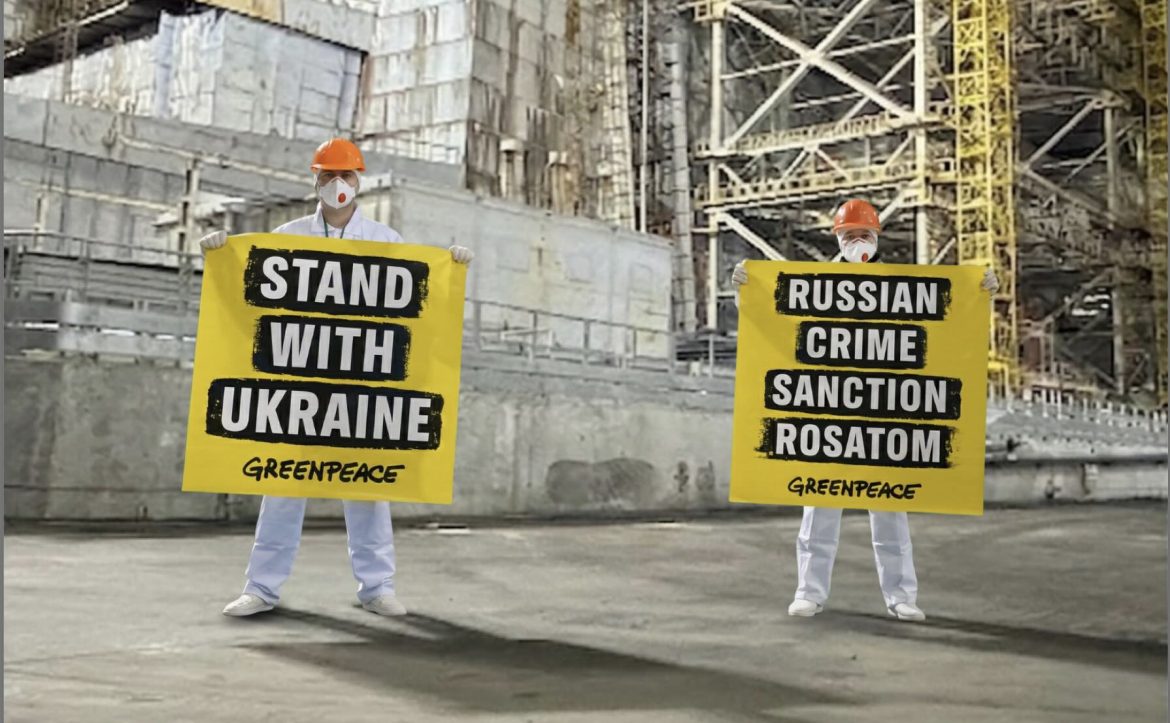
Greenpeace Ukraine has warned that the sarcophagus enclosing the destroyed fourth reactor at the Chornobyl nuclear power plant should be dismantled as soon as possible, but that damage to the New Safe Confinement has made this impossible for now.
In a report published on 14 April, Greenpeace said Russia’s war against Ukraine was directly threatening international efforts to repair the protective structure over Reactor Four. The organisation said the New Safe Confinement was damaged by a Russian drone strike in February 2025, leaving the remains of the reactor and the original sarcophagus inside a compromised structure.
The warning comes less than two weeks after international donors approved an initial €30 million package for engineering and procurement work linked to repairs at Chornobyl. The European Bank for Reconstruction and Development said the funding forms part of a broader plan to address damage to the New Safe Confinement, with total repair needs estimated at around €500 million.
Eric Schmieman, an engineer who worked for years at Chornobyl and was involved in the design and construction of the New Safe Confinement, warned that without urgent repair work the risk of collapse of the old sarcophagus would increase significantly. Greenpeace said such a collapse could raise the risk of radioactive material being released into the environment.
The New Safe Confinement, a large steel arch completed in 2019, was built to contain radioactive material and allow the eventual dismantling of unstable structures left after the 1986 disaster. Reactor Four exploded in April 1986, causing the world’s worst nuclear accident.
According to Reuters, G7 foreign ministers discussed repair efforts at their meeting in France in late March, with costs estimated at about €500 million, or $576 million. France said the G7 should take a leading role in fundraising, in cooperation with the EBRD.
Ukraine says the 2025 strike was carried out by a Russian drone with an explosive warhead. Moscow has denied responsibility. The International Atomic Energy Agency said after the attack that radiation levels remained normal and stable, but later reporting said the damaged structure required major repair to restore its safety function.
Shaun Burnie, senior nuclear specialist at Greenpeace Ukraine, said the drone strike had increased the risk of collapse before the sarcophagus could be safely dismantled. He also called for sanctions against Rosatom, Russia’s state nuclear corporation, which Ukraine says is illegally involved at the occupied Zaporizhzhia nuclear power plant.
Greenpeace said stronger sanctions against Rosatom had been blocked by some European countries, including Hungary and France. The organisation argued that continuing contracts with the corporation helped sustain Russia’s war economy.
The latest warning places renewed attention on Chornobyl as both a nuclear safety issue and a funding challenge. The EBRD-backed donor mechanism has begun the first phase of repair planning, but full restoration will require far larger commitments.
For Ukraine and its partners, the immediate question is whether repairs can proceed quickly enough to stabilise the New Safe Confinement before the ageing sarcophagus inside it deteriorates further.

