
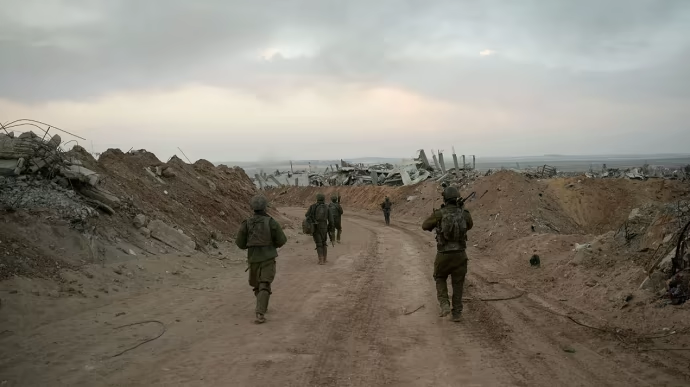
The Israeli Defence Forces (IDF) have launched what officials describe as “extensive ground operations” across both northern and southern Gaza, marking a significant escalation in efforts to dismantle Hamas and exert full military control over the coastal enclave. The renewed campaign comes amid continued pressure from the United States and the failure of indirect ceasefire negotiations in Qatar to produce a breakthrough.
The IDF stated that its forces had entered key positions throughout Gaza and had eliminated dozens of militants while targeting Hamas infrastructure, including weapons depots, tunnel networks, and missile launchers. The operation forms part of the broader ‘Gideon’s Chariots’ campaign, which began with over 670 airstrikes on Hamas-linked targets during the preceding week.
Armoured units and tanks pushed into major urban centres on Friday, and by Sunday evening the military confirmed that full ground manoeuvres were underway. Northern Gaza was again subject to sustained bombardment overnight, and reports from local hospitals indicate that at least 103 people were killed during the latest wave of Israeli strikes. Many of the casualties were women and children, according to medics.
In a parallel development, Prime Minister Benjamin Netanyahu on Sunday signalled Israel’s conditional openness to a negotiated settlement. His office stated that Israeli negotiators were in Doha “working to exhaust every possibility for a deal”, including options under the so-called Witkoff framework. The proposed arrangement would involve the release of remaining hostages taken by Hamas in the 7 October 2023 attack, the exile of Hamas leadership, and the full disarmament of the Gaza Strip.
Netanyahu’s position marks a notable shift from earlier statements rejecting any cessation of hostilities. The Prime Minister said last week there would be “no way we will stop the war,” but on Sunday acknowledged that a ceasefire deal could now be possible under specific terms.
Hamas has so far rejected any proposal that does not include a permanent cessation of hostilities and full Israeli withdrawal from Gaza. The group also refuses to disarm or agree to the exile of its senior figures.
The humanitarian situation inside Gaza has continued to deteriorate rapidly. International aid agencies have warned that the blockade imposed by Israel since March has pushed Gaza to the brink of famine. On Sunday evening, following mounting diplomatic pressure – including from President Donald Trump and Secretary of State Marco Rubio – Israel announced it would permit limited food deliveries into Gaza.
A statement from Netanyahu’s office said the decision was aimed at preventing a full-scale hunger crisis, which could “jeopardise Israel’s new military offensive”. Aid groups including the World Food Programme and World Central Kitchen have reported that they are now effectively out of supplies, with many community kitchens closed and queues forming for basic staples.
Despite the announcement, humanitarian officials have questioned the feasibility and effectiveness of the aid delivery mechanism proposed by Israel, which involves distribution hubs guarded by Israeli troops and managed by private contractors. Critics argue this may lead to further displacement and falls short of addressing the scale of need on the ground.
The conflict continues to generate political tensions domestically within Israel. National Security Minister Itamar Ben-Gvir, whose Jewish Power party re-entered the governing coalition after hostilities resumed earlier this year, rejected any suggestion of a framework that does not end in the complete defeat of Hamas. “A framework to end the war without defeating Hamas – will not arise and will not happen,” he said.
Netanyahu has faced allegations that he is prolonging the conflict to satisfy hardliners in his coalition. Meanwhile, public pressure continues to mount from families of hostages. Einav Zangauker, whose son remains captive in Gaza, accused the government of prioritising political interests over lives. “They are deliberately tormenting us,” she posted on social media.
In parallel to military and diplomatic efforts, Washington has moved independently to secure the release of its own citizens. The recent release of US-Israeli dual national Edan Alexander was reportedly arranged by American negotiators without Israeli involvement, further fuelling speculation of strain between the Netanyahu and Trump administrations.
President Trump’s recent visit to the Gulf region included efforts to revive the Abraham Accords, a series of normalisation agreements between Israel and Arab states signed during his previous term. However, intelligence obtained by Israeli forces in Gaza suggests that Hamas may have launched the 7 October attack specifically to derail such normalisation efforts.
Documents reportedly recovered from Hamas tunnels in Gaza cite instructions from the group’s late leader Yahya Sinwar to undertake a “major move” to prevent a Saudi-Israeli agreement. One document dated 2 October 2023 directly referred to progress in the normalisation process and called for extraordinary action to halt it.
Saudi Arabia has since reiterated that it will not establish formal diplomatic relations with Israel until a Palestinian state is recognised – a condition Israel continues to reject. While President Trump described the potential inclusion of Saudi Arabia in the Abraham Accords as his “dream”, Riyadh’s position remains unchanged.
With Israeli forces expanding operations and the humanitarian situation in Gaza reaching critical levels, the prospects for a sustained ceasefire or political resolution remain uncertain. Despite ongoing diplomatic efforts in Qatar and limited aid concessions, both sides appear entrenched, and further escalation is likely.

