

The China–Kyrgyzstan–Uzbekistan railway is presented as a transport corridor, but speakers at a UN Human Rights Council event warned that it could also open fragile mountain territory to mining, industrial construction and the export of strategic minerals to China.
The proposed China–Kyrgyzstan–Uzbekistan railway has become a test case in the developing debate over ecocide: environmental destruction so severe, widespread or lasting that conventional regulation and financial penalties may no longer provide an adequate response.
At a side event held during the 62nd session of the United Nations Human Rights Council in Geneva, Gary Cartwright, editor of EU Today, argued that protecting the snow leopard was inseparable from protecting Central Asia’s mountain ecosystems, water resources and human communities.
Gary described the snow leopard as both a keystone and an umbrella species. As the leading predator in its habitat, it helps regulate populations of ibex and argali. If that balance is lost, excessive grazing can remove fragile vegetation, accelerate erosion, destabilise slopes and damage watersheds supplying water to millions of people.
The consequences would extend beyond one endangered animal. Snow leopard habitat also supports Himalayan brown bears, Eurasian lynx, wolves, vultures, golden eagles and numerous smaller species. Protecting the predator therefore means protecting the ecological system around it.
That argument forms the basis of EU Today’s white paper, Vanishing Tracks: The Snow Leopard and the China–Kyrgyzstan–Uzbekistan Railway, authored by Gary. The report identifies potential risks including habitat fragmentation, disruption of wildlife movement, displacement of prey, construction disturbance, increased access to remote areas and greater exposure to poaching.
New EU Today white paper examines CKU railway’s ecological impact on snow leopard range
The issue is not simply the railway’s immediate footprint. Speaking at the same event, former Danish MP Sascha Faxe argued that the line may serve not only to transport existing goods, but also to facilitate the extraction and export to China of rare-earth elements, iron, aluminium and other mineral resources.
A railway through mineral-rich territory can become the backbone of a much larger industrial network. Mines require access roads, power supplies, water, explosives storage, processing plants, tailings facilities, freight yards and worker accommodation. Once the main corridor is operating, this supporting infrastructure can spread outwards into mountain areas that were previously difficult to reach.
The environmental assessment must therefore consider the cumulative development enabled by the railway, rather than examining only its tracks, bridges and tunnels. Habitat fragmentation could be followed by excavation, blasting, chemical storage, waste disposal and increased heavy traffic.
Sascha argued that such development could turn one of the region’s least disturbed mountain systems into a zone of extraction and industrial processing. She also questioned whether local communities had received sufficient information or an effective opportunity to participate in decisions affecting their environment and livelihoods.
These risks are greater because Kyrgyzstan is one of Central Asia’s most seismically active countries. More than 300 earthquakes are registered annually, while the country is also exposed to landslides, mudflows, avalanches and glacial-lake floods. Extensive tunnelling, bridge building and the construction of mines or tailings facilities in such terrain require detailed geological surveys, seismic modelling and continuing independent oversight.
EU Today’s white paper raises concerns about the absence of a fully accessible environmental impact assessment for the Kyrgyz section and the lack of route-level engineering documentation sufficient for independent scrutiny. The European Commission subsequently confirmed that the paper and related correspondence had been forwarded to EU delegations in the countries concerned.
It is within this wider context — railway construction, mineral extraction, associated infrastructure and seismic risk — that previous industrial disasters become relevant.
In May 1998, a lorry transporting sodium cyanide to the Kumtor gold mine crashed near the Barskoon River. An international investigation into the accident examined the release of cyanide into a river system flowing towards Lake Issyk-Kul.
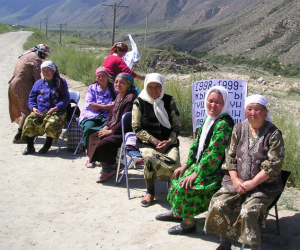
Local residents protest over compensation for the consequences of the 1998 cyanide spill linked to the Kumtor gold mine. More than 1,000 people reportedly sought assistance from Karek, a civil society organisation in Barskoon, to pursue compensation and defend their rights following the accident.
The Barskoon accident was not a dam collapse, but it demonstrated the consequences of moving hazardous mining chemicals through mountain terrain. It also led to disputes over emergency management, health effects, compensation and the reliability of information provided to affected communities.
Kyrgyzstan has also experienced the failure of industrial waste infrastructure. In 1964, a tailings dam at Ak-Tyuz, associated with rare-earth processing, collapsed and released waste containing heavy metals and radioactive material into the Kichi-Kemin river system.
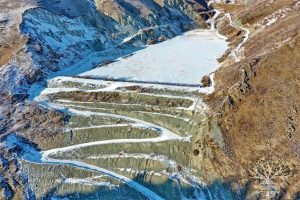
The Ak-Tyuz tailings complex in Kyrgyzstan, where waste from Soviet-era rare-earth processing remains stored in steep mountain terrain above the Kichi-Kemin river system. A tailings dam at the site collapsed in 1964, releasing contaminated waste downstream.
Elsewhere in Kyrgyzstan, abandoned uranium tailings at Mailuu-Suu remain in an area threatened by earthquakes, floods and landslides. International remediation work has sought to prevent radioactive waste from entering downstream water systems.
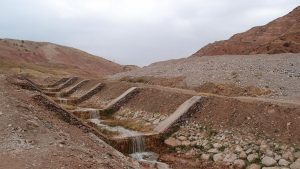
World Bank-supported water-control works at Mailuu-Suu, Kyrgyzstan, designed to stabilise former uranium-processing sites and reduce the risk that radioactive tailings could be carried by landslides, floods or erosion into the Mailuu-Suu River and downstream towards the Fergana Valley.
Comparable failures elsewhere show how mining accidents can extend far beyond an industrial site. At Baia Mare in Romania in 2000, a tailings dam released more than 100,000 cubic metres of cyanide and heavy-metal-contaminated water into rivers that carried the pollution towards the Danube and Black Sea.
In Brazil, the 2015 Mariana collapse caused what federal researchers have described as the country’s largest socio-environmental mining disaster. Four years later, the Brumadinho tailings failure released about 12 million cubic metres of waste and killed 272 people.
These cases do not establish that the CKU railway will cause a comparable disaster. They demonstrate why an assessment limited to the railway track would be inadequate if the corridor is also expected to enable mining and mineral exports.
Sascha called for recognition of the rights of nature and for ecocide to become an international crime. Ecocide is not yet a separate offence under the Rome Statute of the International Criminal Court, but the concept has entered EU legislation.
The revised Environmental Crime Directive requires qualified criminal offences for unlawful conduct causing irreversible or long-lasting, widespread and substantial damage to ecosystems. Its preamble states that such offences may encompass conduct comparable to ecocide.
Gary told the Geneva event that the railway debate was not an argument against development. It was a question of whether development could proceed without destroying the natural systems on which both wildlife and human depend.
The central requirement is therefore prevention: publication of the complete environmental assessment, disclosure of route-level engineering documents, examination of induced mining development and an independent ecological and seismic review before irreversible damage occurs.
The ecocide argument adds a harder question. When governments and developers know that a project may produce extensive and permanent ecosystem damage, at what point does failure to prevent it cease to be poor environmental governance and become a matter of criminal responsibility?

