
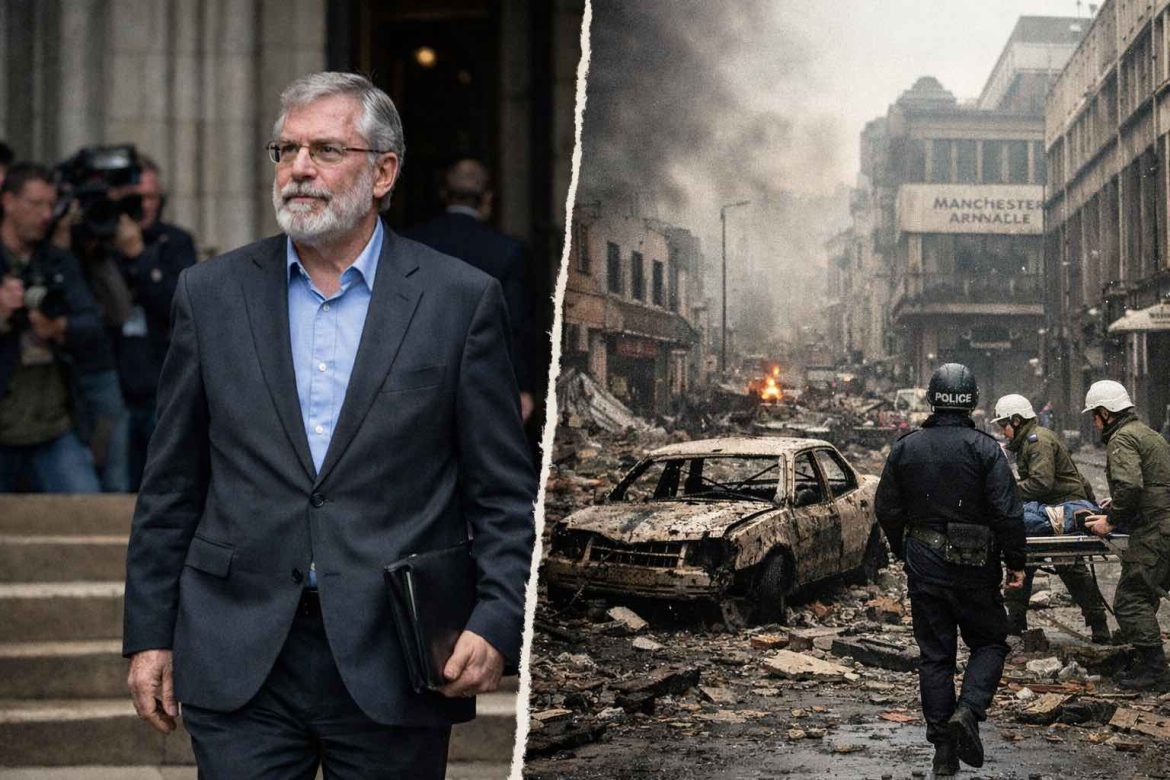
Gerry Adams arrived at London’s High Court on Monday to face a civil lawsuit that may reopen some of the most bitter questions of the Northern Ireland conflict.
For decades he has been one of the central figures of modern Irish republicanism — revered by supporters as a statesman of peace and reviled by critics as a man who escaped scrutiny for a violent past. Now, in a courtroom on the Strand, that unresolved history is once again under examination.
The case has been brought by three men injured in bomb attacks attributed to the Provisional Irish Republican Army during the long years of the Troubles. They are not seeking substantial compensation. Instead, the claimants are asking for a symbolic £1 in damages — a gesture intended less as financial redress than as a declaration of responsibility.
Their legal argument is stark. They contend that Adams, who led Sinn Féin for decades and later helped negotiate the peace process culminating in the 1998 Good Friday Agreement, was also a senior member of the IRA during the period when the bombings occurred. If the court accepts that assertion, they say, he bears responsibility for the organisation’s actions, including attacks that devastated parts of London and Manchester.
The bombings cited in the lawsuit span more than two decades. One took place at the Old Bailey in 1973, an early demonstration that the conflict in Northern Ireland could be carried directly to the British mainland. Two further attacks occurred in 1996: the Docklands bombing in London and the massive truck bomb that ripped through central Manchester. Together they caused enormous damage, injured hundreds and left deep scars on British public life.
Adams, now 77, has always denied being a member of the IRA. Throughout his political career he maintained that while he supported the republican cause, he was never part of the paramilitary organisation that pursued it through violence. His lawyers reiterated that position at the opening of proceedings, arguing there is no credible evidence tying him to the IRA’s command structure.
For the plaintiffs, however, the case is about more than formal proof. Their legal team has described the evidence as a “jigsaw”, pieced together from intelligence reports, statements by former IRA members and historical accounts of internal meetings. Among the claims expected to be examined are allegations that Adams attended senior-level gatherings of the IRA’s leadership during the conflict.
The proceedings will be heard as a civil trial, meaning the judge must decide the case on the “balance of probabilities” rather than the higher criminal standard of proof beyond reasonable doubt. That distinction may prove crucial. A finding that Adams was involved in the IRA would not amount to a criminal conviction, but it would nonetheless carry immense political and historical weight.
Indeed, the trial comes at a moment when the legacy of the Troubles remains deeply contested. For many victims and survivors, decades have passed without formal acknowledgement of responsibility for the violence that marked the period from the late 1960s until the peace settlement of 1998. Civil litigation has increasingly become one of the few remaining avenues through which they can pursue accountability.
The case is also unfolding against a shifting legal backdrop. Recent legislation aimed at drawing a line under Troubles-era prosecutions has sparked controversy in both Britain and Ireland, with critics arguing it risks denying justice to victims. For some of those now appearing in court, the lawsuit represents what they regard as a final opportunity to test long-standing claims about Adams’s role.
Adams’s political journey has been one of the most remarkable of the modern era. Rising through the ranks of Sinn Féin during the 1970s and 1980s, he became the public face of the republican movement at a time when the party was widely seen as the political wing of the IRA. Yet by the 1990s he was also central to the negotiations that helped bring the armed conflict to an end.
Supporters regard that transformation as proof of his commitment to peace. Critics counter that the peace process should not obscure unanswered questions about the earlier years.
The courtroom proceedings promise to revisit those disputed decades in forensic detail. Witnesses, including former intelligence officials and individuals linked to the republican movement, may be called to provide testimony about events that occurred half a century ago.
Whether the court ultimately finds for the plaintiffs or the defence, the trial is unlikely to settle the historical argument surrounding Gerry Adams and the IRA. The Troubles remain a conflict whose narratives are still fiercely contested, shaped by memory, politics and grief.
But for a brief moment, at least, one of its most enigmatic figures must once again stand in the witness box while the past is examined under the cold light of the law.
Click here for more News & Current Affairs at EU Today
Click here to check out EU TODAY’S SPORTS PAGE!
_____________________________________________________________________________________________________________________

