
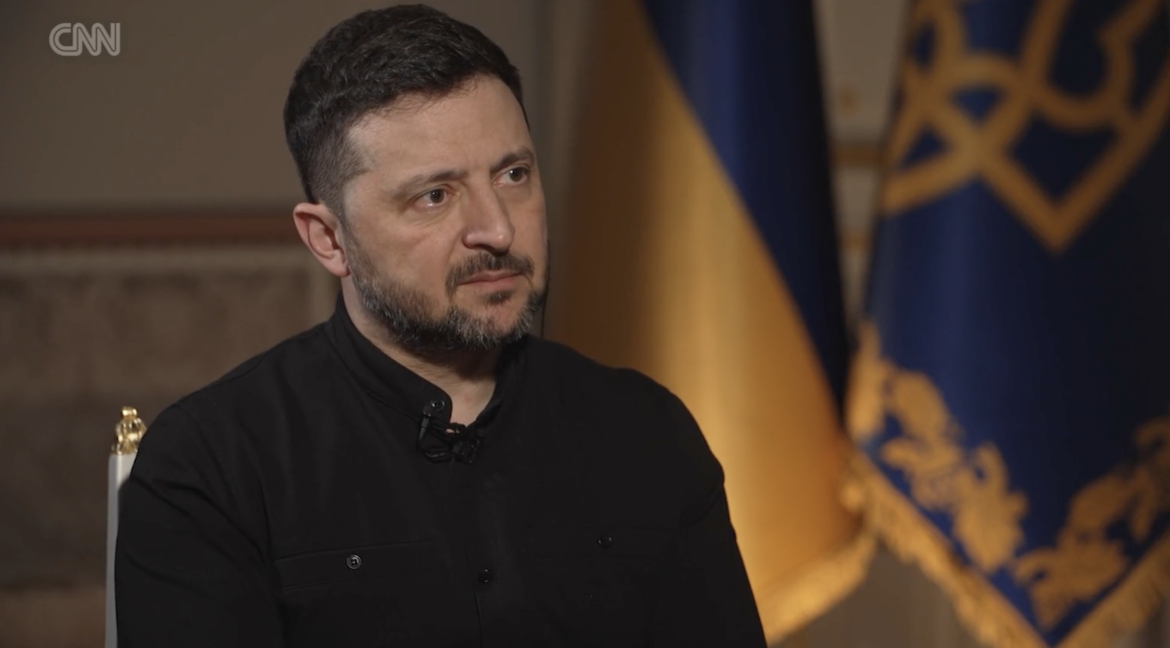
Ukrainian President Volodymyr Zelenskyy has again rejected any suggestion that peace can be achieved by withdrawing Ukrainian forces from the remaining government-held parts of Donbas, and has now framed the issue in even starker terms.
Speaking on 31 March at the Bucha summit, Zelensky said Russian representatives were effectively presenting Ukraine with an ultimatum: leave Donbas within two months or face new demands after Russia attempts to seize the region by force.
According to reports from the summit, Zelenskyy said the Russian side was claiming that it would capture Donbas within two months, meaning Ukraine supposedly had the same period in which to withdraw voluntarily. He added that if Ukraine did not leave, Russia would then impose “other conditions”. Zelenskyy responded by questioning the logic of any proposal limited only to Donbas. If Moscow’s real objective were merely the region, he asked, why would Russian officials already be signalling that further demands would follow?
That argument goes to the centre of Kyiv’s current disagreement with Washington. In an interview published by Reuters on 25 March, Zelenskyy said the Trump administration and its envoys appeared to see only one path towards ending the war: a Ukrainian withdrawal from the Donbas front in exchange for post-war security guarantees. He said he believed Donald Trump genuinely wanted the war to end, but warned that requiring Ukraine to abandon fortified positions on its own territory would not create peace, only a weaker strategic position for Kyiv and a more dangerous situation for Europe.
The White House has rejected that interpretation. US Secretary of State Marco Rubio publicly denied that Washington was demanding territorial concessions from Ukraine, saying the United States had merely conveyed Russia’s terms rather than endorsed them. Rubio said it was for Ukraine to decide how to respond to Russian conditions. That denial has not removed the political significance of the dispute. The fact that Zelenskyy has repeated the allegation publicly, and now reinforced it with fresh comments in Bucha, suggests that Kyiv believes the pressure is real, whatever language Washington uses to describe it.
Zelenskyy’s remarks also mark a shift in tone. For months, Ukrainian officials generally described contacts with the United States in cautious and constructive language, even when there was little tangible progress. More recently, that has changed. Zelenskyy has said that the latest consultations with American representatives produced no meaningful result, while his public comments have become more direct and more sceptical. Reuters reported that he was concerned the Trump administration, once its attention moved from the conflict involving Iran, could resume efforts to push Ukraine into concessions to Russia.
The added Bucha remarks make clear why Zelenskyy is resisting such pressure. His argument is not only constitutional or political, but strategic. If Russia’s demands do not stop at Donbas, then a Ukrainian withdrawal from the region would not settle the conflict. It would instead remove one defensive barrier and improve Moscow’s position for future offensives. That is the point implicit in his question to American counterparts: if Donbas were truly the final objective, why are Russian officials already talking about what comes after Donbas?
This concern is reinforced by the wider diplomatic setting. Reporting by Ukrainska Pravda on 24 March said the United States was pressing Ukraine, alongside Russia, over the withdrawal of Ukrainian troops from Donetsk Oblast, and that Washington could disengage from the talks if no progress were made and instead focus on military operations involving Iran. While that report relied on sources rather than formal public statements, it fits with Zelenskyy’s later description of American pressure and his concern that the Middle East conflict is distracting Washington from Ukraine.
The Iran factor has become increasingly important in Zelenskyy’s public messaging. In his interview with Axios, he argued that a prolonged war involving Iran benefits Russia by pushing up oil prices, easing pressure on Moscow, and redirecting US military and political attention away from Ukraine. He also said Ukraine had shared intelligence indicating that Russia had provided Iran with satellite imagery of Western military sites in the Middle East. In Kyiv’s view, this makes any attempt to separate Russia’s behaviour in Ukraine from wider regional instability increasingly difficult.
What emerges from Zelenskyy’s latest statements is a clearer public line from Kyiv. Ukraine is no longer merely rejecting territorial concessions in principle; it is openly arguing that the specific formula now being discussed by others would fail on its own terms. A withdrawal from Donbas, in this reading, would not end the war’s hot phase. It would confirm to Moscow that further pressure works, and invite the next set of demands. That is why Zelenskyy’s latest intervention matters. It is not simply a rebuttal to Russia. It is also a warning to Ukraine’s partners that a settlement imposed around Donbas may postpone conflict rather than conclude it.

