There was a time when space exploration felt like a proper human endeavour. Men – and it was mostly men – in improbable suits sat atop controlled explosions and went somewhere genuinely new.
Those of us lucky to have been born in time to watch the Apollo 11 Moon Landing on a flickering black and white television set felt that history had, for once, decided to move briskly.
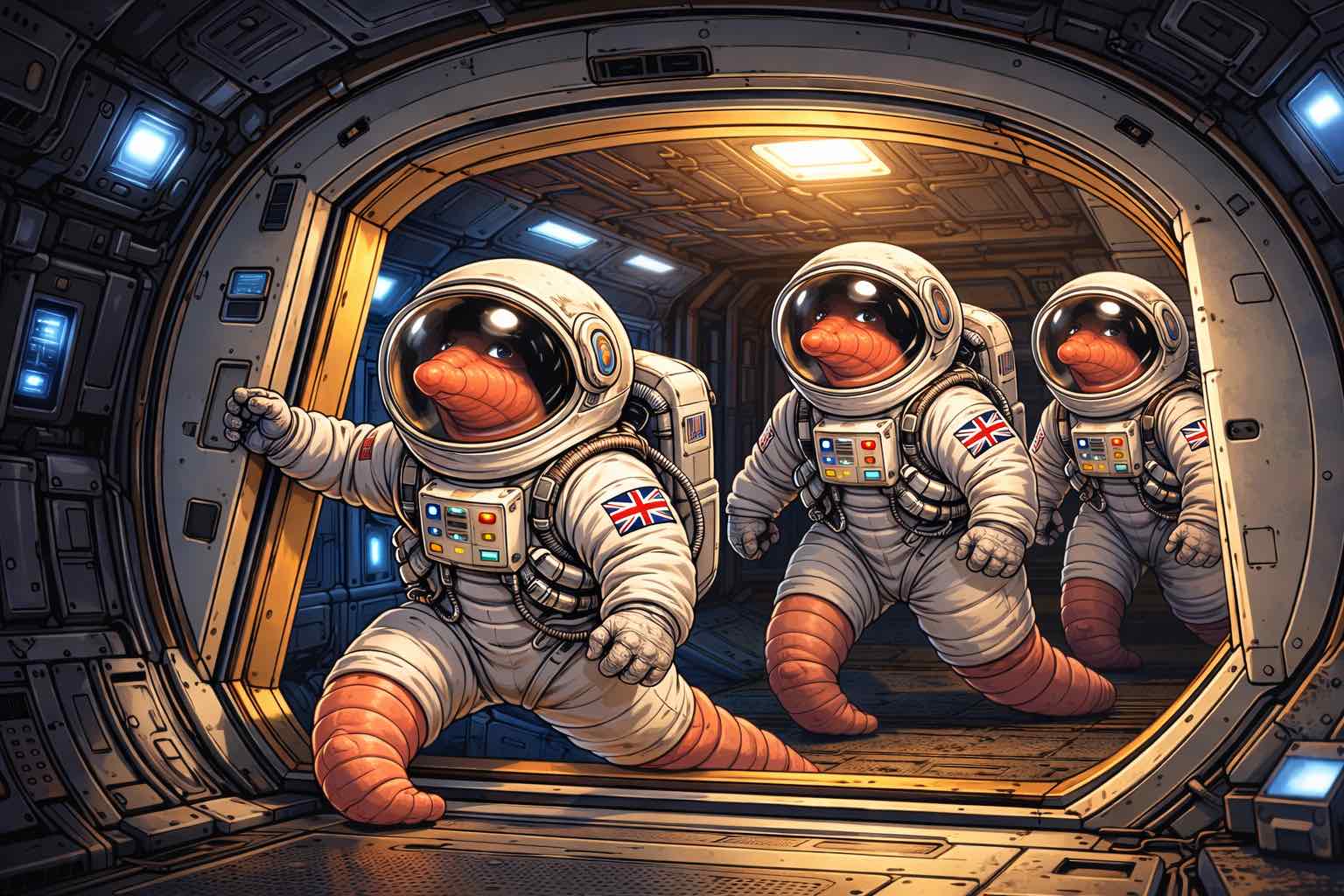
And now, in the spring of 2026, Britain has entered the space race with… worms.
Not astronauts, you understand. Not even particularly ambitious robots. Worms. Microscopic ones, no less. The sort one might find in a damp patch of garden soil, now repurposed as the vanguard of British scientific ambition.
The official line, as ever, is stirring. According to the UK government, these wriggling pioneers have been dispatched to the International Space Station to “unlock the secrets of long-duration space travel” and pave the way for future lunar missions. It is, we are assured, a “pioneering experiment”. Which is true, in the sense that no one has yet thought to celebrate worms quite so enthusiastically.
The timing is unintentionally comic. Only days after Artemis II carried human beings around the Moon in a triumphant rehearsal for a return to the lunar surface, Britain arrives breathlessly at the scene clutching a shoebox full of nematodes. One imagines the awkward pause at the international press conference.
“NASA has sent astronauts around the Moon.”
“Splendid. We’ve sent something rather smaller.”
Still, one must not be entirely unfair. The worms – Caenorhabditis elegans, for those who enjoy saying such things at dinner parties – are not random hitchhikers. They are, in fact, among the most studied organisms in biology, prized for their genetic simplicity and surprising similarity to human cellular processes. In space, they will be exposed to radiation, microgravity, and the general hostility of the cosmos, all while being observed in a miniature laboratory the size of a particularly modest lunchbox.
The aim is serious enough. Long-duration space travel plays havoc with the human body: muscles waste, bones thin, eyesight falters, and radiation does what radiation tends to do. If worms can reveal how cells respond to such indignities, they may yet contribute to keeping astronauts alive on future missions.
And yet, one cannot entirely suppress a certain British scepticism. This is, after all, a nation that once ruled a quarter of the globe and now finds itself proudly announcing the orbital deployment of invertebrates. It is progress of a sort, but one is tempted to ask: progress towards what, exactly?
Part of the answer lies in the modern nature of space exploration itself. The heroic age – all flags, footprints and Cold War bravado – has given way to something more bureaucratic. Space is no longer simply about planting a boot on a distant surface; it is about spreadsheets, incremental research, and the slow accumulation of data. The romance has been replaced by risk assessments.
In this context, the worms make perfect sense. They are cheap, expendable, and scientifically useful. The entire experiment weighs a few kilograms and can be monitored remotely from Earth. No need for dramatic launches or stirring speeches. Just a steady stream of biological data, quietly informing the next generation of missions.
One suspects, however, that this is not quite the narrative the public had in mind when politicians began speaking of Britain as a “space power”.
There is also, inevitably, a political dimension. The UK Space Agency is keen to demonstrate relevance in an increasingly crowded field. With the United States, China, and even private companies such as SpaceX pushing the boundaries of what is possible, Britain must carve out a niche. If that niche happens to involve worms, then worms it is.
To be fair, there is a certain understated charm in this approach. While others chase glory, Britain quietly gets on with the business of science. It is a very British sort of ambition: less “giant leap for mankind”, more “useful incremental improvement, pending further study”.
And perhaps that is no bad thing. Grand gestures may capture the imagination, but it is often the unglamorous work that makes them possible. If future astronauts are able to spend months on the Moon without their bones dissolving or their DNA unravelling, it may well be thanks to a handful of worms that once circled the Earth in a plastic box.
Still, one cannot help but feel a twinge of nostalgia. There was something rather magnificent about the idea of humans venturing into the unknown, driven by curiosity and a dash of recklessness. Worms, for all their virtues, do not quite stir the soul in the same way.
Perhaps that is the real story here. Space exploration has grown up. It has become cautious, methodical, and – dare one say it – slightly dull. The age of heroes has given way to the age of laboratory technicians, and the great adventures of our time are conducted not in rockets, but in research grants.
So yes, Britain has sent worms into space. It is, undeniably, a clever and worthwhile experiment. It may even prove crucial to the future of human exploration beyond Earth.
But one suspects that somewhere, in a quiet corner of the cosmos, the ghost of 1969 is looking on with mild bemusement.
From giant leaps to microscopic wriggles. Progress, it seems, comes in many forms.
Click here for more News & Current Affairs at EU Today
Click here to check out EU TODAY’S SPORTS PAGE!
___________________________________________________________________________________________________________________