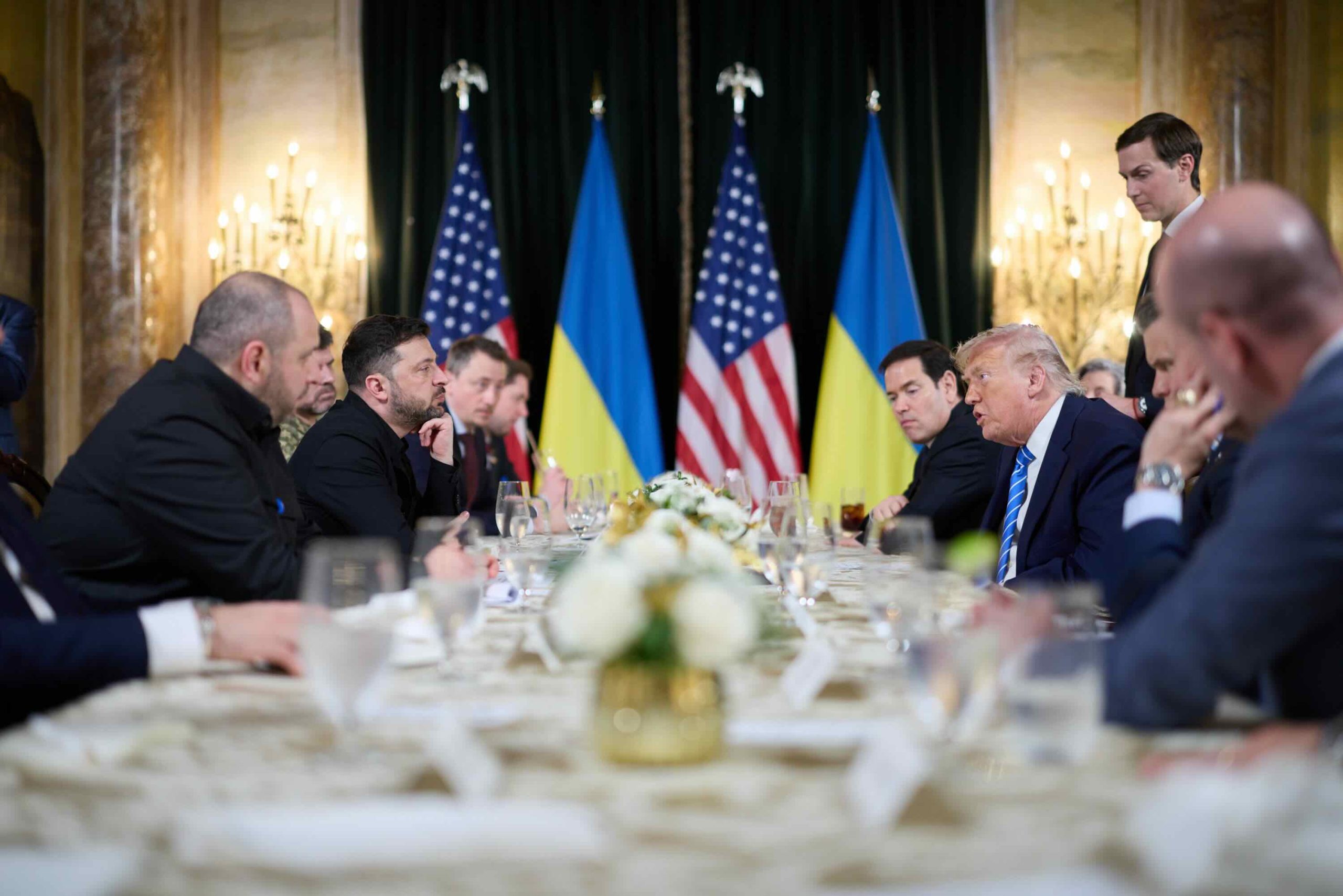
European leaders have reported “progress” in talks on a proposed Ukraine peace framework after President Volodymyr Zelenskyy met Donald Trump at Mar-a-Lago and then joined a video call with European counterparts.
Finland’s President Alexander Stubb said the call lasted more than an hour and covered “concrete steps” to end the war, adding that participants were working towards what he described as a “just and lasting peace”.
Had a good call with @POTUS @ZelenskyyUa @EmmanuelMacron @Keir_Starmer @_FriedrichMerz @GiorgiaMeloni @NawrockiKn @jonasgahrstore @SecGenNATO @vonderleyen. The call lasted over an hour.
We discussed concrete steps how to end the war.
We are all working towards a just and…
— Alexander Stubb (@alexstubb) December 28, 2025
Mr Stubb listed those on the call as Emmanuel Macron, the French President; Karol Nawrocki, the Polish President; Sir Keir Starmer, the British Prime Minister; Giorgia Meloni, Italy’s Prime Minister; Jonas Gahr Støre, Norway’s Prime Minister; Friedrich Merz, Germany’s Chancellor; Mark Rutte, Nato Secretary General; and Ursula von der Leyen, President of the European Commission.
In Brussels, Mrs von der Leyen said there had been “good progress” and stressed the need for security guarantees “from day one”. She said Europe was ready to keep working with Ukraine and the United States to consolidate what had been achieved in Florida.
We had a good, one-hour-long call with @POTUS, President @ZelenskyyUa and several European leaders to discuss their meeting today on peace negotiations.
There was good progress, which we welcomed.
Europe is ready to keep working with Ukraine and our US partners to consolidate…
— Ursula von der Leyen (@vonderleyen) December 28, 2025
Poland used the call to highlight its logistical role in sustaining Ukraine’s war effort. In a statement, the Polish presidency said Rzeszów–Jasionka airport has served as the hub for more than 90 per cent of assistance delivered to Ukraine since Russia’s full-scale invasion began. It added that Poland’s position would be “crucial” at the point of signing any agreement affecting regional security.
President of the Republic of Poland Karol Nawrocki participated in a teleconference between European leaders, US President Donald Trump, and Ukrainian President Volodymyr Zelensky.
They discussed the status of peace talks aimed at ending the war in Ukraine caused by Russia.…
— Kancelaria Prezydenta RP (@prezydentpl) December 28, 2025
In Dublin, Ireland’s Taoiseach Micheál Martin welcomed what he called progress in the peace talks discussed by Mr Trump and Mr Zelenskyy in Florida, and said he hoped it would be built on “to enable a ceasefire to take place”.
I welcome the progress in Ukraine peace talks that Presidents Trump and Zelenskyy spoke of this evening in Florida.
I firmly hope that this will be built on in the time ahead to enable a ceasefire to take place. pic.twitter.com/4mJTl2J4Id
— Micheál Martin (@MichealMartinTD) December 28, 2025
The Netherlands struck a cautious note. Prime Minister Dick Schoof said that positive signals from Washington would need to be matched by action from Moscow, writing that Russia must show it is serious about negotiating a “just and lasting peace”.
Positive reports from the US about the peace negotiations concerning Ukraine. Many thanks to the United States for their important role in this process. Now Russia must show that they really want to end this war and that they are serious about negotiating a just and lasting…
— Dick Schoof (@MinPres) December 28, 2025
Dutch Foreign Minister David van Weel referred to further steps taken in Miami and said the Netherlands would continue supporting Ukraine while pressing for tougher measures against Russia.
Czech Foreign Minister Jan Lipavský described the Zelenskyy–Trump meeting as “optimistic” but said pressure on Russia remained central, calling for economic sanctions and support for Ukraine’s defence to force Moscow towards peace.
The European reaction followed Mr Trump’s public claim that negotiations are close to a deal, while acknowledging unresolved disputes. He said the two sides were “a lot closer” but that “thorny issues” remained, including territorial questions in the Donbas and the form of security guarantees.
The talks have been framed around a revised 20-point proposal, drafted by Ukrainian and American negotiators in recent weeks. The document includes reaffirmation of Ukraine’s sovereignty, security guarantees and a reconstruction plan, while major disagreements persist over territory and the Zaporizhzhia nuclear power plant.
A separate dispute concerns how any domestic Ukrainian endorsement would be organised. Mr Zelenskyy has said a peace plan could be ratified by parliament or put to a referendum, and that a national vote would require at least 60 days and a complete ceasefire during that period. On 29 December that Mr Zelenskyy reiterated support for a referendum on the 20-point plan, again linking it to a ceasefire long enough for campaigning and polling.
Moscow has publicly rejected the idea of a ceasefire linked to a referendum timetable. Russian presidential aide Yuri Ushakov has said that a temporary ceasefire “under the pretext” of a referendum would only prolong the conflict.
In practical terms, European leaders appear focused on ensuring they remain part of the negotiating structure. The line repeated across capitals is that any agreement must involve Ukraine directly, be backed by enforceable guarantees, and be paired with continued pressure on Russia.