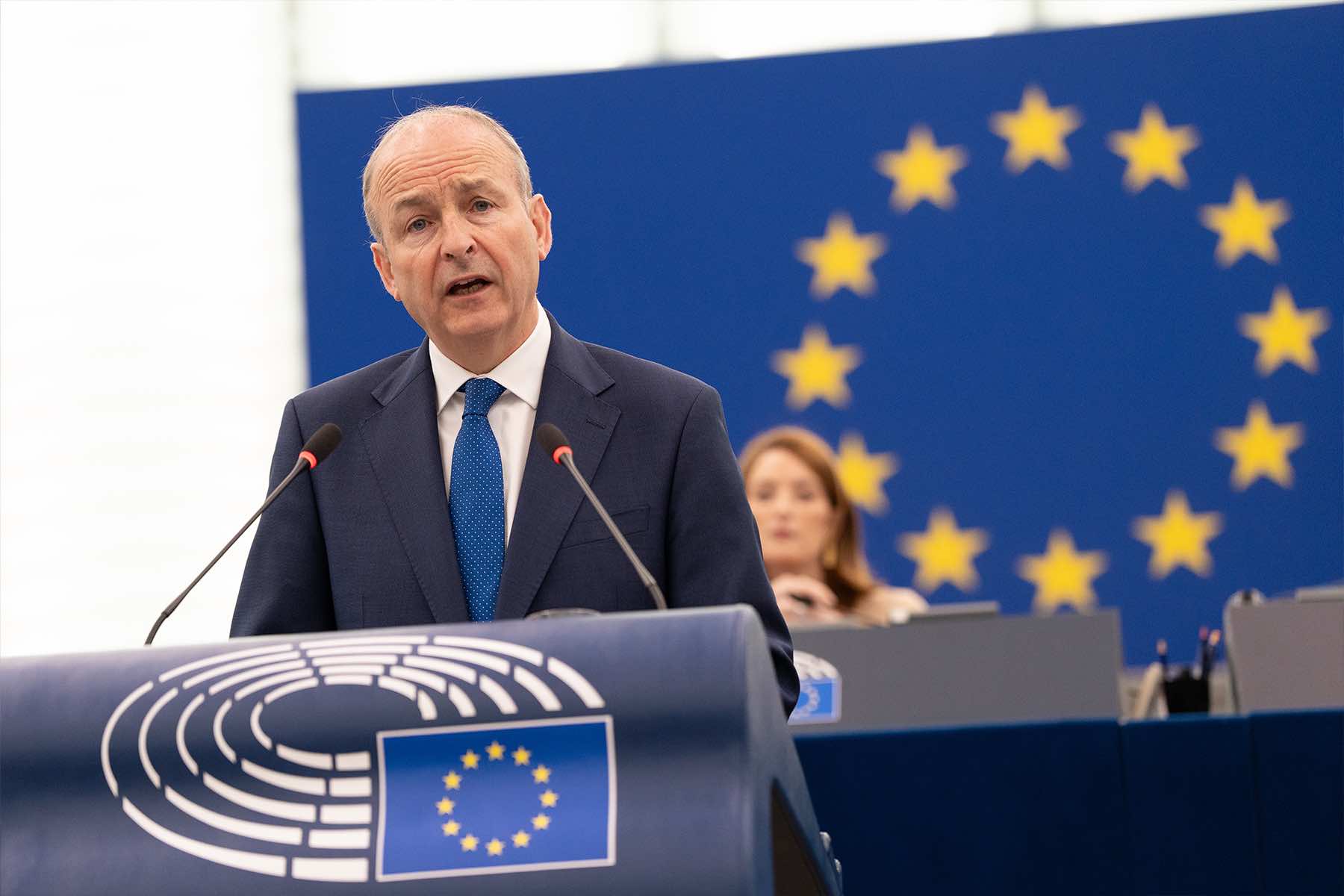
When Micheál Martin used the European Parliament this week to present the priorities of Ireland’s six-month presidency of the Council of the EU, the broad shape of the message was familiar enough: competitiveness, security and values, all wrapped in the reassuring slogan of “strength with unity”.
It was a neat formula, and in one sense an honest one. Europe is trying to do three things at once — revive growth, harden itself against external threats and preserve the liberal political identity on which the European project still claims to rest. The problem is that these goals increasingly collide with one another.
That tension will define Ireland’s presidency more than any slogan. Dublin takes the chair at a moment when the EU is not short of ambition but is short of room for manoeuvre. The bloc wants to be more productive without giving up its social compact; more strategically autonomous without admitting the fiscal and political costs of autonomy; more geopolitically serious while remaining dependent on unanimity, procedural compromise and the internal politics of 27 states. Ireland’s presidency will not resolve those contradictions. Its real test will be whether it can manage them without adding to the sense of European drift.
Martin’s pitch in Strasbourg was calibrated to that task. He promised action on regulatory burdens, the single market and external trade ties, including a steadier relationship with the US and a “close and constructive” partnership with the UK. He also highlighted enlargement, support for Ukraine, a push on maritime and cyber resilience, and an attempt to move negotiations on the EU’s next long-term budget towards agreement by the end of the year. On paper, it is a substantial programme. In practice, it is less a list of policy choices than a catalogue of Europe’s unresolved dilemmas.
Start with competitiveness, the safe word in almost every Brussels speech of the past two years. Everyone agrees Europe has a problem. Productivity growth has lagged behind the US; energy costs remain a structural handicap; capital markets are fragmented; scale is harder to achieve; and regulation, while often defensible in isolation, has accumulated into a drag on investment and risk-taking. Martin’s emphasis on cutting barriers and easing unnecessary burdens therefore sounds sensible. But the gap between diagnosis and execution is wide.
The Irish presidency inherits a debate in which “competitiveness” has become a catch-all term for everything Europe wishes it were better at. It can mean deregulation, industrial policy, state aid, deeper capital markets, more trade deals, more defence spending, cheaper power or simply faster permitting. These are not always complementary. An EU serious about competitiveness would need to make harder choices about market integration, common financing and the trade-offs between green ambition and industrial pragmatism. That is politically more difficult than invoking the single market as a talisman.
Ireland is well placed, at least intellectually, to make the case for a more open and pro-business Europe. It has long benefited from the single market, foreign investment and a clear instinct for Atlantic trade. It also has credibility as a country that broadly likes the EU without romanticising it. Yet that same profile may limit how far it can push the debate. A presidency can broker and prioritise; it cannot conjure consensus where member states remain divided on how much economic sovereignty they are actually willing to pool.
The same is true of security. Martin was explicit that support for Ukraine must remain political, financial, military and humanitarian, and be matched by tighter pressure on Russia. That is easy to applaud and increasingly hard to operationalise. Europe’s commitment to Ukraine is real, but it now sits alongside a growing recognition that the continent’s own defence, infrastructure and cyber resilience are inadequate to the strategic environment it inhabits. The old European habit — speaking the language of power while outsourcing much of the substance — is no longer sustainable.
Here Ireland’s presidency faces a particularly delicate balancing act. Dublin wants to advance resilience and security while also preserving its political identity as a state historically cautious about military integration. That is not hypocrisy; it reflects the wider EU position in miniature. Europe wants to be harder without quite saying how hard, and more sovereign without settling the question of who pays. The coming negotiations over the next multiannual budget will force those evasions into the open.
That budget fight may in fact become the most revealing part of the Irish presidency. Martin told MEPs he believed agreement in Council on the EU’s next long-term budget could be reached by the end of 2026, with an Irish “negotiating box” to follow in the autumn. Ambitious is one word for it. Another is risky. The next budget will be asked to do almost everything: finance competitiveness, defence capability, enlargement preparation, climate goals, industrial transition and continued support for Ukraine, while also protecting farm spending, cohesion funds and domestic political red lines across the union.
This is where the language of values begins to collide with arithmetic. Europe’s governing class still prefers to describe every spending priority as existential. But if everything is existential, then little is prioritised. The budget battle will expose whether the EU is prepared to shift money decisively towards common strategic goods, or whether it remains trapped in the logic of preserving every legacy programme while layering new ambitions on top. Ireland’s reputation as an “honest broker” may help at the margins. It will not abolish the basic scarcity.
Then there is the external dimension. Martin used Strasbourg to reaffirm support for enlargement and for a two-state solution in the Middle East, while saying Europe must do more in response to the humanitarian catastrophe in Gaza and the West Bank. That is morally coherent and politically awkward. The EU has spent years presenting itself as a values-based power, but its credibility on values has been eroded by inconsistency, especially when strategic interests intrude. On Ukraine, the union has found a striking degree of purpose. On Gaza, it has looked divided, cautious and often self-protective. Ireland, one of the more outspoken member states on the issue, now presides over that dissonance.
None of this means the Irish presidency is doomed to underperform. On the contrary, it may be well suited to a period in which the EU needs patient brokerage rather than grandstanding. Ireland is institutionally literate, broadly trusted and capable of speaking both the language of market liberalism and the language of European solidarity. But it also arrives at a moment when the presidency system itself can look smaller than the crises it is meant to steward.
The uncomfortable truth is that Europe’s problem is no longer a lack of priorities. It is an excess of them, combined with a shortage of political candour about what they cost and what they displace. Ireland’s presidency will succeed if it can force some order on that confusion — not by pretending that competitiveness, security and values naturally reinforce one another, but by acknowledging that Europe now has to choose, sequence and pay for its ambitions. That would be a more modest message than “strength with unity”. It would also be closer to the truth.
Main Image: European Parliament.
__________________________________________________________________________________________________________________
Click here for more News & Current Affairs at EU Today
Click here to check out EU TODAY’S SPORTS PAGE!
___________________________________________________________________________________________________________________