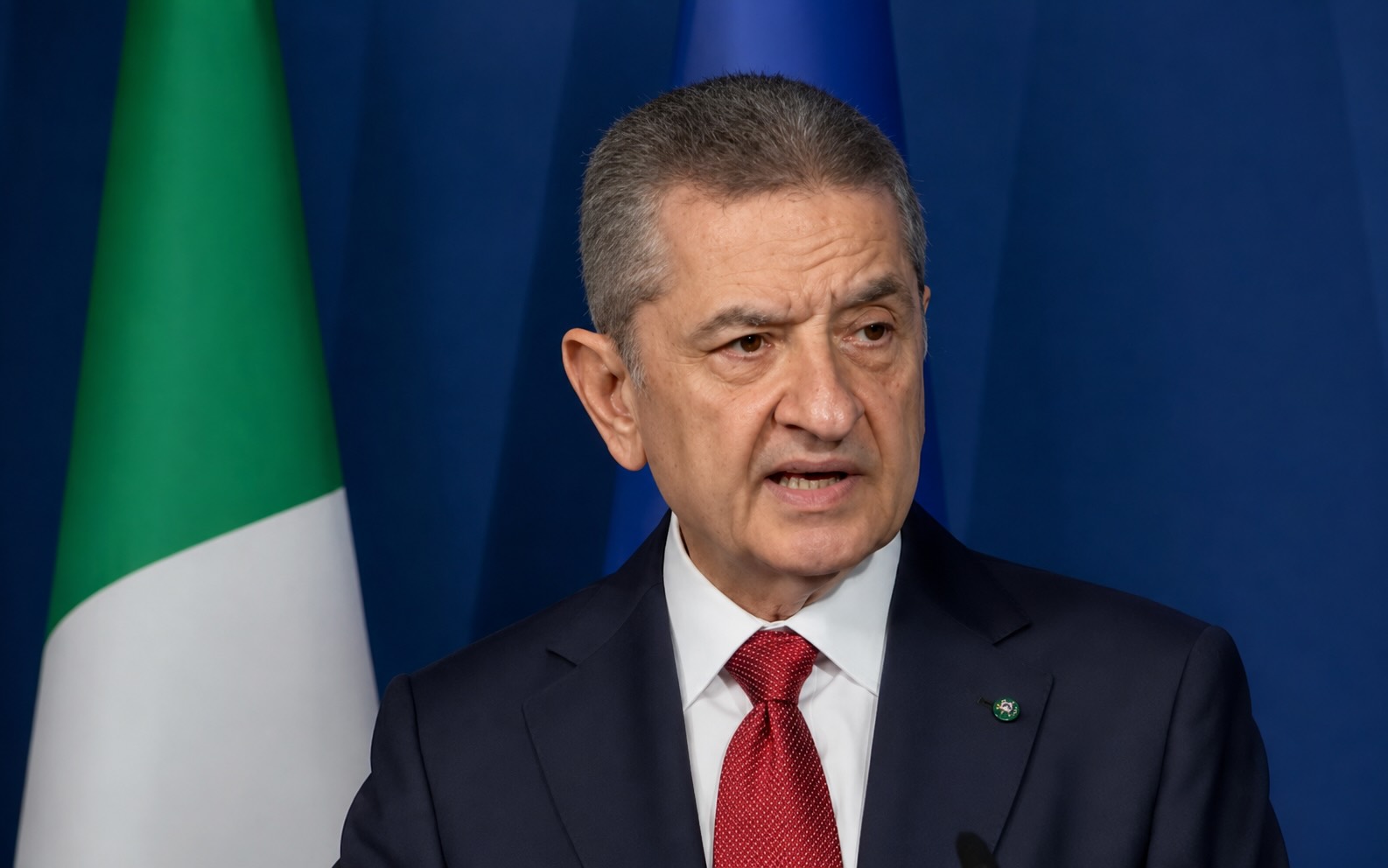
As governments finance rearmament, industrial support and ageing welfare systems, ECB policymaker Fabio Panetta has warned that fiscal demands could place growing political pressure on monetary policy.
Europe’s rapid increase in defence and industrial spending is creating a second-order risk that receives less attention than the headline budget figures: governments carrying heavier debts may become less tolerant of central banks that keep borrowing costs high.
Fabio Panetta, governor of the Bank of Italy and a member of the European Central Bank’s Governing Council, warned on Monday that European central banks could face growing political pressure as governments struggle to finance pensions, industrial policy and defence. His remarks, reported after an event in Rome, concerned the danger of “fiscal dominance” – a condition in which the financing needs of governments begin to constrain monetary policy.
The warning does not mean that the ECB is about to abandon its inflation mandate. It does identify a conflict that is becoming harder to avoid. Germany, France and Italy all need to fund stronger armed forces and industrial renewal while supporting welfare systems under pressure from ageing populations.
Higher spending changes the rate debate
When public debt is large, interest-rate decisions have immediate fiscal consequences. Higher rates raise the cost of refinancing government bonds and reduce the money available for other priorities. Lower rates ease that pressure but may be inconsistent with price stability if inflation remains persistent.
The ECB’s formal independence is protected by EU law. Political pressure can nevertheless operate through public criticism, appointments and demands that monetary policy take greater account of growth, employment or national debt-service costs.
That risk is especially relevant as governments describe defence spending as an emergency. Germany’s cabinet has just approved a 2027 budget built around exceptional borrowing and higher security expenditure. France faces high debt and deficit pressure, while Italy combines a large debt stock with extensive pension commitments.
Defence is not the only source of fiscal strain. Europe needs grid investment, clean-industry support, digital infrastructure and adaptation to an ageing population. Each objective is defensible. Together, they increase the political value of cheap government financing.
What fiscal dominance would mean
Fiscal dominance does not require a direct instruction from a finance minister to a central banker. It can emerge when the consequences of tighter monetary policy become so politically or financially disruptive that the central bank’s room for action narrows.
In the euro area, the problem is complicated by the fact that one monetary policy serves 20 national fiscal systems. A rate appropriate for an economy with lower debt may impose much greater pressure on a highly indebted state. Market concerns about debt sustainability can then widen bond-yield spreads and force the ECB to consider whether market fragmentation is obstructing monetary transmission.
The ECB has tools designed to address unjustified fragmentation, but using them can itself be politically contentious. Governments may regard support as necessary for euro stability; critics may see it as indirect fiscal assistance.
Independence also requires credible budgets
Central-bank independence is often discussed as a question of institutional courage. Panetta’s intervention points to the other side of the equation: monetary independence is easier to preserve when governments maintain credible fiscal frameworks.
That does not require Europe to abandon defence investment. Russia’s war against Ukraine and uncertainty over the future US role in European security create real capability requirements. The issue is whether additional spending is prioritised, coordinated and linked to reforms that improve productivity.
Borrowing that finances common procurement, infrastructure and industrial capacity can strengthen future growth and security. Spending that is fragmented, delayed or absorbed by cost overruns adds debt without delivering equivalent resilience. The quality of expenditure therefore matters to monetary policy as well as defence policy.
The EU’s fiscal rules permit additional flexibility for defence, but flexibility is not the same as a permanent exemption from sustainability. Governments still need medium-term plans that explain how debt will be serviced once exceptional spending becomes part of the baseline.
A political warning before a monetary crisis
Panetta’s language was striking because central bankers rarely welcome discussion of political limits on their independence. His point was not that fiscal dominance has already arrived, but that the forces producing it are strengthening.
Europe is asking states to rearm, subsidise strategic industries, protect citizens from economic shocks and sustain welfare commitments. If productivity and revenue do not rise at the same time, those objectives will compete for borrowed money.
The ECB can control short-term interest rates, but it cannot resolve that political allocation. Governments that want both strategic spending and independent monetary policy must make the fiscal settlement credible themselves. Otherwise, the next argument over rates will not be only about inflation. It will also be about who bears the cost of Europe’s new security state.