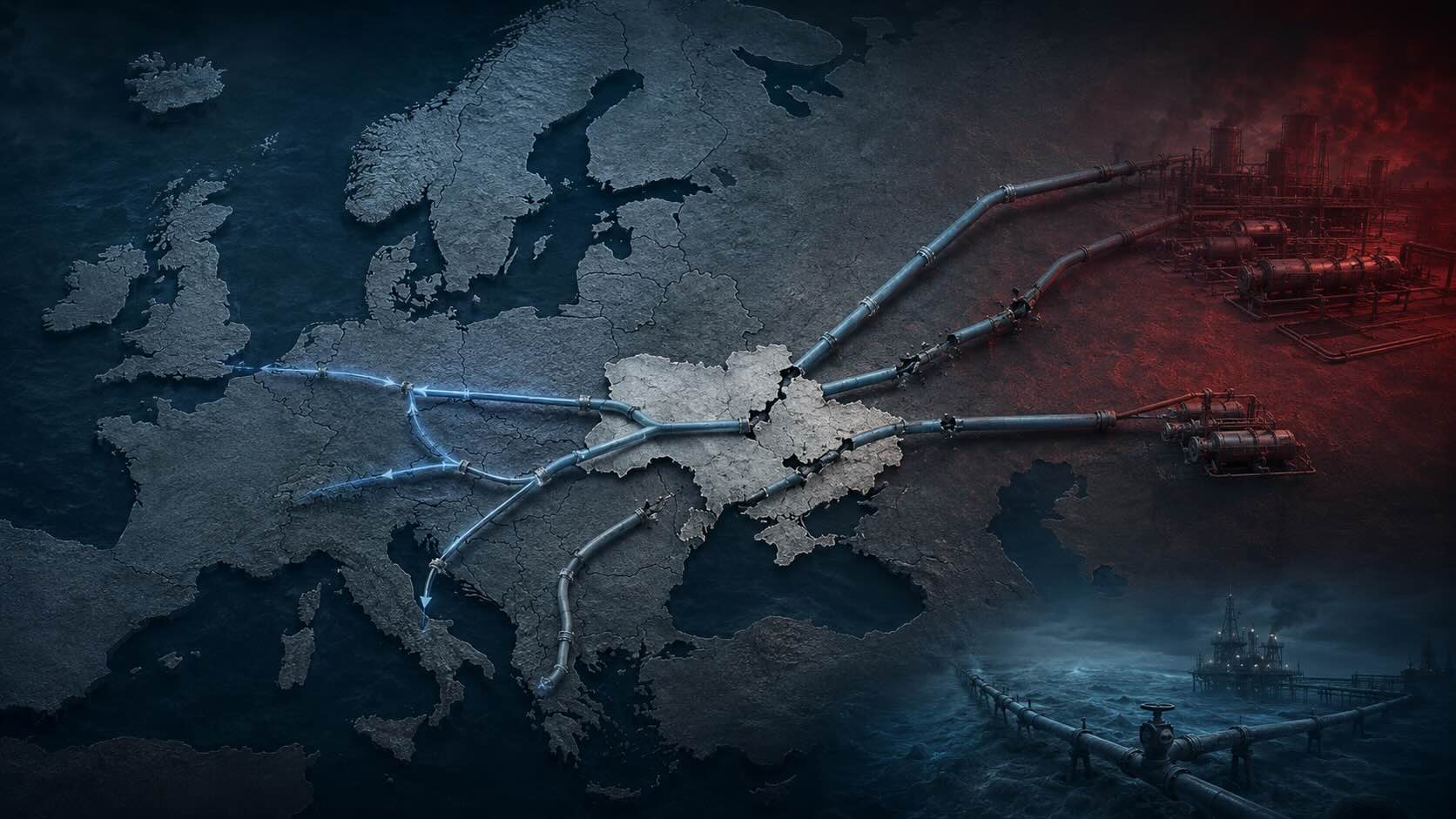
In this opinion piece, Mykhailo Gonchar argues that Russia’s war against Ukraine should be understood not only as a military campaign, but also as part of a wider energy strategy aimed at weakening Ukraine’s role as a gas transit state, creating dependency inside the EU, and preserving Moscow’s influence in Europe through pipelines, corporate networks and political pressure.
Russian aggression against Ukraine, which has now continued for a 13th year and which the media continue to call the “war in Ukraine”, had a whole range of motives on the Russian side. They have still not been fully studied. One of these motives was to eliminate Ukraine as a transit country, to make it part of “great russia”, and finally and irreversibly drive the EU into the Russian “gas chamber”. In its time, I devoted considerable attention to this issue in Ukrainian and foreign publications, as well as at various international conferences and forums, including in Prague, Bratislava, Warsaw, Paris, Berlin and Brussels. I see that the time has come to refresh the memory of some who would like once again to sit on the “streams” — gas streams and money streams from the Russian “Petrostate”.
Synchronisation of special operations
In March 2014, an armed sabotage group led by FSB colonel Igor Girkin was preparing for operations in eastern Ukraine and was transferred to Donbas in April. On April 12 it seized the buildings of the National Police and the Security Service of Ukraine in Sloviansk. Later, in cooperation with other sabotage groups and illegal armed formations created by FSB and GRU agents, it established control over part of Donbas.
I do not know whether russia took the “recipe” for effective terrorist activity from Yevgeny Messner, a White émigré officer who, in his book Mutiny — the Name of the Third World War, published in Buenos Aires in 1960, prophetically wrote: “A warring side will be on the territory of the other side, creating and supporting a partisan movement, will ideologically and materially, through propaganda and finance, support opposition parties there, will in every possible way nourish disobedience, sabotage, diversion and terror there, creating rebellion there.” But it is obvious that it was precisely according to such a technology — sabotage-terrorist technology — that it acted in Ukraine in 2014.
In interviews with Russian media after his departure from Donbas, Girkin emphasised that it was the actions of his groups that made it possible to unfold an armed confrontation in Ukraine. By doing so, he gave Russian propaganda a pass for interpreting the events as a “civil war in Ukraine”, leading to the “self-destruction of Ukraine”, “transit risks” and so on.
In turn, relying on these propaganda theses, from April to July 2014 russia sharply intensified its energy diplomacy in order to accelerate implementation of the South Stream gas pipeline project in the Black Sea and initiate Nord Stream 2 in the Baltic, on the pretext that Ukraine as a transit country for the export of Russian gas to Europe was unreliable because there was a war in Ukraine.
Confirmation of this was a surge in gas-diplomatic activity: a series of meetings between Gazprom’s leadership and the leadership of the European Commission, the federal government of Germany, the heads of leading European gas companies, and especially the special appeals by vladimir putin to European leaders on April 10 and May 15, 2014, telephone conversations with Angela Merkel on May 4 and a three-way call with François Hollande and Mrs Merkel on June 19, as well as media events by Gazprom’s leadership. Here is a list of the main high-level contacts of that time in the language of official Russian statements; the density of contacts is striking:
– On April 2 in Brussels, working meetings took place between the Chairman of the Management Committee of OJSC Gazprom, Alexey Miller, and European Commissioner for Energy Günther Oettinger, and Germany’s Foreign Minister Frank-Walter Steinmeier;
– On April 10, putin addressed the leaders of a number of foreign states to which Russian gas is supplied in transit through Ukraine;
– On April 15 in Strasbourg, a working meeting took place between the Chairman of the Management Committee of OJSC Gazprom, Miller, and European Commissioner for Energy Oettinger;
– On April 22, Gazprom and Austria noted the relevance of creating alternative routes for the supply of Russian gas to Europe;
– On May 4, there was a telephone conversation between putin and A. Merkel; discussion continued of the crisis situation in Ukraine… The leaders of the rf and the FRG also exchanged views on issues of ensuring the supply and transit of Russian gas, taking into account the results of multilateral consultations — russia, the EU and Ukraine — held the other day in Warsaw on this subject;
– On May 15, putin addressed the leaders of European states regarding the supply and transit of Russian gas through the territory of Ukraine;
– On June 19, there was a telephone conversation with A. Merkel and F. Hollande. The exchange of views continued regarding the development of the crisis situation in Ukraine. Also discussed were the possible consequences of Kyiv’s disruption of negotiations on resolving the problem of debt for Russian gas supplies for the economy and energy security of Europe.
Gazprom Deputy Chairman and Gazpromexport Director General Alexander Medvedev, who played the role of corporate “foreign minister”, made two indicative statements in April and May. The first came in an interview with Germany’s Handelsblatt on April 7, 2014: “In order to avoid risks connected with unreliable transit countries, Gazprom, together with European partners, built the Nord Stream gas pipeline along the bottom of the Baltic Sea and plans to lay South Stream through the Black Sea.” The second statement — about the expansion of Nord Stream — was made at his meeting on May 22 with the president of the Dutch gas company Gasunie, Han Fennema, and reflected in the official press release: “The participants in the meeting also discussed issues of developing European gas infrastructure in the context of increasing the efficiency of Russian gas supplies to European consumers. In particular, the successful implementation and possibilities for expanding the Nord Stream project were discussed.”
On June 3, at a press conference of Gazprom’s leadership, information materials were distributed, including a reference note, “Exports and increasing the reliability of gas supplies to Europe”, which stated: “In order to increase direct supplies of Russian gas to consumers in European countries, the possibility of constructing the Yamal-Europe 2 gas pipeline and expanding the Nord Stream project is being considered.”
Gazprom head A. Miller, on June 16, at a joint press conference with the energy minister of the rf, focused attention on Ukraine: “… The mechanisms of state and economic administration have been destroyed. In general, Ukraine is engaged in self-destruction… As for Ukrainian transit risks. The Russian side has spoken about them for a long time. And it is precisely Ukrainian transit risks that are the reason for the construction of such a gas pipeline as Nord Stream, and the construction of such a gas pipeline as South Stream. And if we speak about Ukrainian transit risks in the current period of time, they exist, and they are considerable.”
It is indicative that the very next day, June 17, sabotage was carried out on the Urengoy-Pomary-Uzhhorod trunk gas pipeline in Poltava region — the pipeline was blown up. A similar act of sabotage had already occurred on the same gas pipeline on May 12 in Ivano-Frankivsk region. The explosion coincided in time with the suspension of gas supplies for Ukraine’s needs and the withdrawal of the Russian side from the negotiation process, with the participation of the European Commission, on the security of natural gas supplies to Ukraine and the EU.
A special Gazprom press release of July 11, 2014, stated: “The Board of Directors of OJSC Gazprom approved the company’s policy on the diversification of export routes and additional measures to increase the reliability of gas supplies to European markets. In order to increase the reliability of supplies, the company is implementing projects for the construction of new export gas pipelines that neutralise transit risks… Two strings of the Nord Stream gas pipeline have been laid along the bottom of the Baltic Sea; there is an opportunity to expand this corridor by additionally building one or two strings. The implementation of the South Stream project is proceeding at full speed, according to schedule…”
Thus, the terrorist activity of sabotage groups of the FSB of the rf in Donbas in April-July 2014 was synchronised in time with the activity of the Russian political leadership and Gazprom in Europe, which at the international level spread narratives about the “crisis in Ukraine”, “civil war” and “self-destruction of Ukraine”, creating a basis for discrediting it as a transit country while simultaneously imposing on Europeans the projects of bypass gas pipelines in the Black and Baltic Seas. It was precisely in this period that the first message was voiced about the expansion of Nord Stream, the corresponding project of which, under the name Nord Stream 2, was officially announced in 2015 at the St Petersburg International Economic Forum.
The political and diplomatic activity of russia and Gazprom in pushing the expansion of Nord Stream in Europe sharply decreased after July 17, 2014 — the destruction by a Russian Buk-M1 air-defence system of flight MH17 in the sky over the occupied part of Donbas. Obviously, the suspicion that the rf was guilty of destroying a civilian aircraft created a negative background for the Kremlin to continue direct lobbying for bypass gas pipeline projects. Russia took a time-out, switching to the Chinese direction: lobbying for the Power of Siberia gas pipeline, while the theme of expanding Nord Stream was transferred to the inter-corporate level of quiet work with a group of European companies to create a “strike fist” in Europe that would allow the issue of approving the project to be resolved from within the EU.
Financing terrorist activity
Of key importance for clarifying the hidden mechanism for launching and supporting sabotage and terrorist activity is the aspect of financing the “war in Ukraine” by the gas lobby. It is clear that part of the funds for the activity of Girkin’s group came through the FSB line. But only part. The appearance in the war against Ukraine of the name of the Orthodox oligarch Konstantin Malofeev and his company Marshal Capital, where Igor Girkin worked as head of corporate security, points to the most probable indirect financing scheme for Russia’s hybrid invasion under the scenario of a “civil war”, with the aim of creating political, diplomatic and media illustrations of “transit risks through Ukraine” and of “Ukraine as an unreliable transit link”.
In general terms, it looks like this:
→ The Kremlin — v. putin — directs Gazprom — A. Miller — to carry out packages of work on the construction of South Stream and Nord Stream 2 bypassing Ukraine, through a system of contracts with inflated cost estimates. At the same time, the FSB — A. Bortnikov — is directed towards a special operation to destabilise Ukraine in order to demonstrate to Europe its unreliability as a transit link →
→ Gazprom allocates inflated financing to contractors Stroygazmontazh — SGM — of A. Rotenberg and Stroytransneftegaz — STNG — of G. Timchenko, persons from putin’s close circle. Russian experts have repeatedly noted that the cost of building one kilometre of gas pipeline on the territory of the rf is more than twice as high as European equivalents →
→ SGM and STNG direct part of the funds, through the traditional mechanism of performing fictitious work, to fill an “anti-transit fund” for the further special operation “civil war in Ukraine”, the provider of which the FSB, in agreement with the Kremlin, designates as Konstantin Malofeev’s Marshal Capital →
→ The private Marshal Capital finances the activity of I. Girkin’s sabotage-terrorist group, while Girkin is at the same time both K. Malofeev’s subordinate and an officer of the FSB of the rf.
The Insider, in a publication of May 27, 2014, noted: “There may be several scenarios of interaction between Malofeev and the administration [of the president of the rf — M.H.]. One of the most probable is the direct use of Malofeev’s resources to conduct military actions without using Russia’s official armed forces.”
In the language of international law
In reality, the above-mentioned resources of Malofeev were, in origin, funds of state companies, the flow of which the Kremlin covertly directed through a private company controlled by the FSB to finance the special operation “civil war in Ukraine”.
The Geneva Conference on Terrorism of 1987, in its declaration The Geneva Declaration on Terrorism, unambiguously defines as state terrorism the following actions:
— the creation and support of armed detachments of mercenaries with the aim of destroying the sovereignty of another state;
— covert operations by intelligence or other state forces aimed at destabilising or subjugating another state.
And this is precisely what the rf did in Ukraine in spring 2014. The Russian covert invasion by sabotage-terrorist groups into Ukrainian Donbas in spring 2014 and the sharp surge in the political-diplomatic activity of the rf and Gazprom in Europe testify that the “crisis in and around Ukraine” served, among other things, the aim of justifying the need to build gas pipelines bypassing Ukraine, which was supposedly engulfed in “civil war”, and to incline European politicians, above all German ones, towards supporting bypass projects. As we can see, in relation to Germany, Austria and France this worked brilliantly and, for the time being, continues to work.
Why did the Kremlin try to complete Nord Stream 2 at any price, and ultimately complete it? The answer becomes clear in the context described above. Putin’s streams are intended to expand the financial capabilities of the aggressive regime to conduct subversive activity in Europe, which includes propaganda, migration waves, poisonings, murders, the expansion of the network of Putinversteher — all as Y. Messner described. That is, German and Austrian burghers, whose governments actively support Nord Stream 2, by paying russia for natural gas that enters the EU through putin’s pipelines, will finance the Kremlin’s war against Europe from within Europe itself. This is the perpetuum mobile of the putin regime.
Having made certain efforts, spent certain funds and time on destabilising Ukraine in order to demonstrate to Europeans the need to compensate for risks, russia built the new pipelines Nord Stream 2 and TurkStream, which, as planned, would for at least half a century serve as feeding troughs for the rulers of the Kremlin, their entourage and European proxies. This is the height of the art of hybrid-type technologies, when russia wages war against Europe at Europe’s own expense.
Dangerous mutations
Why is this story with putin’s streams still largely relevant now, although Nord Stream is gone and only half of its “twin” remains? After all, one can say that the EU has a firm intention not to return to Russian gas from 2027, and this has recently been stated repeatedly by Brussels. However, in recent years we have observed unsuccessful attempts by the EU to introduce sanctions against Russian LNG and, in general, Russian gas. The oil sanctions package was adopted back in 2022, but there is no gas package. And this is an indicator that someone in Europe thinks differently from how this is imagined in Brussels. Most importantly, the template of Russian influence special operations remains unchanged; only its shell is modified, adapting to changing circumstances. It is worth looking more carefully at some things.
If before 2022 Gazprom and its corporate leadership — Miller and Medvedev — were russia’s main actor in Brussels, now the main influence is exerted not through direct lobbying, but through European market players. They justify their position on returning Russian gas to the EU market with arguments of economic pragmatism and legal realities: the terms of long-term contracts, guarantees of price stability, the need to avoid arbitration disputes, and considerations of energy security. This form of advocacy is far less visible, but no less influential, because it relies on the legitimate interests of European companies and the sector in general, rather than on official Russian structures.
After 2022, Gazprom practically lost its official influence; Russian state structures were excluded from most consultations. Novatek became the main corporate representative of Russian interests in the LNG sphere, all the more so because formally it is a private company. It tried to work directly with Brussels think tanks through its deputy chairman of the board, Denis Solovyov, but these attempts did not produce results.
Before 2022, Gerhard Schröder was, without exaggeration, the most influential political advocate of Russian gas in Europe. He combined the status of former federal chancellor, personal relations with putin, management positions in Nord Stream AG, Nord Stream 2 AG and Rosneft, and had extensive connections in German politics and business. After russia’s full-scale invasion of Ukraine, his position changed. He was effectively isolated from Germany’s main political establishment, lost party support in the Social Democratic Party, ceased to be an acceptable interlocutor for most EU government structures, and his name now creates reputational risks rather than adding political weight. However, this does not mean that he has completely lost his weight.
In my opinion, Matthias Warnig, a former Stasi officer and long-standing friend of putin, is today a more influential backstage figure than the former federal chancellor. Unlike Schröder, he is not a public politician, hardly appears in the media, and works mainly through personal contacts. He enjoys long-standing trust from putin, has decades of experience working in the Russian energy sector, and at the same time has deep links with the German corporate environment and knowledge of the inner workings of large gas projects. At the same time, his opportunities are also substantially limited because he is under US and UK sanctions, since July 2023 no longer heads Nord Stream 2 AG, and has no open access to EU institutions.
If before the war the network of influence was largely based on figures such as Schröder, Warnig or individual former high-ranking officials, now the centre of gravity has shifted from personal political figures to corporate actorship.
Today the most influential are large European energy concerns with long-term LNG contracts, sectoral associations such as Eurogas and Gas Infrastructure Europe, the governments of some states that favour easing energy restrictions — primarily Hungary and Slovakia — and right-wing and Eurosceptic political forces that promote the idea of returning to cheaper energy resources.
Therefore, Schröder and Warnig today are rather figures from the recent past, architects of the old model of Russian gas influence, while the modern network is much less personalised and relies more on corporate and political structures than on individual people. A generational change is also taking place. The leader of Alternative for Germany, AfD, Alice Weidel, is one of the best-known political supporters of restoring Russian gas imports to Germany, but she cannot be characterised as the key organiser or coordinator of Russian gas lobbying. Since 2022, Weidel has systematically advocated for restoring the operation of Nord Stream and purchases of Russian pipeline gas, ending the EU sanctions policy against Russian energy resources, and returning to the model of “cheap energy for German industry”. At the same time, she has supported reducing military aid to Ukraine.
Weidel is one of the main faces of AfD, which consistently promotes the thesis that Germany’s economic problems are caused by the rejection of cheap Russian energy resources. AfD’s main arguments are: German industry has lost competitiveness, American LNG is more expensive than Russian gas, sanctions primarily harm Germany, and Nord Stream should be repaired and used again.
In June 2026, AfD again spoke in favour of restoring Nord Stream. One of the party’s leaders, Markus Frohnmaier, visited the St Petersburg International Economic Forum, where he met the head of Gazprom, A. Miller, and the special representative of the president of the rf, K. Dmitriev, and called for renewed energy cooperation. At the same time, A. Weidel continues to state: “The secret of the success of the ‘Made in Germany’ brand was cheap energy from russia. We need to bring it back.” And she is indifferent to the fact that russia is waging a genocidal war against a neighbouring country.
In the French case, the main centre of gravity is not parliamentary politicians, but the traditional link between TotalEnergies, French economic diplomacy and sectoral energy structures. If one assesses influence on policy towards Russian LNG, the greatest influence is held by the head of TotalEnergies, Patrick Pouyanné. He is not a political figure, but his position is regularly taken into account by the French government. After 2022, he consistently stated that TotalEnergies was simply fulfilling existing contracts, that the company was not investing in new Russian projects, that an abrupt withdrawal from the Yamal LNG project could cause legal and market consequences, and that a ban had to be clearly formulated to avoid legal uncertainty. That is why many analysts believe that the most effective influence on French policy towards Russian LNG is exerted through TotalEnergies, not through parties or individual politicians.
Italy today is not a centre of pro-Russian gas lobbying as it was in the time of the late Silvio Berlusconi. Instead, it is a centre of discussion about energy security. After 2022, the country actively diversified supplies, increasing imports from Algeria, Azerbaijan and other sources, while the government officially supported the EU course towards completely ending imports of Russian gas by 2027. That is why the main dividing line in Italy does not run between supporters and opponents of russia, but between those who believe that the timetable for abandoning Russian gas may be temporarily adjusted in the event of a force-majeure energy crisis — this position is most visibly represented by ENI head Claudio Descalzi and, politically, by League leader and Deputy Prime Minister Matteo Salvini — and those who insist that even in difficult market conditions the EU sanctions course should not be reviewed: Giorgia Meloni, Antonio Tajani and the official position of the government.
In the Benelux countries, influence is exerted through infrastructure. Before the adoption of a pan-European ban, it was Belgian and Dutch LNG terminals, traders and logistics operators that ensured a significant part of the import and transshipment of Russian LNG. Therefore, if one analyses the modern network of influence, more attention should be paid to corporate actors such as Fluxys, major energy traders and terminal operators.
In the Czech Republic, the situation differs from Hungary or Slovakia. There is no major political force that openly makes the return of Russian gas a central element of its programme, but there are several politicians and parties that directly or indirectly support the restoration of imports of Russian energy resources or criticise the refusal to use them. Tomio Okamura, Speaker of the Chamber of Deputies of the Czech parliament, is the most consistent and most open political supporter of the return of Russian energy resources. His arguments are that sanctions harm Czechia more than russia, cheap Russian gas is necessary for industry, “ideological” energy policy must be ended, and imports of Russian gas and oil would help reduce prices for the population. In April 2026, he directly stated that the restoration of imports of Russian gas and oil would help Czechia fight high energy prices. His party also consistently opposes sanctions against russia and military aid to Ukraine.
It is interesting that politicians from Okamura’s party are integrated into the same political network as other European Eurosceptic forces. His party, Freedom and Direct Democracy, cooperates with Alice Weidel and AfD in the European Parliament. ANO belongs to the Patriots for Europe group together with leader-type parties — Viktor Orbán’s, Marine Le Pen’s and other far-right European forces. It is through this network that issues of energy, sanctions and the restoration of economic relations with russia are often promoted not as a separate “gas campaign”, but as part of a broader programme to revise sanctions policy, reduce support for Ukraine and strengthen the economic sovereignty of EU member states.
Bulgaria is one of the most interesting cases in Europe because it combines historically strong pro-Russian sentiment, an important role in gas transit and, at the same time, gradual inclusion in EU policy on abandoning Russian gas. Before 2022, Bulgaria was almost completely dependent on Russian gas, but after Gazprom stopped supplies the country reoriented towards Azerbaijani gas and LNG through Greece. In 2025-2026, Sofia also supported EU decisions on the phased cessation of imports and transit of Russian gas.
If Bulgaria is considered in a broader European context, it is one of the potential nodes of political support for easing policy towards Russian energy resources. The most active actors here are Rumen Radev and the Vazrazhdane party, but they operate in a country that at the same time remains integrated into EU energy policy and participates in the development of alternative gas supply routes from Greece and Azerbaijan. That is why Bulgaria has not yet become an analogue of Hungary, where the government systematically blocks or slows European decisions on Russian energy.
If speaking about the most influential political figure, it is Rumen Radev. His position consists not in open defence of Gazprom, but in the fact that he regularly states that sanctions harm European economies, Bulgaria must conduct pragmatic dialogue with russia, normal economic relations should be restored when possible, and energy should not become hostage to politics. In his 2026 political campaign, Radev also advocated restoring economic ties with russia, including gas and oil supplies, which caused concern among EU partners.
If one assesses the most consistent political supporter of Russian gas, it is Kostadin Kostadinov and the Vazrazhdane party. His party demands the restoration of Russian gas purchases, opposes sanctions, calls for renewed cooperation with Gazprom, sharply criticises imports of American LNG, and opposes REPowerEU.
The “Emergency Situation” scenario
After russia’s full-scale invasion of Ukraine, the sabotage of the Nord Streams, the collapse of gas supplies from the rf to the EU, and the end of transit through Ukraine, Norway replaced russia as the main supplier of natural gas to Europe. Russian media purposefully spread narratives about the supposedly “high accident rate” of Norwegian gas platforms as part of the Kremlin’s information-psychological operations and energy propaganda. The discrediting of the Norwegian oil and gas sector is Moscow’s attempt to undermine the confidence of the European energy market in it. Propaganda is trying to impose on Europeans the idea that without Russian gas their energy system is on the verge of collapse because of the “unreliability” of alternatives. Any reports about the “instability” or “accident rate” of a supplier that provides more than 30 per cent of the EU’s gas needs also aim to provoke fluctuations in energy prices.
European intelligence services, in particular Norway’s PST, have repeatedly warned of the threat of Russian diversions and sabotage on Norwegian platforms and pipelines. Unknown drones are regularly recorded around platforms, while Russian research vessels and submarines engage in mapping underwater infrastructure. By spreading fakes about “technical wear and regular accidents”, Russian media are preparing in advance the ground for denying their involvement in acts of sabotage, blaming everything on “Norwegian negligence” and “traditional accident-proneness”.
In the event of successful sabotage disguised as an “emergency situation”, russia expects that the EU, in conditions of winter cold and gas shortages, will find itself in a hopeless situation and be forced to return Russian gas to the market. Corporate structures and a number of European politicians and parties, including those mentioned here, will demand its return to the EU market for the sake of “stabilising the situation”, “diversifying supplies”, “ensuring energy security” and so on. As noted at the beginning of the article, Russian actions generally have a template character, but each time they are improved along the way. Therefore, all of us should be ready for further surprises from the Russian “petrostate”.
In starting the war against Ukraine in 2014, putin thought in much broader terms than simply “we are taking back what is ours”. It is worth recalling that on November 24, 2016, during the awards ceremony of the Russian Geographical Society, putin stated that “russia’s borders end nowhere”. This should be remembered, as should the history of the beginning of the aggression against Ukraine, which became the embodiment of the description of a future war authored by Yevgeny Messner. And russia is already waging this war in Europe, acting from within Europe, using energy resources and the flows they generate to corrupt European elites, run disinformation and propaganda campaigns, and carry out acts of sabotage, which since Vrbětice have occurred ever more frequently in various EU and NATO countries. The only way to prevent a negative scenario for Europe is to help Ukraine inflict a military defeat on russia and finally end the “Russian threat” to the continent.