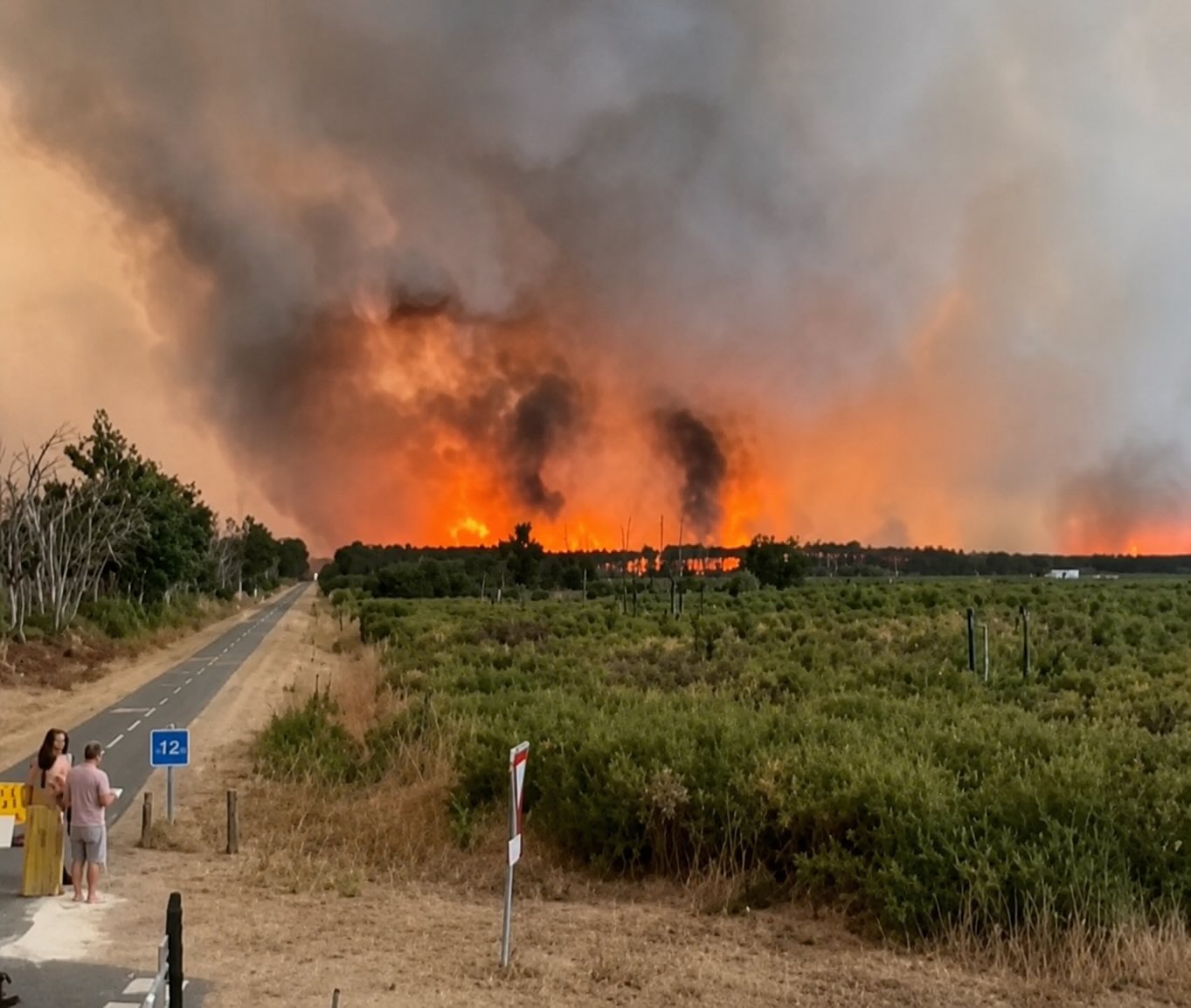
Around Bordeaux, where a vast wildfire has advanced to within roughly 15 kilometres of the city, firefighters spent the night exploiting weaker winds and a brief spell of rain to reinforce containment lines.
Yet meteorologists are already warning that the window of opportunity may close as quickly as it opened. Temperatures are expected to climb back towards 40C on Tuesday, threatening to breathe fresh life into an already formidable blaze.
For emergency planners, this has become the defining characteristic of Europe’s modern wildfire season: every apparent victory is provisional.
.
Across the Gironde region, an estimated 220,000 people have been forced from their homes. Schools, community centres and exhibition halls have been transformed into temporary shelters, while roads that only days ago carried summer holiday traffic now serve as evacuation corridors.
The situation is scarcely less severe across the border in Spain. Wildfires sweeping through Valencia and neighbouring regions have driven tens of thousands more from their homes, taking the combined number of evacuees in France and Spain beyond 300,000. Sports halls and municipal buildings have become improvised refuges for families uncertain whether they will have homes to return to.
The numbers alone are striking. Yet they reveal only part of a crisis that is becoming steadily more difficult to measure.
Each major wildfire consumes not only forests and farmland but also economic confidence. Vineyards face uncertain harvests. Tourism businesses lose peak-season revenue. Supply chains are interrupted, infrastructure damaged and insurers confronted with another costly reminder that extreme weather events are becoming more frequent and more destructive.
French President Emmanuel Macron is due to convene an emergency meeting on Monday as ministers assess both the immediate emergency and the resources required should conditions deteriorate further. In Spain, Prime Minister Pedro Sánchez is expected to visit the fire-stricken areas of Valencia, where exhausted firefighters continue to battle unpredictable fire fronts.
Political leaders increasingly find themselves responding to disasters that no longer appear exceptional.
Only a generation ago, wildfires of this scale were viewed as rare catastrophes. Today they arrive with uncomfortable regularity. Extended droughts leave forests tinder dry, while prolonged heatwaves create ideal conditions for flames to spread with extraordinary speed. Even modest shifts in wind direction can transform manageable fires into fast-moving infernos within hours.
Fire services across southern Europe have become markedly more sophisticated, investing in aerial firefighting fleets, satellite monitoring and predictive modelling. Yet even these improvements struggle against environmental conditions that continue to intensify.
Firefighters in Gironde have worked continuously to prevent the blaze from reaching populated areas around Bordeaux. Aircraft have dropped thousands of tonnes of water and fire retardant, while crews on the ground have established defensive firebreaks through woodland already desiccated by months of exceptionally dry weather.
Their efforts have so far prevented the worst-case scenario.
Whether that remains true by the end of the week is another matter.
Forecasts suggesting another surge in temperatures have introduced fresh uncertainty into operational planning. Higher heat reduces humidity, dries vegetation still further and increases the likelihood that embers carried by the wind will ignite entirely new fires kilometres ahead of existing fronts.
Such conditions place enormous strain not only on emergency personnel but also on national resources. Fire crews require rotation. Aircraft need maintenance. Evacuation centres demand staffing and medical support. Local authorities face mounting logistical pressures as displacement extends from days into weeks.
Behind every statistical update lies an accumulating human toll.
Families separated during hurried evacuations wait anxiously for news. Farmers watch years of investment disappear behind walls of smoke. Small businesses that depend on the summer season confront another financial shock at precisely the moment they would normally expect their strongest revenues.
For many communities, recovery will prove considerably longer than the fire itself.
Scientists have repeatedly cautioned that Europe is warming faster than the global average, particularly across the Mediterranean basin. Longer fire seasons, more intense heatwaves and increasingly volatile weather patterns are altering landscapes that have supported agriculture and tourism for centuries.
The consequences extend well beyond the immediate destruction.
Repeated wildfire damage affects biodiversity, accelerates soil erosion and compromises water quality long after flames have been extinguished. Burnt forests lose their capacity to regulate local climates, increasing the risk that future fires will become even more severe. The cycle feeds upon itself.
That prospect lends an unmistakably ominous quality to the current emergency.
The overnight lull around Bordeaux offers valuable time for exhausted firefighters. It offers hope to evacuated residents. But it does not yet offer certainty.
As Europe braces for another surge in temperatures, officials understand that the coming days may determine not only the fate of communities in Gironde and Valencia but also whether another summer enters the record books as evidence that the continent’s wildfire crisis is no longer episodic.
It is becoming structural.
The flames advancing across southern Europe are no longer merely seasonal disasters. They are increasingly becoming a measure of how successfully—or unsuccessfully—the continent can adapt to an era in which extreme weather is no longer the exception, but the expectation.
__________________________________________________________________________________________________________________
Click here for more News & Current Affairs at EU Today
Click here to check out EU TODAY’S SPORTS PAGE!
___________________________________________________________________________________________________________________