
Environment covers EU climate and environmental policy, energy transition, biodiversity, pollution control, and green finance. Reporting includes legislative updates, industry impacts, scientific findings and international negotiations relevant to Europe’s climate and environmental goals.
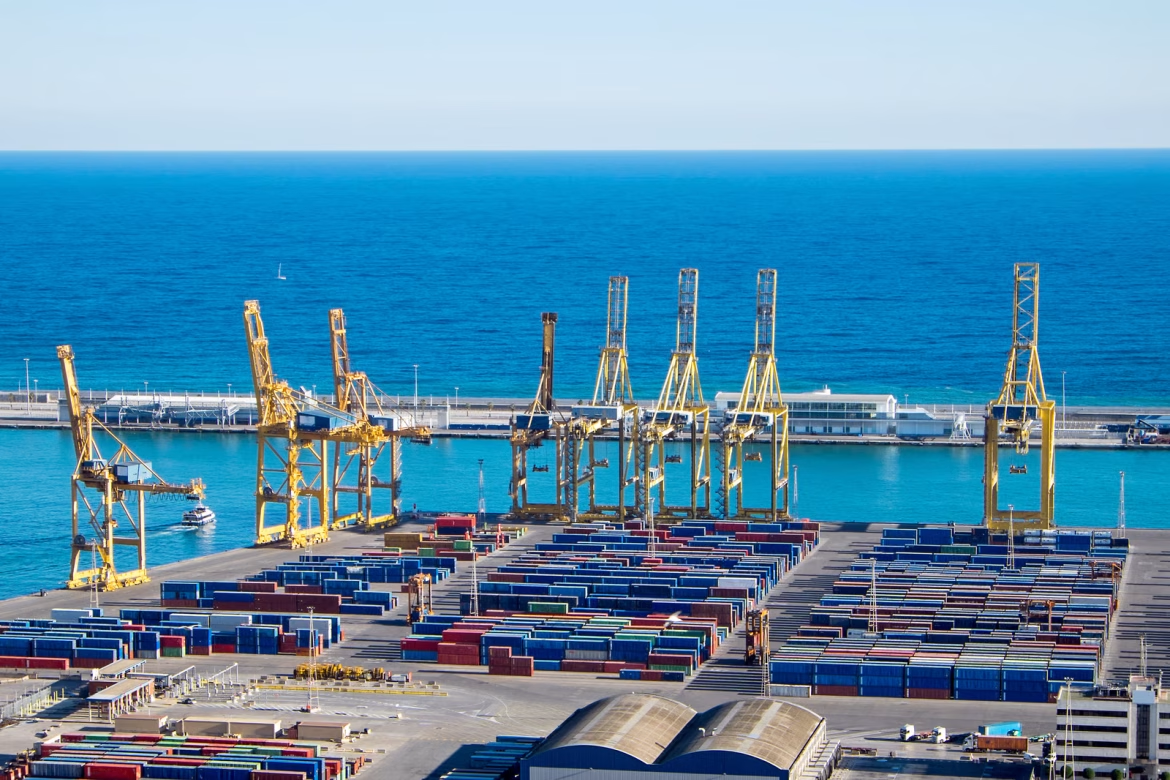
Brussels is preparing tighter rules to stop ships cutting their EU carbon liabilities through nearby non-EU port calls, turning maritime climate enforcement into a contest over routing, Mediterranean transhipment and the competitiveness of European ports.
The European Commission is preparing changes to close a loophole that may allow shipping companies to reduce carbon costs by stopping at nearby non-EU ports before entering the bloc, escalating a dispute over whether the maritime emissions market is redirecting trade away from European terminals.
Shipping entered the EU Emissions Trading System in 2024. Companies must surrender allowances for all emissions between EU ports and half of the emissions on voyages between an EU and non-EU port.
That structure creates an incentive to redefine where a long international voyage begins or ends. A call at a nearby non-EU hub can divide the route and reduce the share exposed to EU carbon pricing.
Why port calls matter
The Commission anticipated this risk and identified certain neighbouring container transhipment ports whose calls do not reset the ETS voyage. Its maritime ETS guidance currently lists Tanger Med in Morocco and East Port Said in Egypt under the mitigation mechanism.
The reported changes would strengthen the regime as companies alter routes and other ports compete for transhipment traffic. The legal detail matters because a rule aimed at emissions can affect which terminals handle containers, collect fees and attract investment.
Climate policy meets trade geography
EU ports argue that they should not lose business to nearby competitors simply because European terminals fall inside the carbon market. A container shifted outside the bloc may still reach an EU customer on a smaller feeder vessel, adding handling and potentially emissions without changing final demand.
Shipping companies counter that routing decisions reflect many factors: congestion, port efficiency, fuel, cargo demand and network design. A stop near Europe is not necessarily artificial avoidance.
The Commission’s first implementation review found no general evidence of evasion, although it identified isolated potential cases. Revising the rules now suggests Brussels wants to act before a pattern becomes entrenched.
Neighbouring states will resist discrimination
Ports in North Africa and the eastern Mediterranean can argue that EU rules should not penalise their legitimate growth. Countries may view designation as an extraterritorial measure that changes commercial treatment without an international agreement.
Brussels will need objective criteria based on transhipment share, distance and equivalent climate measures. Rules written around individual competitors would invite legal and diplomatic challenge.
The issue also interacts with the International Maritime Organization’s work on global emissions measures. A credible global system would reduce incentives to divert around a regional carbon price, but negotiations remain politically difficult.
Enforcement must preserve the environmental result
A successful reform should make artificial calls uneconomic without punishing genuine trade. That requires accurate cargo and voyage data, predictable lists of covered ports and coordination with customs and maritime authorities.
The EU must also watch for substitution. Tightening rules for container hubs may push avoidance towards different ship types, feeder structures or ports beyond the distance threshold.
EU Today has covered how energy and climate measures increasingly become questions of European industrial competitiveness. Maritime ETS enforcement adds port geography to that debate.
The carbon price will retain legitimacy only if similar voyages face comparable obligations. If route engineering can materially reduce payment without cutting emissions, compliant operators and EU ports bear the cost while the climate objective is weakened.
Closing the loophole is therefore not a technical adjustment alone. It is a test of whether Brussels can defend environmental integrity without exporting European port activity to the other side of the Mediterranean.

