
Health covers EU health policy, public health, pharmaceuticals, medical devices, research, preparedness, health data and workforce issues.
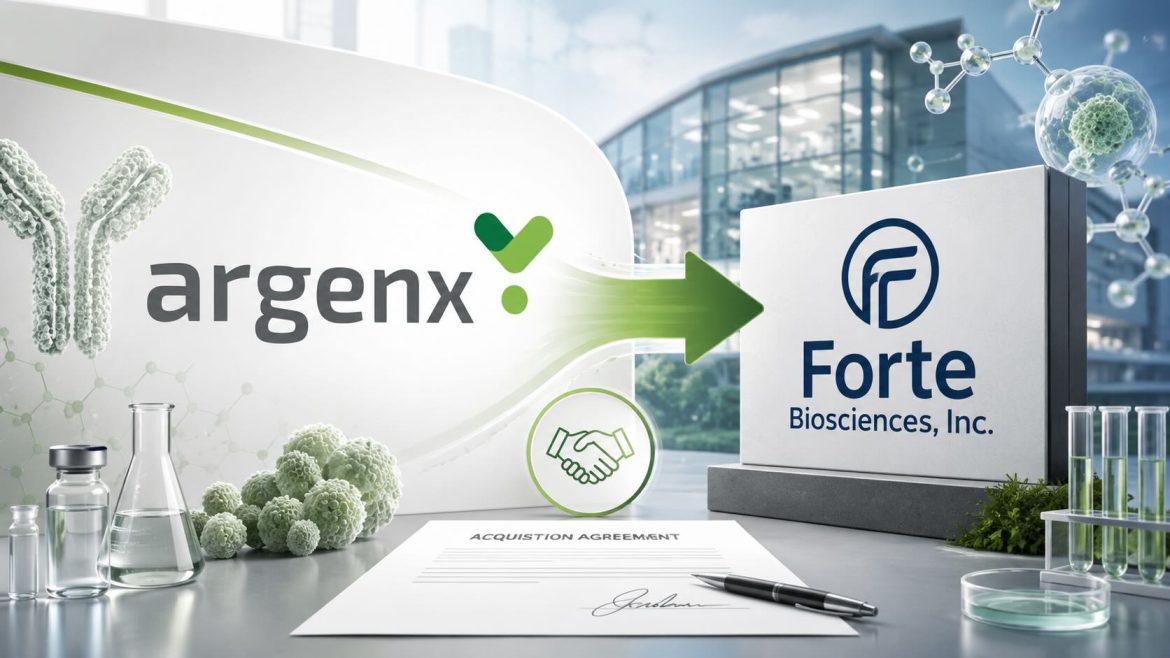
The Belgian-Dutch group can fund its purchase of Forte from cash, but the 86 per cent premium rests on a clinical asset that has shown promise in small early trials and still carries substantial development risk.
Belgian-Dutch biotechnology group argenx has agreed to acquire Forte Biosciences for about $2.2bn in cash, using the financial strength created by its successful VYVGART franchise to buy an early clinical programme that could broaden the company beyond the mechanism on which much of its present value depends.
Under the definitive agreement announced by the companies, argenx will begin a tender offer at $77 for each Forte share. The price represents an 86 per cent premium to Forte’s volume-weighted average share price from 9 July, when it reported positive Phase 1b results in vitiligo.
The transaction is expected to close in the third quarter, subject to a majority of outstanding shares being tendered, the relevant US antitrust waiting period and other customary conditions. It is not conditional on financing and will be paid entirely from cash on hand.
That last point separates argenx from a development-stage buyer relying on equity markets to fund an ambitious bet. Four days before announcing the acquisition, the company reported $5.2bn of cash, cash equivalents and current financial assets at the end of June. It generated $1.5bn in second-quarter product net sales, 60 per cent more than a year earlier, almost entirely from VYVGART.
Argenx can afford Forte. The more difficult question is whether the evidence for Forte’s lead drug, FB102, is mature enough to justify spending more than 40 per cent of the buyer’s liquid resources on it.
A different route into autoimmune disease
FB102 is an experimental monoclonal antibody targeting CD122, a receptor subunit involved in signalling by the cytokines interleukin-2 and interleukin-15. Those pathways influence T cells and natural-killer cells, including immune populations implicated in autoimmune disease.
Forte’s proposed therapeutic logic is selective modulation rather than broad immunosuppression. By targeting CD122, the company aims to reduce pathogenic immune-cell activity while preserving regulatory T cells that help restrain harmful immune responses. That combination, if reproduced in larger studies, could support use across several diseases rather than a single indication.
Argenx describes FB102 as a potential “pipeline in a product”. The phrase means one molecule may be developed in multiple diseases because the biological mechanism is shared across them. The immediate evidence comes from vitiligo and coeliac disease; the companies also identify alopecia areata and other autoimmune conditions as possible targets.
This complements rather than duplicates argenx’s established approach. VYVGART, whose active ingredient is efgartigimod, blocks the neonatal Fc receptor and reduces disease-causing immunoglobulin G antibodies. FB102 acts on pathogenic T-cell and natural-killer-cell biology. If both platforms succeed, argenx would have more than one way to address diseases in which different parts of the immune system drive damage.
Strategically, that diversification matters. VYVGART’s expansion has transformed argenx into a profitable commercial biotechnology company. The group reported $2.8bn of product net sales in the first half of 2026 and has studies under way across a wide range of neuromuscular, haematological and rheumatological conditions. Success creates cash; it also creates concentration. A company valued around one dominant franchise must continually demonstrate where the next durable source of growth will come from.
The clinical signal is promising — and still early
Forte’s 9 July data came from a double-blind, placebo-controlled Phase 1b study in 43 people with vitiligo. Thirty-two received FB102 and 11 received placebo. The company reported a statistically significant improvement in a centrally reviewed facial vitiligo score at week 24.
In the protocol-defined efficacy population, the mean improvement was 29.6 per cent for FB102 and 7.9 per cent for placebo, a placebo-adjusted benefit of 21.7 percentage points. In the intention-to-treat analysis, the placebo group deteriorated, producing a larger apparent treatment difference. Both analyses are relevant, and the divergence is a reminder that results from a small trial can be sensitive to the outcome of a single participant.
The response reportedly continued after the 12-week treatment period ended, supporting the hypothesis that the drug changes relevant immune activity rather than providing only a transient effect. Forte has also reported positive Phase 1b data in coeliac disease, with Phase 2 results expected in the second half of 2026.
These are meaningful signals. They are not the evidence base required for approval.
Phase 1 studies are primarily designed to examine safety, dosing and early biological activity. A statistically significant result in 43 participants can justify larger development; it cannot establish how consistently the benefit will appear across a diverse patient population, how it compares with available therapies or what less common adverse events emerge with longer exposure.
Vitiligo trials also involve measurement choices and natural variation. Facial repigmentation scores are clinically relevant, but larger studies must clarify the magnitude patients regard as worthwhile, the duration of response, the need for repeat dosing and performance across different skin types and disease histories.
Coeliac disease presents a separate challenge. A therapy that modifies immune response may reduce harm from gluten exposure, but development must define whether it supplements or changes the need for a gluten-free diet, which endpoints regulators will accept and whether chronic treatment produces a favourable safety balance.
The premium buys control before the next data point
Argenx was already a strategic investor in Forte. Moving from minority investment to full acquisition gives it control of development, intellectual property, trial design and prioritisation before Forte reports further data.
That timing explains part of the premium. If the forthcoming Phase 2 coeliac result is strong, the asset could become more expensive or attract competing interest. Buying now secures the programme while the evidence is still incomplete. It also makes argenx, rather than Forte shareholders, the principal owner of any future upside.
The inverse is equally clear. Argenx is paying $2.2bn before a pivotal study, before approval and before commercial revenue. A disappointing Phase 2 result, an unexpected safety signal or a failure to reproduce the vitiligo effect would impair the value of the acquisition. The deal does not use a contingent-value right that shifts part of the price to future milestones; Forte shareholders receive cash and argenx assumes the development risk.
The company’s liquidity makes that risk tolerable, not negligible. After a purely arithmetic deduction of the headline equity value, argenx would retain roughly $3bn of reported cash and current financial assets before transaction costs and ordinary cash flows. Its commercial business is generating cash, but research, global launches and multiple late-stage trials are also expensive. Second-quarter research and development spending was about $500mn.
Investors should therefore judge the purchase against alternatives: internal discovery, licensing, smaller acquisitions, share repurchases or retaining capital for VYVGART expansion. Management’s case is that validated biology and control of a broad asset are worth more than waiting.
A European buyer with American clinical reach
The acquisition also reverses a familiar narrative about European life sciences. Rather than a US pharmaceutical group buying a promising European biotech, an Amsterdam-based, Belgian-rooted company is using commercial success to acquire a Nasdaq-listed American clinical developer.
That does not by itself solve Europe’s wider problems of fragmented capital, slower reimbursement and weaker late-stage funding. EU Today has examined how drugmakers are delaying some European launches as transatlantic pricing policy changes, and how pharmaceutical dependence has become a strategic concern. Argenx nevertheless shows what a European innovation company can do once an approved product gives it global revenue and a large balance sheet.
The deal may also attract conventional regulatory review, but its central risk is clinical rather than antitrust. Argenx and Forte do not present the transaction as the consolidation of two established products competing in the same market. It is the purchase of a research platform whose value depends on future trials.
That makes the next milestones more important than the 86 per cent premium. Investors should watch the full Phase 1b safety data, the Phase 2 coeliac readout, the design of larger vitiligo studies, dosing strategy and which additional indications argenx chooses to fund.
Argenx is not buying sales. It is buying the right to decide how quickly and broadly FB102 is tested, backed by a commercial organisation capable of taking a successful antibody through global development and launch.
The acquisition is therefore both a sign of strength and a deliberate concentration of risk. VYVGART has supplied the cash and credibility. FB102 must now demonstrate that a promising immune mechanism and small early trials can become a second platform substantial enough to justify one of the largest biotechnology purchases yet made by a European growth company.

