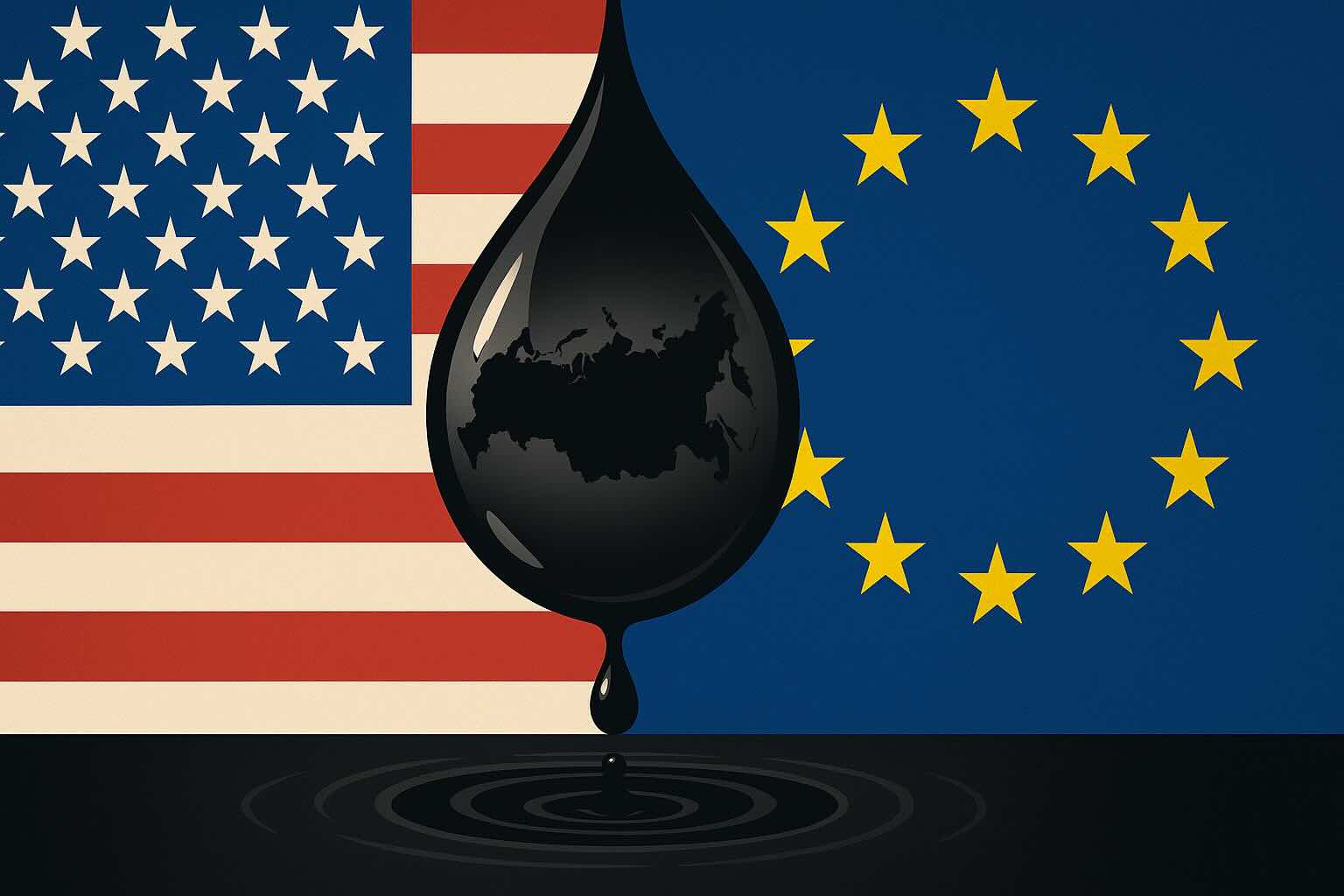
A widening policy gap between the United States and the European Union over Russian oil exports to India is expected to trim shipments next month, even as Brussels considers accelerating its broader exit from Russian fossil fuels after pressure from Washington.
The price-cap regime, introduced by the US, EU and other G7 countries after Russia’s 2022 invasion of Ukraine, allows Western insurers and maritime service providers to handle Russian crude exports to third countries only if sales are below a set ceiling. The aim is to restrict Moscow’s revenues while keeping barrels on the market and avoiding a supply shock.
That approach is being tested. President Donald Trump has urged India to stop buying Russian crude and, after New Delhi declined, doubled tariffs on some Indian exports to the US to as much as 50 per cent. He has also pressed European leaders to cease Russian oil purchases and called for tariffs of up to 100 per cent on major buyers China and India. The stance diverges from Europe’s cap-and-flow model, which seeks to keep oil moving at constrained prices rather than halt trade outright.
“Sanctions coordination between the US and the other G7 nations does seem to have largely broken down under the Trump administration,” said Richard Bronze, head of geopolitics at Energy Aspects. EU officials maintain the cap remains relevant because Western shippers still participate in parts of the trade, but acknowledge that a looser transatlantic line complicates enforcement.
From October, the EU and UK have lowered the crude cap to $47.60 a barrel from $60, a move not backed by Washington. With Brent around $67 on Wednesday, Indian refiners say discounts on Russian grades need to widen to roughly $10 a barrel to meet compliance thresholds, versus $2–$3 seen in September. Banks have tightened scrutiny amid the policy divergence, raising financing costs and documentation risk, traders said.
Some Russian sellers have pushed back against steeper discounts and are diverting spot cargoes to China, according to trading sources. As a result, Russian crude arrivals in India are projected to average about 1.4 million barrels per day in October, down from roughly 1.6 million bpd in September and 1.5 million bpd in August. Final volumes will depend on negotiations over the next fortnight. Even with a $10 discount, most October barrels to India would still price above the new EU/UK cap.
Brussels is seeking to tighten its Russia energy stance more broadly. European Commission President Ursula von der Leyen told the European Parliament that the EU is “looking at phasing out Russian fossil fuels faster, the shadow fleet and third countries” as part of a 19th sanctions package now in preparation. EU officials are in Washington this week for talks on further measures and coordination.
Energy diplomacy continues on Thursday, when US energy secretary Chris Wright meets EU energy commissioner Dan Jørgensen in Brussels to discuss efforts to restrict Russian energy trade. “We’re working on doing what we can to speed up the process,” Jørgensen said, adding that continued Russian energy imports mean Europe is indirectly helping to finance the war.
The EU’s seaborne crude ban has reduced Russian oil imports by 90 per cent, but pipeline deliveries continue to Hungary and Slovakia. Europe still expects to source about 13 per cent of its gas from Russia this year, down from 45 per cent before the invasion, Commission data show. The bloc is negotiating legal proposals to phase out Russian oil and gas imports by 1 January 2028, though sanctions could bring forward elements of that timetable. Hungary and Slovakia have resisted further curbs on gas, citing price impacts. The two import an estimated 200,000–250,000 barrels per day of Russian oil via pipeline, equivalent to about 3 per cent of EU demand. Sanctions require unanimity among member states.
Enforcement remains uneven. A large share of Russian crude moves on a “shadow fleet” of tankers with Russian links and domestic insurance, operating outside the Western service ecosystem and, by extension, the cap. Since 2022, Russian firms and intermediaries have managed to sell significant volumes above cap levels by using such vessels or via documentation practices that have drawn scrutiny from market participants and Western authorities.
“A growing split on oil sanctions policy will further increase confusion for market participants and potentially weaken levels of compliance,” said Tom Boughton of risk consultancy S-RM. The cap, while a hindrance, is “not a major threat” to Russian traders absent a concerted US-EU move to choke off shipping, insurance and payments channels, said Benjamin Godwin, partner at PRISM Strategic Intelligence, noting the risk of wider economic disruption.
Analysts also question the feasibility of targeting non-EU buyers. “Western powers need to have China and India on board for sanctions to be truly effective,” said Ajay Parmar of ICIS, adding that it is unlikely the EU will apply sanctions on India or China — or on intermediating hubs such as the UAE.