

There was a time when medals were pinned to uniforms by kings after battles, or bestowed upon scientists, explorers and writers who had dragged civilisation a little further up the hill.
Today, however, Europe’s political class appears increasingly content to hand decorations to itself in a glittering hall of mutual congratulation, while the public watches on with raised eyebrows and thinning patience.
The European Parliament’s newly created “European Order of Merit” holds its inaugural ceremony today in Strasbourg, complete with ribbons, badges and solemn declarations about “European values”
Among the first recipients will be Angela Merkel, Volodymyr Zelenskyy and Lech Wałęsa, alongside a supporting cast of former prime ministers, commissioners, central bankers and Brussels grandees.
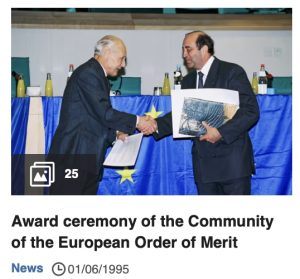
Although touted as the “inaugural” ceremony, the European Order of Merit, in fact, goes back at least as far as 1995.
In those days, however, it appears to have involved an honorary degree, something that would certainly not be adequate by today’s standards of granduer.
One cannot help noticing the pattern.
The committee selecting recipients included former EU heavyweights such as Michel Barnier, José Manuel Barroso and Josep Borrell. In other words: politicians honouring politicians for services rendered to politicians.
At moments like this, the phrase “reality check” starts to acquire a certain urgency.
Europe in 2026 is not exactly short of pressing concerns. Growth is anaemic. Industrial competitiveness is wobbling. Farmers continue to revolt against regulatory overreach. Defence spending has become a desperate scramble after years of complacency.
Trust in institutions across much of the continent is brittle at best. Yet in Strasbourg, amid all this uncertainty, the Parliament found time to create an ornate order of merit, complete with classes of distinction and ceremonial insignia.
There is something unmistakably late-imperial about the spectacle. When governing elites become detached from ordinary anxieties, they often retreat into ritual. Medals proliferate. Committees multiply. Titles become grander. The establishment begins speaking increasingly to itself, applauding itself, rewarding itself.
Of course, some recipients are plainly deserving figures. Wałęsa’s role in breaking Soviet domination is unquestionable. Zelenskyy’s wartime leadership has been remarkable. Mary Robinson’s human rights work commands genuine respect. Nobody sensible would deny these achievements.
But that is not really the point.
The problem lies in the instinct behind the ceremony itself: the assumption that the European project now requires a hereditary-style honours ecosystem to validate its own importance. Brussels increasingly resembles a political universe convinced of its historic destiny while struggling to persuade voters to turn out enthusiastically for European elections.
One suspects many Europeans would prefer functioning border controls, lower energy bills and less bureaucratic intrusion over another layer of institutional pageantry.
Then there is the awkward inclusion of Merkel as one of the order’s highest-ranking laureates. To her admirers, she embodies stability and European continuity. To critics, she presided over catastrophic energy dependence on Russia, mishandled migration on a continental scale, and left Germany economically vulnerable. Even the most avid pro-European commentators might question whether her record truly deserves canonisation.
Awarding honours is always political, however much organisers pretend otherwise. Decorations are statements about what an establishment values, what it rewards, and what version of history it wishes to write.
And this particular ceremony generates the unmistakable scent of institutional self-preservation.
The European Parliament insists the award exists to honour those who contributed to “European integration and European values”. Yet one might ask whether integration itself has become too often confused with virtue. Across Europe, voters are not uniformly anti-European, but many are increasingly sceptical of the managerial class clustered around Brussels — a class that seems perpetually surprised when electorates rebel against decisions made in distant conference rooms.
That growing disconnect explains the uncomfortable optics of politicians pinning medals on fellow politicians while populist parties continue gaining ground from Vienna to Paris.
There was a revealing line in one commentary supporting the awards, which declared that Europe “has always been built by people”. Quite true. But Europe was not built primarily by committees, parliamentary bureaux or carefully choreographed ceremonies. It was built by workers, entrepreneurs, inventors, soldiers, taxpayers and citizens who generally did not expect decorative ribbons in return.
Indeed, the more insecure institutions become, the more elaborate their symbolism often grows. The European Union already possesses flags, an anthem, a parliament, a diplomatic corps and a sprawling bureaucracy. Now it has an order of merit too — another brick in the architecture of a quasi-state many voters never consciously signed up for.
None of this means honours themselves are inherently absurd. Britain’s own honours system, for all its flaws, at least still manages occasionally to recognise charity volunteers, community organisers, nurses and eccentric local heroes alongside establishment figures.
What jars about Strasbourg’s new decoration is its overwhelmingly insider character. It feels less like gratitude from a continent and more like applause echoing around a conference chamber.
And when political elites start awarding each other medals while public confidence erodes outside the building, history suggests it may be time to stop polishing the insignia and start listening to the crowd.
Main Image: Photographer: Daina LE LARDIC: © European Union 2026 – Source : EP
Click here for more News & Current Affairs at EU Today
Click here to check out EU TODAY’S SPORTS PAGE!
___________________________________________________________________________________________________________________

