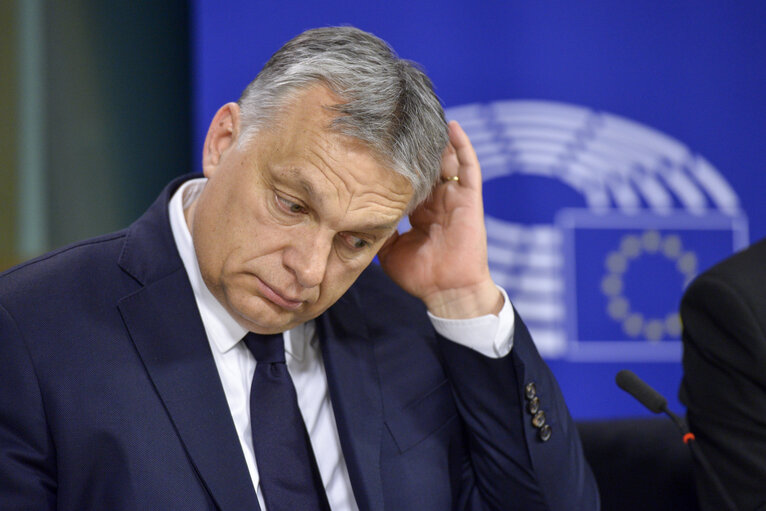
European politics has grown accustomed to Viktor Orbán’s Hungary providing drama, but the coming parliamentary election promises something deeper than a familiar clash of personalities.
It is, rather, a contest between two visions of the state: one built on national autonomy and central authority, the other on technocratic reform and reintegration with Europe’s economic mainstream.
The new actor is the Tisza party, led by the former government insider turned insurgent reformer Peter Magyar. Its freshly published election programme reads less like a campaign pamphlet and more like a manifesto for re-engineering Hungary’s economic and geopolitical orientation. The document promises a wealth tax on the richest households, a pathway to euro adoption and a renewed anchoring of the country within both the European Union and NATO.
For Viktor Orbán, who has dominated Hungarian politics since 2010, this represents the most serious political challenge in a generation. Even opinion polling reflects the volatility: some surveys suggest Tisza holds a notable lead among decided voters, while others still place Fidesz ahead, leaving a large bloc of undecided Hungarians as the true arbiters of the nation’s direction.
At first glance, the most striking policy is the proposed wealth tax. Tisza intends to levy a 1 per cent annual charge on fortunes exceeding one billion forints (about €3 million) above that threshold. It is a proposal calculated not merely to raise revenue but to signal moral change. Hungary’s opposition has concluded that Orbán’s political durability rests partly on a perception — widespread in Budapest’s cafés as much as Brussels’ committee rooms — that political power and economic privilege have grown intertwined.
Magyar has therefore placed anti-corruption at the heart of his campaign. He argues that tackling patronage networks would help unlock billions of euros in frozen EU funds and stimulate economic growth. That is a carefully chosen argument. For many Hungarian voters, Brussels is not loved but its money is. The opposition’s wager is that financial pragmatism may succeed where moral exhortation fails.
Yet the truly transformative proposal lies elsewhere: the commitment to set a credible target date for joining the euro. In Central Europe, currency choice has become a proxy for identity. Retaining the forint has symbolised sovereignty under Orbán; adopting the euro would symbolise a return to deeper European integration. Tisza is effectively asking voters to decide not just who governs Hungary, but where Hungary belongs.
The economic implications are profound. Euro adoption would require fiscal discipline, regulatory alignment and institutional reform — all of which would curtail the discretionary economic management that has characterised the Orbán era. Critics would call that a loss of sovereignty; supporters, a return to predictability.
Energy policy underscores the divide. Tisza promises to end reliance on Russian energy by 2035 and expand renewable generation, while reviewing the Russian-built Paks II nuclear project. In a region shaped by the war in Ukraine, this is not merely an environmental commitment but a geopolitical repositioning. Hungary has been an outlier in maintaining cordial economic ties with Moscow; the opposition seeks alignment with the EU’s strategic consensus.
Domestic reforms complete the picture. The programme promises sweeping changes to healthcare, education, welfare and public transport. This is classic European centrist politics — technocratic competence replacing ideological confrontation — but presented with a distinctly Hungarian urgency. The state, in this telling, is not too strong or too weak; it is simply malfunctioning.
What makes the election fascinating is that neither side is campaigning entirely on ideology. Orbán’s case remains stability, national control and a proven political machine. Tisza’s case is efficiency, European funding and administrative normalisation.
Both are, in their own way, pragmatic appeals.
For the European Union, the stakes are enormous. Hungary has long been the bloc’s internal dissenter — challenging migration policy, resisting sanctions enthusiasm and questioning federalising tendencies. Brussels officials privately admit that the Hungarian government’s frequent readiness to wield vetoes, often in ways critics say appeared to shield Moscow from pressure, has tested the patience of fellow member states. Should a change of government occur, few in EU institutions would mourn the passing of that confrontational approach.
For voters, however, the question is less philosophical than practical. Hungarians face rising living costs, uneven public services and a lingering sense that economic advancement has not been evenly shared. The wealth tax speaks to fairness; euro adoption speaks to stability; EU funds speak to prosperity.
Elections are often described as referendums on the past. This one feels more like a referendum on the future.
Hungary is being asked to choose whether its next decade should resemble its last — or whether it should quietly, methodically, and perhaps reluctantly return to the European centre from which it once drifted.
Would the EU Be Better Off Without Orbán’s Hungary, or Just Better Off Without Orbán?
Click here for more News & Current Affairs at EU Today
Click here to check out EU TODAY’S SPORTS PAGE!
_______________________________________________________________________________________________________________________